
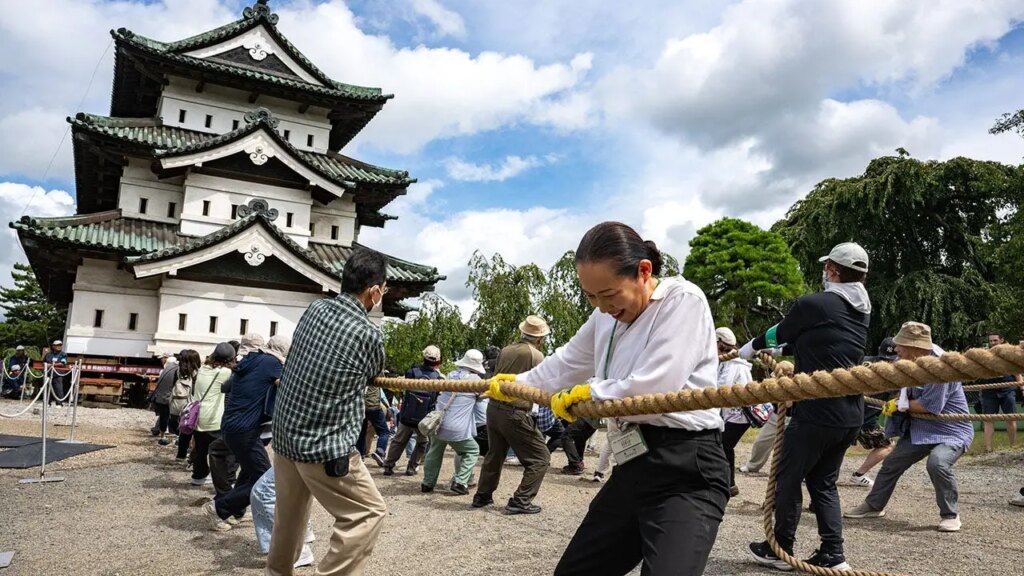
In a remarkable event that showcased community spirit and cultural pride, over 1,800 volunteers in Japan came together to move the Hirosaki Castle keep back into position following repairs. The Hirosaki Castle, a historical landmark located in Aomori Prefecture, requires the meticulous relocation of its substantial 360-ton structure, which had been moved six feet to facilitate restoration work after earthquake damage. This event has not only highlighted the dedication of the local community but also the ancient Japanese technique employed to preserve such historical monuments.
| Article Subheadings |
|---|
| 1) The Historic Relocation of Hirosaki Castle |
| 2) Community Involvement and Volunteer Spirit |
| 3) Techniques for Moving Historic Structures |
| 4) The Significance of Hirosaki Castle |
| 5) Future of Historical Preservation in Japan |
The Historic Relocation of Hirosaki Castle
Hirosaki Castle, renowned for its stunning architecture and historical significance, is located in Hirosaki City, Aomori Prefecture. The castle’s keep, a fortified tower that stands as a symbol of Japanese feudalism, was recently relocated to enable essential repairs following damage from a significant earthquake. This operation began over the weekend, where hundreds of volunteers assisted in moving the 360-ton structure back into its original position—it was shifted over six feet. The restoration effort is crucial to maintaining the castle’s integrity and honoring its historical legacy.
The repair work on Hirosaki Castle was crucial as it involved rebuilding a wall that had been compromised during the earthquake. This involved repositioning all 2,185 stones back to their original configuration, a task that underscores the commitment to historical preservation. Moving the castle itself was not merely about physical labor but reconnecting the community with its historical roots.
Community Involvement and Volunteer Spirit
The event saw an impressive turnout of around 1,800 individuals who were eager to lend a hand in this historical endeavor. Participants included local residents and volunteers from across Japan and overseas, encapsulating a remarkable spirit of community engagement. With approximately 8,000 applications submitted for the limited slots available, the event was significantly oversubscribed, demonstrating the passionate interest in heritage and community solidarity.
According to Kensuke Hayasaka, head of the parks and green spaces division in Hirosaki City, the overwhelming response emphasizes how deeply individuals feel connected to their cultural heritage. “We had about 8,000 applications for the 1,800 slots…so not everyone could participate,” Hayasaka stated. The turnout included not just locals but also volunteers from Southeast Asia, Europe, and North America, showing the global appreciation for historical sites and their preservation.
Techniques for Moving Historic Structures
The method used for relocating Hirosaki Castle involves an ancient Japanese technique known as hikiya, in which structures are placed on rollers or rails prior to being moved. This method is traditional and designed to ensure that the buildings are preserved intact during the relocation process. By eliminating risks of damage associated with disassembly, the hikiya technique maintains the integrity and authenticity of historical buildings.
With rotating teams working over several days, the volunteers are using hand tools and basic lever mechanics to pull the castle back to its designated position. The efforts of approximately 4,100 additional volunteers are expected to continue throughout August, culminating in a total movement of more than 16 feet. This meticulous approach not only honors the castle’s historical significance but also serves to educate participants about traditional methodologies in architectural conservation.
The Significance of Hirosaki Castle
Hirosaki Castle is not only a visually striking fortress but also an integral part of Japan’s history. Originally built in 1611, it was destroyed by a lightning strike in 1627 and subsequently rebuilt in 1811 as a three-story structure, reflecting the architectural styles of its time. As many historical castles in Japan faced dismantling post-Samurai era and during World War II, Hirosaki Castle endures as a testament to Japan’s feudal heritage and an attraction for history enthusiasts.
In addition to being a prominent tourist destination, the castle has cultural importance, providing insight into the artistry and craftsmanship of Japanese masons. The community’s efforts to repair and preserve the castle reflect a commitment to maintaining cultural landmarks for future generations. With the continued emphasis on tourism and local history, Hirosaki Castle stands out as a beacon of resilience against the challenges posed by natural disasters and modernization.
Future of Historical Preservation in Japan
As Japan continues to encounter earthquakes and natural disasters, preserving historical sites like Hirosaki Castle becomes even more crucial. The success of this event may inspire additional community-driven initiatives across the country where residents collaborate to protect their cultural heritage. This represents a growing movement to not only preserve significant structures but also foster a sense of unity among communities.
The methodologies employed at such events demonstrate how indigenous techniques can coexist with modern technology to achieve historical conservation goals. Local governments and cultural preservation organizations might look to this model as a framework for future endeavors, ensuring that Japan’s storied past remains a part of its vibrant present and future.
| No. | Key Points |
|---|---|
| 1 | Over 1,800 volunteers moved the Hirosaki Castle keep to enable repairs after earthquake damage. |
| 2 | The event garnered about 8,000 applications for the 1,800 available volunteer positions. |
| 3 | The ancient hikiya technique was employed to relocate the castle intact, preserving its historical integrity. |
| 4 | Originally built in 1611, Hirosaki Castle has crucial historical and cultural significance in Japan. |
| 5 | The successful relocation event may pave the way for future historical preservation initiatives across Japan. |
Summary
The community-driven effort to move Hirosaki Castle demonstrates a profound commitment to preserving Japan’s cultural heritage. Through collective action and time-honored techniques, locals not only repaired a historical landmark but also solidified a sense of community identity and engagement. This event highlights the importance of historical preservation in the face of natural challenges and the dedication of individuals to maintaining their cultural history for generations to come.
Frequently Asked Questions
Question: What techniques were used to move Hirosaki Castle?
The ancient Japanese technique known as hikiya was employed, where buildings are placed on rollers or rails and moved intact, ensuring preservation.
Question: How many volunteers participated in the relocation of the castle?
A total of 1,800 volunteers participated, with approximately 8,000 applications submitted for the available slots, indicating high community interest.
Question: Why is Hirosaki Castle significant?
Hirosaki Castle is significant as it is a symbol of Japan’s feudal history, originally built in 1611, and serves as a reminder of the architectural artistry of the time.