
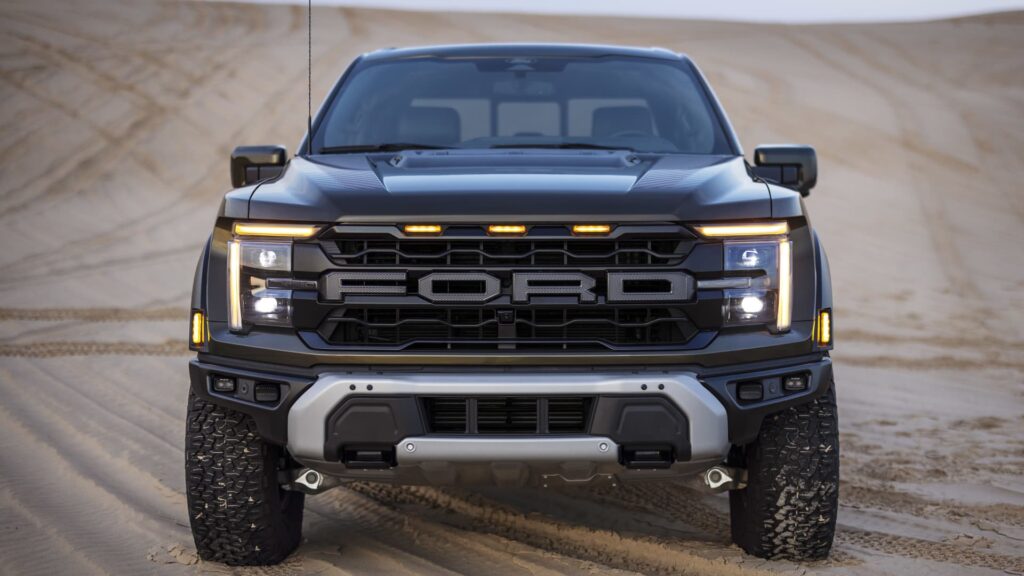
Ford Motor Company has announced plans to expand the availability of V-8 engines and reduce the starting prices for select performance models in its upcoming 2027 lineup of F-150 pickup trucks. These changes aim to enhance customer choice and boost sales in a market where affordability has become a pressing issue. As part of a broader strategy under CEO Jim Farley, Ford is adjusting specifications while embracing the revival of V-8 engines amid evolving emissions regulations.
| Article Subheadings |
|---|
| 1) Strategic Shift Towards V-8 Engines |
| 2) Pricing Adjustments for Enhanced Accessibility |
| 3) Model Updates and New Collaborations |
| 4) Supply Chain Challenges and Their Impact |
| 5) Responding to Market Demands |
Strategic Shift Towards V-8 Engines
Ford Motor Company is making a significant move in its F-150 lineup by expanding the availability of V-8 engines across all models. This transition, communicated by Todd Eckert, Ford Blue’s senior director of truck consumer marketing, comes at a time of changing customer preferences. Traditionally, V-8 engines were limited to select models, but Ford is now keen to provide this option even for higher-end variants like the King Ranch and Platinum models for the first time since 2023.
The initiative reflects a growing consumer demand for V-8 engines among both customers and dealers.
“We heard pretty loudly from both customers and dealers that even on those premium series, that they wanted the option to have a V-8 engine,”
stated Eckert. As fierce competition in the truck market continues, Ford’s decision to embrace V-8 engines could reinforce its commitment to performance while appealing to a core segment of its customer base that values power and capability.
Pricing Adjustments for Enhanced Accessibility
In conjunction with expanding V-8 options, Ford is also revising the starting prices for several performance models in the F-150 lineup. For instance, the 2027 Ford F-150 Raptor will begin at $77,800, reflecting a decrease of $4,000 compared to the current model. Additionally, the 2027 Tremor has a new starting price of approximately $62,400, which is about $5,300 lower than its predecessor. Ford aims to make these vehicles more accessible to a broader audience while redefining what value means in the context of performance pickups.
While the lower price is appealing, it comes with a caveat; Ford has achieved this by eliminating certain standard equipment. For example, amenities such as heated second-row seats have been removed, and some features like power controls for the steering column are being replaced with manual alternatives. The company emphasizes that these adjustments do not detract from the overall capabilities of the trucks. In fact, the changes could attract new customers who are seeking quality performance with more affordable entry points.
Model Updates and New Collaborations
As part of the revamp for the 2027 F-150 lineup, Ford is not only adjusting pricing but also introducing fresh style updates across various models. A notable highlight is the collaboration with the Detroit-based clothing company, Carhartt, to produce a specialized model aimed at fans of the brand. This initiative represents a strategic effort to differentiate the F-150 in a crowded market and appeal to specific lifestyle segments that value both rugged utility and brand identity.
By leveraging partnerships like this, Ford seeks to enhance its connection with potential buyers while also tapping into popular culture. This move is indicative of the broader trend in the automotive industry to blend lifestyle branding with automotive performance, creating a more holistic product offering that resonates with a diverse array of consumers.
Supply Chain Challenges and Their Impact
Ford’s adjustments and new offerings come in direct response to the challenges faced in the supply chain over the past year, particularly related to fires at an aluminum supplier that severely impacted production schedules. The F-Series trucks, including the F-150 and larger models like the F-250, F-350, and F-450, have been notably affected due to their heavy reliance on aluminum for construction and design.
The aluminum supplier incidents led to some output constraints, prompting Ford to rethink its strategies and adapt its offerings. Recognizing these hurdles, the automotive giant is now focused on improving availability and ensuring that its essential truck lineup can meet market demands effectively. The company is committed to overcoming these technicalities to restore production levels and maintain its competitive presence in the truck market.
Responding to Market Demands
With these strategic shifts, Ford aims to solidify its position in a rapidly evolving industry. The company is providing customers with the freedom to choose high-performance V-8 engines while also responding to affordability concerns that many consumers face today. In an age where pickup truck buyers are increasingly discerning, these decisions signal a fundamental understanding of the market’s landscape and the potential backlash against companies that ignore their customers’ feedback.
Ford’s focus on adaptability and consumer-centric offerings reflects a broader trend in the automotive industry aimed at retaining loyalty and expanding the customer base. By embracing its classic V-8 roots while modernizing its approach, Ford is strategically positioning itself to win over both traditional fans of performance trucks and new customers looking for capability and affordability.
| No. | Key Points |
|---|---|
| 1 | Ford expands the availability of V-8 engines across its 2027 F-150 lineup. |
| 2 | The starting prices for select performance models have been reduced, making them more accessible. |
| 3 | Collaborations, such as with Carhartt, have been introduced to enhance model appeal. |
| 4 | Supply chain challenges, particularly with aluminum, have affected production timelines. |
| 5 | Ford aims to bolster customer choice and affordability in a competitive truck market. |
Summary
The changes introduced by Ford for its 2027 F-150 lineup illustrate a strategic response to shifting consumer preferences and affordability concerns. By expanding the availability of V-8 engines while simultaneously lowering starting prices for select models, the automaker seeks to enhance customer choice and engagement. Coupled with new collaborations and updates, these adjustments are crucial for Ford as it navigates the complexities of modern auto manufacturing, especially in light of recent supply chain challenges.
Frequently Asked Questions
Question: What does Ford’s expansion of V-8 engines entail?
Ford is now offering V-8 engine options across all models of the F-150 lineup, including high-end variants like the King Ranch and Platinum models for the first time since the 2023 model year.
Question: How does Ford plan to make its trucks more affordable?
The company has lowered starting prices for certain performance models by reducing standard equipment and using manual controls for various features, such as the steering column.
Question: What challenges has Ford faced recently regarding production?
Ford has encountered significant supply chain challenges due to fires at an aluminum supplier, which have impacted production timelines for its F-Series trucks.