
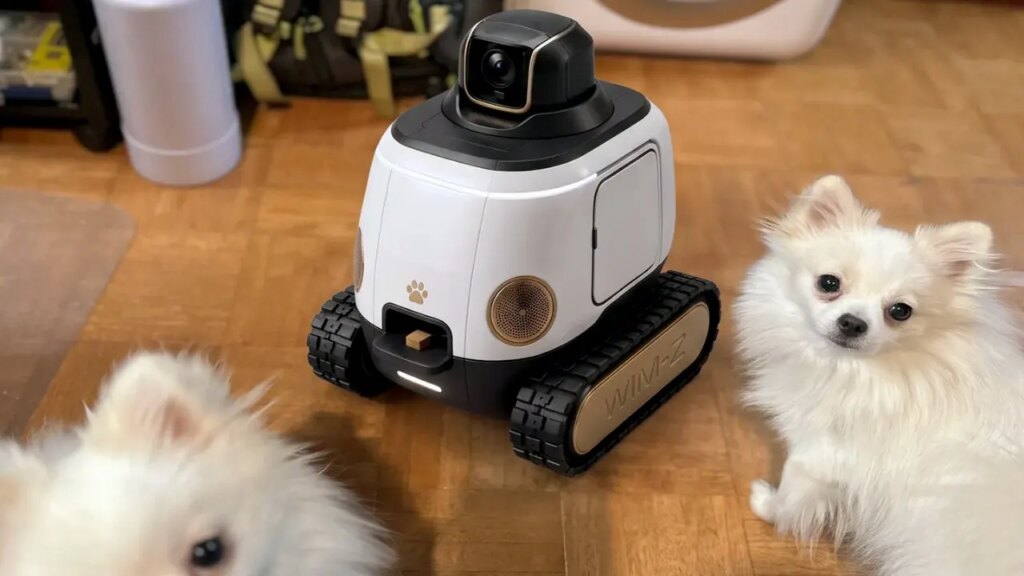
In a groundbreaking development for pet owners, the WIM-Z robot is making waves in the realm of canine care. This innovative device utilizes artificial intelligence to monitor dog behavior and respond to barking with rewards in real-time. Designed to enhance the relationship between pets and their owners, WIM-Z aims to alleviate anxiety and improve training outcomes by detecting signs of distress before symptoms manifest. With early trials indicating a significant reduction in barking, this technology has the potential to reshape how dog owners interact with their pets when away from home.
| Article Subheadings |
|---|
| 1) Introduction to WIM-Z: A Technological Marvel |
| 2) How WIM-Z Works: The Technology Behind the Robot |
| 3) Efficacy of WIM-Z: Results from Early Trials |
| 4) Customer Privacy: Data Management and Assurances |
| 5) Future of WIM-Z: Pricing and Availability |
Introduction to WIM-Z: A Technological Marvel
The WIM-Z robot, which stands for Watchful Intelligent Mobile Zen, is an innovative device developed with the purpose of enhancing pet care through artificial intelligence. Measuring approximately 11 inches tall, this mobile robot is designed to navigate within the home, employing AI to monitor a dog’s behavior and intervene when necessary. By detecting barking and rewarding positive behavior with treats, the WIM-Z aims to minimize anxiety and training challenges faced by dog owners when they are away from their pets.
Within a digital age where smart technology plays an increasingly vital role in our everyday lives, the advent of the WIM-Z reflects a significant movement towards integrating AI into pet care. The WIM-Z is capable of being monitored and controlled via an app, allowing dog owners to stay connected with their pets even from a distance. This level of interaction not only serves to alleviate the absence felt by dogs but also empowers owners with valuable insights into their pets’ behavior while they’re away.
How WIM-Z Works: The Technology Behind the Robot
At its core, WIM-Z utilizes advanced AI technology to function effectively. Equipped with a Raspberry Pi 5 and a Hailo-8 AI accelerator, the robot is capable of identifying individual dogs and assessing their behavior through a pan-and-tilt camera. This camera can rotate 270 degrees and tilt over 120 degrees, enabling comprehensive monitoring of the dog’s activities from an expansive angle.
One of the key features of WIM-Z is its built-in treat dispenser, which can hold up to 44 treats. When the robot detects that a dog is barking, it assesses the context and can choose to issue a calming cue along with a treat if it is deemed appropriate. However, it’s important to note that WIM-Z currently does not possess the capability to autonomously navigate a home; instead, dog owners must manually direct it using a mobile app. The ability for the robot to dispense treats based on behavioral responses is designed to reinforce positive actions without the need for punitive measures, aligning with widely accepted practices in animal behavior training.
Efficacy of WIM-Z: Results from Early Trials
WIM-Z has recently released promising results from seven field trials conducted in various homes and a kennel between May and September 2026. These trials involved four hand-built robots that facilitated over 50 sessions of usage. The findings revealed that the WIM-Z robot detected more than 2,100 barks and effectively managed 107 autonomous interventions, dispensing roughly 500 rewards.
In one trial, a notable decrease was observed in excessive barking, which fell from 161 barks per hour to a mere 40, marking a 75% reduction. In another home, the reduction was even more significant, with barks decreasing from 317 to 53 per hour, translating to an impressive 83% reduction. These early results are indicative of the potential impact that WIM-Z may have on managing canine behavior, particularly in homes where barking might signify anxiety or distress.
Customer Privacy: Data Management and Assurances
With the growing concern surrounding privacy in the digital age, WIM-Z has placed significant emphasis on data protection and transparency. The company has articulated that all AI processing occurs directly on the robot, meaning that behavior detection and bark classifications do not require external cloud support. This measure is designed to ensure that video footage and audio data are not transmitted for analysis beyond the robot’s immediate processing capabilities.
Furthermore, while event data like bark activity, interventions and treat dispensing statuses are stored on a secure Amazon Web Services relay server, live streams and two-way audio communications are encrypted, providing an additional layer of security. Users have the option to manage video clips captured by the robot, with assurances that no continuous footage is stored or misused. Prospective owners are encouraged to review privacy settings thoroughly before integrating the robot into their home environment.
Future of WIM-Z: Pricing and Availability
As for pricing, WIM-Z has set an introductory price of $799 for its first production units. Interested buyers can place a fully refundable deposit of $99 to reserve their spot in the queue. Anticipated shipping for the initial batch is expected between late Q4 2026 and early Q1 2027, although the company acknowledges potential delays in manufacturing schedules. Should the initial production experience significant setbacks, deposits will be refunded automatically post-Q2 2027.
Currently, five robots are under management, with four deployed for field testing while a fifth is undergoing production evaluations in Shenzhen, China. The careful approach towards manufacturing and distribution reflects WIM-Z’s commitment to delivering a reliable product while fine-tuning the technology based on user feedback.
In conclusion, as the pet technology landscape continues to evolve, WIM-Z exemplifies a forward-thinking solution for dog owners who face challenges related to barking and anxiety in their pets. While the initial phase will require users to control movement, the promise of future enhancements could revolutionize the pet care industry.
| No. | Key Points |
|---|---|
| 1 | WIM-Z is a mobile robot designed to monitor and respond to dog behavior using AI. |
| 2 | The robot can detect barking and reward calmer behaviors with treats without punitive measures. |
| 3 | Early trials showed significant reductions in barking—up to 83% in some cases. |
| 4 | WIM-Z ensures customer privacy by keeping AI processing on-device and not uploading video for analysis. |
| 5 | The first units will be sold at $799, with reservations now open for a refundable deposit of $99. |
Summary
The introduction of WIM-Z marks a pivotal moment in the intersection of technology and pet care. By effectively leveraging artificial intelligence to respond to canine behavior, this innovative device presents a fresh approach to managing anxiety and training challenges encountered by many dog owners. As WIM-Z garners more feedback from early users and continues to evolve technologically, its impact on the pet care market could be transformed, establishing new standards in how we understand and address the behavioral needs of our companions.
Frequently Asked Questions
Question: What makes WIM-Z different from traditional pet cameras?
WIM-Z goes beyond simply monitoring pets by actively engaging with them through rewards and interventions based on real-time analysis of their behavior.
Question: How does WIM-Z ensure my dog’s privacy?
WIM-Z processes all behavioral analysis on-device, meaning no video footage is sent to external servers for processing, ensuring greater privacy and security for your pet.
Question: When will WIM-Z be available for purchase?
The first production units of WIM-Z are expected to ship between late Q4 2026 and early Q1 2027, with a $799 price tag and a refundable deposit option for reservations.