
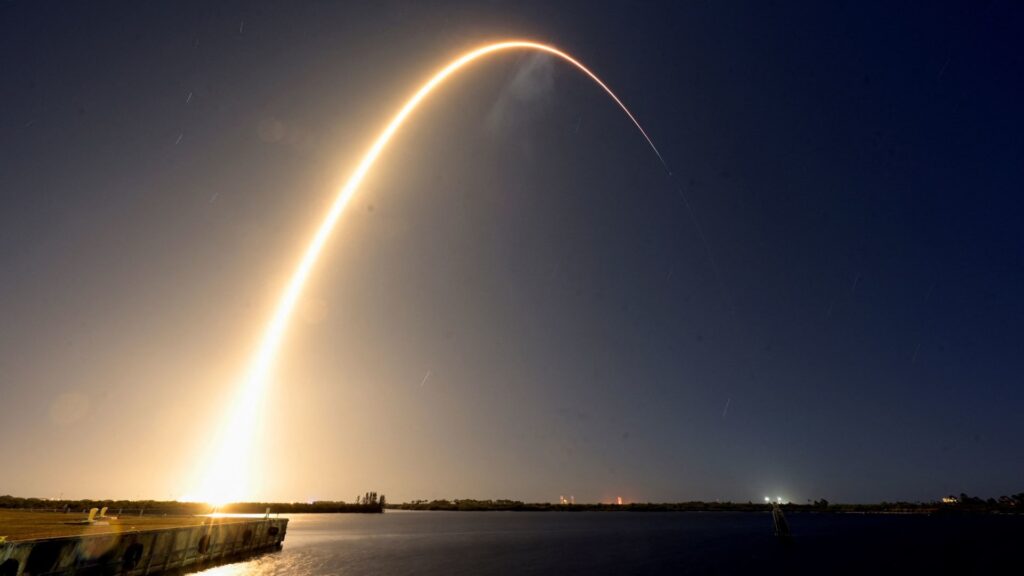
In a striking turn of events, a portion of a SpaceX Falcon 9 rocket reportedly collided with the moon, coinciding with the company’s first quarterly earnings announcement as a publicly traded entity. The Brooklyn-based aerospace manufacturer reported significant revenue growth; however, a dramatic increase in capital expenditures left investors uneasy, reflected in a notable decline in stock prices. This juxtaposition between an ambitious space venture and financial setbacks paints a complex picture for SpaceX during a pivotal moment in its trajectory.
| Article Subheadings |
|---|
| 1) Overview of the Falcon 9 Lunar Incident |
| 2) Financial Performance and Investor Reactions |
| 3) Impact of AI Expenditure on Stock Performance |
| 4) Starlink’s Role in Financial Stability |
| 5) Future Challenges and Market Expectations |
Overview of the Falcon 9 Lunar Incident
On January 15, 2025, SpaceX’s Falcon 9 rocket successfully launched from the Kennedy Space Center in Cape Canaveral, Florida, carrying both the Firefly Aerospace Blue Ghost lunar lander and ispace’s Resilience lander. However, soon after the launch, part of the rocket unintentionally separated and, as reported, crashed into the moon in the early hours of January 17 around 2:35 a.m. ET. The debris, weighing about four metric tons and traveling at over 5,400 mph, is believed to be a remnant of the rocket’s lower stage.
This incident has not only stirred interest among space enthusiasts but also analysts, who have drawn parallels between the fallout of this lunar collision and SpaceX’s declining stock performance.
“Part of a SpaceX rocket crashing into the moon this morning is probably a good metaphor for the share price performance so far,”
commented Chris Beauchamp, the chief market analyst at an investing and trading platform.
Financial Performance and Investor Reactions
SpaceX’s financial performance for the second quarter raised eyebrows during its first public earnings report. The company announced revenue of $7.81 billion, an impressive 92% increase from a year prior, surpassing analyst expectations which projected $6.93 billion. Despite the high revenue, investors were unsettled by a staggering increase in capital expenditures, which surged to $18.4 billion—a sixfold increase supported largely by expenditures in artificial intelligence (AI).
In response to the mix of financial news, SpaceX’s stock price dipped by over 7% in midday trading, erasing gains made earlier in the week. This decline has left the company trading well below its $135 initial public offering (IPO) price.
Analysts have underscored that high spending on AI, while potentially promising for long-term growth, raised immediate concerns among investors. Russ Mould, investment director at an investment management firm, stated,
“As visual metaphors go, the fact a SpaceX rocket crashed into the moon hours after it had delivered its debut quarterly earnings feels almost too on the nose.”
Impact of AI Expenditure on Stock Performance
One of the core reasons for the decline in stock performance is the level of investment into AI, which represents a significant shift in strategy for SpaceX, causing anxiety among investors. While expenditures in AI could lead to enhanced operational efficiencies in the future, many analysts noted that the current cash flow levels do not justify such massive spending.
Mould emphasized that unlike some other entities in the AI sector, SpaceX does not currently generate meaningful cash flows to support such capital expenditures. In the wake of this announcement, the stock sell-off was a reflection of market apprehension surrounding profitability amidst high operational costs.
Investors remain cautious, with Mould observing that SpaceX’s ongoing investments in AI have raised eyebrows across the tech sector, and there is a sentiment among investors that these expenditures could deafen long-term profitability. The need for a more concrete path to profitability is crucial if SpaceX intends to recover and improve its share price.
Starlink’s Role in Financial Stability
Amidst concerns following the earnings report, SpaceX’s satellite internet division, Starlink, has emerged as the company’s critical revenue contributor. Starlink has shown strong performance since its inception, providing much-needed financial stability during turbulent times.
According to Beauchamp, Starlink is effectively the only profitable segment currently within SpaceX, which has driven a sense of optimism among investors. Nonetheless, the long-term outlook raises questions about dependency on Starlink alone to bolster SpaceX’s overall financial health.
Though Starlink has made strides in securing partnerships and expanding its user base, there remains an essential need for the company to create diverse revenue streams beyond its satellite operations. The juxtaposition of Starlink’s performance against high expenditures on other initiatives, particularly in AI, emphasizes the challenges SpaceX faces in maintaining financial equilibrium.
Future Challenges and Market Expectations
Looking ahead, SpaceX faces a multitude of challenges that will test investor confidence. A pivotal moment will occur on January 20, when the first lockup expiry for investors will take effect, allowing over 900 million shares to become potentially available for sale. This influx could significantly impact the company’s stock price, primarily if insiders decide to capitalize on their holdings.
Many insiders acquired shares at prices far below the current IPO price of $135, giving them a financial incentive to sell, particularly in light of the company’s recent share price volatility. Mould articulated that “many of these will be held by insiders whose entry point was significantly below the $135 IPO price, providing an incentive to sell even in light of the recent indifferent showing for the stock.”
The convergence of these factors—the recent lunar incident, high spending on AI, reliance on Starlink, and impending stock availability—highlights a critical juncture for SpaceX. As the public and analysts alike absorb these dynamics, the company’s next course of action will be of paramount importance in determining its future trajectory.
| No. | Key Points |
|---|---|
| 1 | A part of the Falcon 9 rocket crashed into the moon following its launch. |
| 2 | SpaceX generated $7.81 billion in revenue, exceeding analyst estimates. |
| 3 | Capital expenditures rose to $18.4 billion, primarily on AI investments. |
| 4 | Starlink remains the only profitable segment for SpaceX at present. |
| 5 | The upcoming expiration of a lockup period may significantly impact stock prices. |
Summary
The collision of a SpaceX rocket part with the moon serves as a metaphor for the company’s stock performance, illustrating the disconnect between its impressive financial growth and troubling investor reactions. As SpaceX navigates the challenges posed by high expenditures in AI and prepares for significant stock movements due to an impending lockup expiration, the company faces critical decisions that will determine its stability and future success.
Frequently Asked Questions
Question: What happened with the SpaceX Falcon 9 rocket?
A section of the Falcon 9 rocket reportedly crashed into the moon following its launch in January 2025, coinciding with the company’s first quarterly earnings release.
Question: How did investors react to SpaceX’s earnings report?
Despite a 92% increase in revenue, investors were concerned about a significant rise in capital expenditures, leading to a drop in stock price by over 7%.
Question: What is the role of Starlink for SpaceX?
Starlink has become the primary revenue driver for SpaceX, providing profitability during a time when other segments face uncertainties, particularly concerning high operational costs.