
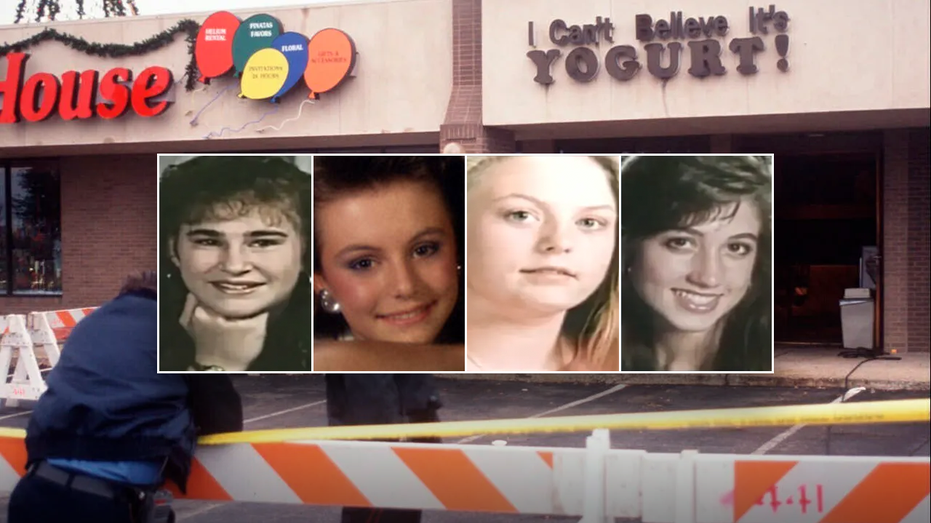
Nearly 34 years after four teenage girls were killed inside an Austin yogurt shop, investigators have identified a likely perpetrator, but important questions remain. DNA and ballistics evidence linked serial killer Robert Eugene Brashers to the 1991 attack. Relatives continue to question whether he acted alone. The case also led to wrongful arrests and convictions involving four local men. Shawn Ayers and his wife, Angie Ayers, later helped establish a national nonprofit focused on unsolved homicide investigations.
| 1) | The 1991 Austin yogurt shop attack |
| 2) | Evidence points to a killer, but questions remain |
| 3) | Wrongful convictions and exonerations |
| 4) | A nonprofit grows from the families’ experience |
| 5) | The continuing search for answers |
The 1991 Austin yogurt shop attack
The killings occurred on Dec. 6, 1991, at an I Can’t Believe It’s Yogurt! shop on West Anderson Lane in Austin, Texas. Jennifer Harbison and Eliza Thomas, both 17, were working the closing shift. Jennifer’s 15-year-old sister, Sarah Harbison, and 13-year-old Amy Ayers were waiting for them so the four could attend a sleepover.
Authorities arrived shortly before midnight after a fire was reported. Fire and sprinkler water altered the scene and diluted evidence. Three victims were found bound and gagged in a storage room and had been shot with .22-caliber bullets. Amy was found elsewhere with a ligature around her neck and burns covering as much as 30% of her body. Investigators also recovered evidence of a .380-caliber handgun.
Evidence points to a killer, but questions remain
The investigation continued for decades through false confessions, arrests, convictions and appeals. In September 2025, DNA and ballistics evidence identified Robert Eugene Brashers as the killer. Authorities said the .380-caliber handgun used in the attack was the same weapon Brashers used to kill himself during a 1999 police standoff in Missouri.
Brashers had also been linked to violent crimes in South Carolina and Missouri. Because he died, the families could not confront him at trial or ask him about the attack. The Ayers family remains concerned that another person may have been involved because investigators found evidence associated with two firearms.
“There has been absolutely no definite answer on whether or not he was by himself, or had an accomplice.”
Angie Ayers said the lack of a surviving suspect leaves the family unable to establish exactly what happened inside the shop.
Wrongful convictions and exonerations
Before Brashers was identified, Austin investigators arrested four local men in 1999: Robert Springsteen, Michael Scott, Maurice Pierce and Forrest Welborn. Springsteen and Scott confessed during questioning but later recanted, saying they had been pressured. Juries convicted Springsteen in 2001 and Scott in 2002. Springsteen received a death sentence, while Scott received life in prison.
The Texas Court of Criminal Appeals overturned their convictions in 2006 and 2007. DNA testing did not match either man to the crime scene, and both were released in June 2009. Prosecutors later dismissed the charges. Pierce spent more than three years in jail before his case was dismissed in 2003 for insufficient evidence. Welborn was never tried, and prosecutors dropped the case in 2000 after grand juries declined to indict him.
On Feb. 19, 2026, a Travis County judge declared all four men actually innocent. The Austin City Council later approved a $35 million settlement for the three surviving men and Pierce’s family. Welborn has described damage to his business and reputation, while the Ayers family said it has not contacted the men or their relatives.
A nonprofit grows from the families’ experience
Shawn Ayers and Angie Ayers joined former prosecutors Mindy Montford and Anne Marie Schubert to establish the National Cold Case Center. The organization grew from the couple’s effort to seek information about Amy’s death and from conversations with other families facing prolonged investigations.
Montford began working with the Ayers family in 2017, when she was an assistant district attorney in Travis County. The couple later met Schubert at a 2023 cold case conference in Marble Falls, Texas. The center aims to fund unsolved homicide investigations, train investigators, improve data collection and reporting, connect law enforcement agencies, and provide peer support for families.
The continuing search for answers
The Ayers family says the investigation remains unfinished despite the identification of Brashers. Angie has questioned whether one person could have used both weapons, while Shawn has criticized the way families can learn important case information only after it reaches others.
The couple is seeking funding to launch the nonprofit’s first cases. They have promoted the effort at cold case conferences in California, Florida, Missouri and North Carolina. Their goal is to support relatives and help investigators identify offenders who may still be alive and capable of committing additional crimes.
| 1 | Four girls were killed in an Austin yogurt shop on Dec. 6, 1991. |
| 2 | Robert Eugene Brashers was identified as the killer in September 2025. |
| 3 | Four wrongfully accused men were declared actually innocent in February 2026. |
| 4 | A $35 million settlement was approved for the exonerated men and Pierce’s family. |
| 5 | A national nonprofit will support cold case investigations and victims’ families. |
Summary
The identification of Brashers resolved a central question in the Austin yogurt shop murders, but it did not settle whether he acted alone or explain the investigative failures that led to wrongful convictions. The Ayers family’s nonprofit seeks to turn decades of frustration into practical support for investigators and families pursuing answers in other unsolved homicide cases.
Frequently Asked Questions
When did the yogurt shop murders occur?
The four girls were killed on Dec. 6, 1991, at a yogurt shop on West Anderson Lane in Austin, Texas.
Who was identified as the killer?
Authorities identified Robert Eugene Brashers in September 2025 using DNA and ballistics evidence. He had died by suicide during a 1999 police standoff.
Why do questions about an accomplice remain?
The Ayers family has pointed to evidence involving two firearms and says there is no definitive answer about whether Brashers acted alone.
What is the National Cold Case Center?
It is a nonprofit established by the Ayers couple and former prosecutors to fund investigations, train law enforcement, improve unsolved-case data and support victims’ families.