
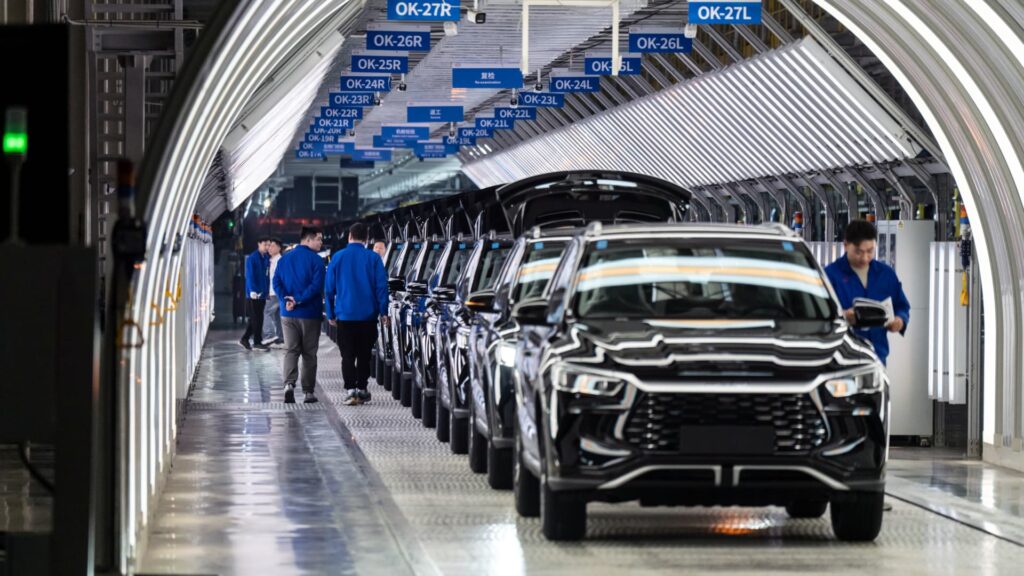
The United Kingdom has made a significant move by welcoming China’s booming electric vehicle (EV) industry, diverging from the protective stance taken by the United States. As Chinese EVs enter the U.K. with only a 10% import duty, they stand to gain a competitive edge in one of the world’s largest automobile markets without facing the tariffs imposed by the U.S. Conversely, the U.K. is currently considering potential tariff adjustments in response to European Union regulations that could impact local businesses. This article delves into the ramifications of these developments on the U.K. automotive sector and examines the growth of Chinese automotive brands within the country.
| Article Subheadings |
|---|
| 1) U.K.’s Trade Position with China |
| 2) Growing Market Share of Chinese Automakers |
| 3) Impact of EU Regulations |
| 4) The Rise of the ‘Temu Range Rover’ |
| 5) Challenges Ahead for U.K.’s Automotive Industry |
U.K.’s Trade Position with China
The U.K. has opened its automotive market to the burgeoning Chinese electric vehicle (EV) sector, adopting a much less restrictive policy than the United States. Currently, Chinese-made EVs are subject to only a 10% import duty in the U.K., making it one of the largest markets to permit the entry of these vehicles without any additional tariffs specifically aimed at China. This contrasts sharply with the U.S., where a prohibitive 100% tariff effectively bans Chinese EVs from entering the market. The European Union, while offering a better position than the U.S., imposes manufacturer-specific tariffs on Chinese EVs which can reach up to 35.3%, in addition to a standard 10% levy imposed on all foreign vehicles.
This strategic decision has allowed more freedom for the Chinese automotive industry to penetrate the U.K. market, raising questions about the long-term implications for both local and foreign manufacturers. However, the U.K. government now faces increasing pressure to reconsider its tariff framework as EU proposals could compel the adoption of similar tariffs to align with the bloc’s regulations. Business Minister Jonathan Reynolds has indicated that the government is weighing its options to possibly match the EU’s rates, signaling a potential pivot that could significantly alter the landscape for Chinese EVs.
Growing Market Share of Chinese Automakers
Chinese automakers have swiftly increased their market share in the U.K., with registrations rising dramatically. Data from JATO Dynamics indicates that from January to August of this year, registrations of Chinese brands surged to 519,424 units, translating to a remarkable growth in market share from 12.9% in 2025 to 28.1% this year. This growth trajectory not only represents a significant win for Chinese automakers but also points to a clear preference among consumers for affordable and technologically advanced vehicles.
Hybrids have contributed notably to this rise, with an increase of 62,655 registrations compared to 32,565 for battery-electric vehicles. The influx of these hybrid models illustrates that not only pure-electric vehicles are gaining traction in the U.K. market, but consumers are also gravitating towards hybrid solutions that offer flexibility. This shift is noteworthy, as it reflects a broader trend towards electrification that encompasses varying types of powertrains while showcasing the evolving preferences of U.K. consumers.
Impact of EU Regulations
The ongoing negotiations and proposed regulations by the European Union present a complex challenge for the U.K. government. The EU’s “Made in Europe” legislation aims to safeguard local industries from international competition by placing a legislative priority on goods produced within Europe. Experts within the automotive sector, including industry officials, are suggesting that to mitigate potential trade barriers, the U.K. may have to elevate its tariffs on Chinese EVs and align more closely with EU trade policies.
This raises pressing questions about the future of trade relations between the U.K. and China, along with the potential repercussions for domestic manufacturers who benefit from current tariff-free imports. While the prospects of aligning with the EU could potentially shield the U.K. market against retaliatory measures from China, officials from the Chinese Embassy in London have voiced concerns about any discriminatory tariff practices that may arise. They urged against actions that could pose unintended restrictions on Chinese goods, emphasizing the need for reciprocal trade practices. As discussions progress, the balance between protecting local businesses and maintaining a competitive marketplace becomes increasingly fragile.
The Rise of the ‘Temu Range Rover’
The “Temu Range Rover,” a name used to refer to the Jaecoo 7 from China, has unexpectedly taken the lead in U.K. car sales, outpacing more established competitors like Tesla and Ford. The mid-size SUV, starting at approximately £29,000 ($38,350), has seen sales soar, achieving 10,814 units sold in September alone. This marks a significant achievement for a brand that is still relatively new to the market and showcases the growing acceptance of Chinese automotive products among U.K. consumers.
The contrast of prices for similar vehicles is stark, with the Jaecoo 7 positioned at a considerably lower price point than the popular Land Rover Discovery Sport, which retails for around £45,500. The competitive pricing and perceived value of the Jaecoo 7 could alter consumer purchasing behaviors, pushing established manufacturers to reassess their pricing strategies to maintain market share. Consequently, the success of the Jaecoo 7 could spark a trend of increasing Chinese models entering the U.K. market.
Challenges Ahead for U.K.’s Automotive Industry
The growing competition from Chinese automakers presents both opportunities and challenges for the U.K.’s automotive sector. Experts assert that the government might have limited options beyond imposing tariffs to ensure a level playing field within the European landscape. Analysts have warned that exclusion from the EU’s “Made in Europe” initiative could have serious ramifications for U.K. automotive businesses, potentially affecting their market positioning in both local and international arenas.
While batteries from China currently benefit from tariff exemptions in the EU, some experts argue that this may not be sustainable in the long term. Given Europe’s struggle to ramp up production capacity and address its dependence on rare earth minerals essential for EV manufacturing, the dynamics are likely to shift. Thus, the automotive industry in the U.K. must adapt by implementing strategic moves such as encouraging local production, enhancing charging infrastructure, and investing in skilled labor to foster competitiveness in this evolving marketplace.
| No. | Key Points |
|---|---|
| 1 | The U.K. currently levies only a 10% import duty on Chinese EVs, contrasting sharply with the U.S. and EU. |
| 2 | Chinese automakers have rapidly increased their market share in the U.K., achieving 28.1% as of August 2026. |
| 3 | EU proposals may compel the U.K. to align its tariffs with those of the bloc, impacting imports from China. |
| 4 | The Jaecoo 7 has emerged as the best-selling car in the U.K., challenging traditional brands with its affordability. |
| 5 | The U.K. automotive sector faces challenges in maintaining competitiveness as it navigates potential EU tariff alignment. |
Summary
In conclusion, the U.K. has positioned itself uniquely in the global automotive market by embracing Chinese electric vehicles while navigating the complexities of trade regulations and evolving consumer preferences. As the landscape continues to be shaped by the influx of Chinese automakers, the U.K. government is faced with challenging decisions that could redefine the market’s future. Balancing industrial interests, consumer choice, and international relations will be critical for the U.K. as it seeks to harmonize its trade policies with the realities of a changing automotive industry.
Frequently Asked Questions
Question: How has the U.K. opened its market to Chinese EVs?
The U.K. has allowed Chinese electric vehicles to enter its market with only a 10% import duty, contrasting with much higher tariffs imposed by the U.S. and the EU.
Question: What is the significance of the Jaecoo 7’s market performance?
The Jaecoo 7 has become the best-selling car in the U.K., demonstrating the increasing acceptance and popularity of Chinese automotive brands among U.K. consumers.
Question: What are the potential implications of the EU’s “Made in Europe” initiative for the U.K.?
The EU’s initiative may compel the U.K. to adopt similar tariffs on Chinese EVs, impacting local manufacturers that rely on tariff-free imports and potentially leading to significant changes in the market landscape.