
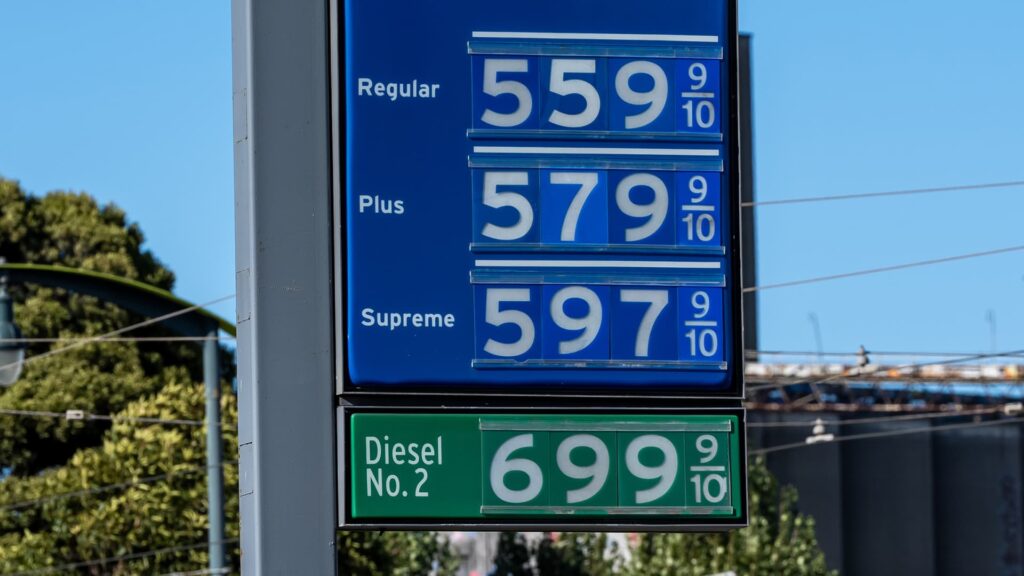
California currently faces the highest fuel prices in the United States, intensified by geopolitical factors including the ongoing war in Iran, now entering its sixth month. With the San Pedro Bay port complex, the nation’s busiest containership hub, processing nearly a third of the country’s imports and exports, the impact of these elevated fuel prices is cascading through the economy. As petroleum product markets tighten, experts warn that consumers nationwide may soon feel the effects in the prices of everyday products.
| Article Subheadings |
|---|
| 1) Overview of Fuel Prices in California |
| 2) The San Pedro Bay Port Complex’s Role |
| 3) Diesel Demand and Global Challenges |
| 4) Environmental Regulations Impacting Prices |
| 5) Implications for the American Supply Chain |
Overview of Fuel Prices in California
As of now, California’s fuel prices are the highest in the nation, with average diesel prices nearing $6.92 per gallon, a significant increase from $5.10 prior to the onset of the Iran conflict. According to AAA, the average price for diesel across the United States is $5.36, highlighting a concerning disparity that is largely due to both local and global factors. While California is renowned for its rigorous environmental regulations, the state’s shrinking fossil fuel industry has played a crucial role in exacerbating fuel costs.
The increasing prices are not just a local issue; they are linked to broader geopolitical tensions, particularly the ongoing war in Iran, which has caused disruptions in global oil supply. Such situations lead to uncertainty in markets, making it challenging for states like California to stabilize their fuel costs. The state’s limited connections to fuel pipelines and ongoing refinery closures further complicate the scenario, making it less capable of leveraging national price adjustments.
The San Pedro Bay Port Complex’s Role
Located in Southern California, the San Pedro Bay port complex is not merely a transit hub; it plays an integral role in the American economy by facilitating nearly one-third of the country’s imports and exports. Given its significance, any disruption in fuel supply or increased transportation costs could result in a ripple effect throughout the entire supply chain, impacting the availability and pricing of goods on shelves across the nation.
Trucks and trains are the backbone of the supply chain across the United States, and as these vehicles depend primarily on diesel, transportation costs are directly impacted by California’s high fuel prices. As they fuel their trucks at elevated rates, these logistics operators pass on the extra costs to consumers, making everyday products more expensive before they even reach retail stores.
Diesel Demand and Global Challenges
As we delve deeper into the implications of rising fuel prices, it is crucial to consider the global state of diesel demand. According to industry experts, the war in Iran, along with augmented attacks on Russian refineries due to the Ukraine conflict, has led to a concerning global supply shortage. Estimates from Lipow Oil Associates indicate that the world is currently short by approximately 8% when it comes to diesel demand.
Diesel is often termed the workhorse of the American economy—essential for transporting goods across vast distances. With the United States being the world’s largest energy producer, one might expect a stable supply. However, the reality is complicated by California’s own constraints, including limited refinery capacity and the gradual reduction of its fossil fuel industry over the years.
Environmental Regulations Impacting Prices
California’s strict environmental regulations have been pivotal in the state’s push for sustainability, but they have also left a considerable impact on fuel prices. The combination of these regulations and the dwindling number of operational refineries has severely limited California’s domestic fuel production capacity. This limited supply exacerbates the price upward pressure on diesel and gasoline, especially given the ongoing geopolitical tensions affecting supply chains globally.
Without significant investment to modernize existing refineries and expand in-state production, the Golden State will likely continue grappling with these spiking prices. Efforts to transition to alternative fuels, while noble in intent, may also leave consumers exposed to higher costs in the short term, as the infrastructure necessary to support these changes is still under development.
Implications for the American Supply Chain
Ultimately, the elevated fuel prices in California represent a microcosm of broader economic challenges faced by the entire U.S. supply chain. JPMorgan analysts highlighted in a recent report that “a meaningful share of America’s supply chain pays West Coast fuel prices,” emphasizing how these rates can influence freight costs, transportation margins, and ultimately the price consumers pay for products.
As more businesses are forced to navigate these challenging circumstances, the potential for a national ripple effect grows. Increased transport costs can lead to surcharges for consumers, thereby affecting everything from grocery prices to online delivery services. As such, the implications of California’s fuel prices could reverberate throughout the economy, underscoring the necessity for strategic planning and adaptation at various levels—from state leadership to individual corporations.
| No. | Key Points |
|---|---|
| 1 | California has the highest fuel prices in the U.S., significantly impacting transportation costs. |
| 2 | The San Pedro Bay port complex is crucial for U.S. imports and exports, emphasizing its economic importance. |
| 3 | Global diesel demand is currently experiencing a shortfall largely due to geopolitical tensions. |
| 4 | Strict environmental regulations in California contribute to higher fuel prices and limited production capacity. |
| 5 | High fuel costs in California can lead to increased prices for consumers across the entire U.S. economy. |
Summary
The elevated fuel prices in California present a multifaceted issue that extends beyond mere numbers; they signify critical challenges faced by the U.S. economy as a whole. As transportation costs rise due to heightened diesel prices, consumers across the nation may soon experience the repercussions in the form of higher product prices. With the interplay between local policies, global tensions, and supply chain logistics, addressing these issues will require coordinated efforts across various sectors and levels of government.
Frequently Asked Questions
Question: Why are California’s fuel prices so much higher than the national average?
California’s fuel prices are affected by strict environmental regulations, limited refinery capacity, and a lack of major fuel pipelines connecting it to other parts of the U.S., contributing to elevated costs.
Question: How does fuel price impact the supply chain?
Fuel prices directly affect transportation costs, which in turn can lead to increased prices for goods as companies pass on these costs to consumers.
Question: What geopolitical factors are influencing fuel prices?
The ongoing conflicts in regions like Iran and Ukraine have disrupted global oil supply chains, contributing to higher fuel prices and a shortfall in diesel demand.