
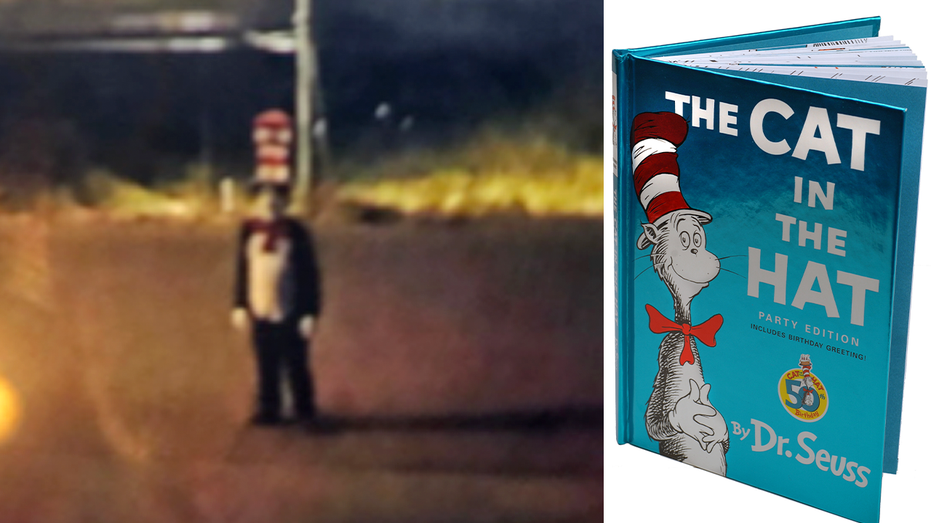
A reported nighttime chase involving a person in a Cat in the Hat-style costume has intensified concern about a wider social media trend targeting schools and communities. The Aug. 24 incident occurred in West Kelowna, British Columbia, where police said a teenage girl reached home safely after being pursued. Across the United States, authorities are investigating edited and AI-generated posts that name students, staff members, schools and towns, while several juveniles have been arrested or face possible charges.
Police agencies have emphasized that wearing a costume is not itself illegal, but pursuing someone or publishing threatening material may lead to criminal investigations. Officials are also urging the public not to repost the content, which could amplify threats and make it harder to identify those responsible.
| 1) | Reported chase in British Columbia |
|---|---|
| 2) | How the online trend targets schools |
| 3) | Police responses and public guidance |
| 4) | Juvenile arrests and potential charges |
| 5) | Separating online hoaxes from credible threats |
Reported chase in British Columbia
The Royal Canadian Mounted Police said an unidentified teenage girl was walking in West Kelowna, British Columbia, at about 9 p.m. on Aug. 24 when a person wearing a costume resembling the Cat in the Hat allegedly began following her. The girl escaped and arrived home safely, but investigators had not identified the costumed person.
The incident was reported near the 2000 block of Shamrock Drive. Police asked residents to provide doorbell-camera, security-camera or dashcam footage recorded in the area around the reported time. Devon Gerrits, a corporal with the police force, said behavior presented as a prank can have serious consequences when it causes a person to reasonably fear for their safety.
“Regardless of whether the individual intended the behavior as a joke, following a young person and causing them to fear for their safety is extremely concerning,” police said.
How the online trend targets schools
The separate online trend involves edited or AI-generated images and videos showing a sinister Cat in the Hat figure outside homes, near schools, at businesses or in local communities. Anonymous accounts have sometimes added the names of students, school employees, campuses and towns, along with ominous captions or apparent threats.
Posts have referenced communities in California, Florida, Virginia and Texas. Some material reviewed by authorities appeared designed to provoke fear rather than identify a specific, credible plan. Police have not established that the West Kelowna chase was connected to the online trend.
Police responses and public guidance
Law enforcement agencies have opened investigations, increased patrols and placed additional officers near schools after posts referenced local campuses. Baldwin Park police in California said they were reviewing concerning posts naming schools, students and staff. The Hanover County Sheriff’s Office in Virginia investigated material referencing Mechanicsville High School and increased its presence at the campus.
Authorities in St. Johns County, Florida, said they were investigating content involving county schools but had not identified a credible threat. Agencies in Frio County, Laredo and Premont, Texas, issued similar warnings and said threatening posts could result in criminal consequences. Officials urged people to move to a populated location, contact a trusted adult and call 911 if they are being followed or face immediate danger.
Juvenile arrests and potential charges
Investigators in several states have linked threatening accounts to juveniles. In Berwick, Louisiana, four girls between 13 and 15 were arrested after police connected them to TikTok accounts that alarmed families and schools. Three faced allegations involving terrorizing or menacing, while the fourth was accused of cyberbullying.
A 12-year-old Florida student was accused of posting a written threat to kill connected to the trend. A 14-year-old Colorado student was arrested after a post referenced a middle school and several homes. Authorities in Alabama, Ohio and Kentucky have also announced juvenile arrests or potential charges involving similar posts. Depending on the evidence and jurisdiction, allegations may include harassment, cyberbullying, intimidation, terroristic threats or filing a false alarm or report.
Separating online hoaxes from credible threats
Police have stressed that investigators must determine whether a post is an internet hoax, a copycat attempt or a credible danger. Reposting threatening content can spread fear, increase attention for anonymous accounts and complicate efforts to trace the original material.
Residents who encounter a threatening post should preserve screenshots showing the account name, message, date and time, then report the information directly to school officials or law enforcement. Officials have also warned that recreating or forwarding the posts is not harmless simply because the creator claims it was a joke.
| 1 | A teenage girl in West Kelowna escaped after an alleged chase involving a Cat in the Hat-style costume. |
|---|---|
| 2 | AI-generated and edited posts have referenced schools, students, staff members and communities. |
| 3 | Police in multiple states increased patrols and investigated threats, even when no credible danger was confirmed. |
| 4 | Juveniles in Louisiana, Florida and Colorado have been arrested or accused in cases tied to similar posts. |
Summary
The Cat in the Hat trend has prompted investigations and school safety warnings across several states, while a separate reported chase in Canada remains unresolved. Authorities are treating threats seriously, asking the public to preserve evidence rather than circulate it. The cases demonstrate how fictional or AI-generated imagery can produce real-world fear and potentially lead to criminal or disciplinary action.
Frequently Asked Questions
What is the Cat in the Hat trend?
It is a series of edited or AI-generated images and videos depicting a sinister Cat in the Hat-style figure near homes, schools and communities, sometimes with names or threatening messages.
Was the reported Canadian chase linked to the online posts?
Police have not said that the West Kelowna chase was connected to the separate social media trend. The costumed person involved in the chase remained unidentified.
What should people do if they see a threatening post?
They should save screenshots showing the account and timing, avoid reposting the material, and send the evidence to school officials or law enforcement. Anyone facing immediate danger should call 911.