
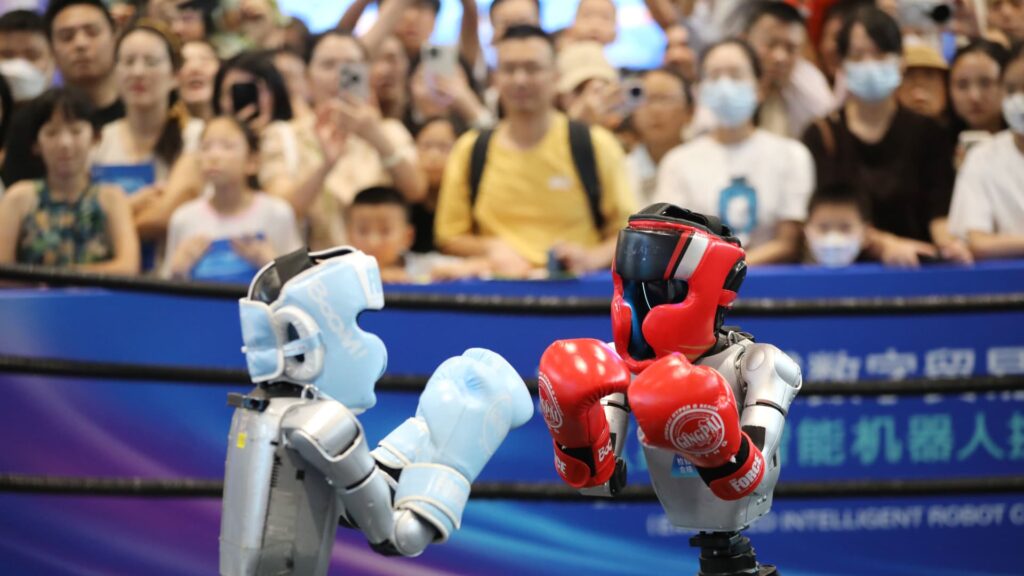
In a significant shift for China’s burgeoning humanoid robot market, the China Securities Regulatory Commission (CSRC) has introduced stringent requirements for startups planning to go public. This move signals a cooling of enthusiasm in a sector that had seen explosive growth amid rising investor interest and concerns over a potential bubble in artificial intelligence stocks. The new criteria demand evidence of sustainable revenue, reduced losses, and core technological capabilities, placing additional pressure on these companies as they navigate the complexities of public offerings.
| Article Subheadings |
|---|
| 1) New Regulatory Requirements for Humanoid Robot Startups |
| 2) The Impact of Unitree’s IPO |
| 3) Industry Insights and Valuation Concerns |
| 4) Investment Landscape for Humanoid Robots |
| 5) Future Prospects for Humanoid Robotics |
New Regulatory Requirements for Humanoid Robot Startups
The CSRC has implemented new guidelines aimed at regulating the public listings of humanoid robot companies, a move interpreted as a response to rising concerns about a speculative bubble in the market. The new requirements state that aspiring companies must demonstrate sustainable revenue and existing commercial orders, and they are expected to provide a three-year financial forecast that shows narrowing losses. Furthermore, companies must possess certain key technological assets, including advanced robotics capabilities, referred to as a “robotic brain” or “robotic hands.” This regulatory shift comes amidst a broader reevaluation of AI and robotics investments, indicating that stakeholders are bracing for more realistic and sustainable growth in the sector.
The Impact of Unitree’s IPO
Unitree, regarded as a flagship company in the humanoid robotics sphere, was recently fast-tracked for its public offering in Shanghai amid a fanfare of attention from the industry and the media. The company’s IPO launched on August 19 and coincided with the World Robot Conference in Beijing, highlighting the growing interest and optimism in artificial intelligence applications. However, despite an explosive debut where shares shot up over 460%, the founder, Wang Xingxing, offered caution regarding the practical applications of humanoid robots, stating that full commercialization is still several years away. This perspective underscores ongoing debates about the viability of humanoid robots and the skeptical viewpoints regarding the industry’s actual revenue generation capabilities. The swift rise of Unitree’s stock contrasts sharply with the volatility observed in its share price over the following months, suggesting that market enthusiasm may be short-lived.
Industry Insights and Valuation Concerns
As China hosts over 100 established humanoid robot startups, this regulatory tightening fosters discussions about the sustainability and future of these enterprises. The authorities have issued warnings about a bubble, imploring investors and companies to approach the rapidly evolving market stocks with caution. Investment in the sector has surged dramatically, with reports indicating that over 47 billion yuan (approximately $6.95 billion) flew into humanoid AI in just the second quarter of the year—doubling from the previous quarter and multiplying more than sixfold year-on-year. Despite this surge, analyses have revealed that many Chinese AI companies are far behind their U.S. counterparts, generating only 10% of the revenue currently earned by leading firms like Anthropic and OpenAI. This disparity presents a challenge for Chinese companies trying to justify their valuations, often inflated when compared to their international rivals.
Investment Landscape for Humanoid Robots
Investment flows into humanoid robotics have witnessed dramatic fluctuations, with recent data revealing a distinct contrast between the influx of capital and the performance of stocks in the sector. Corporations involved in humanoid technologies, sometimes referred to in China as “physical AI,” are seen as appealing avenues for investors eager to capitalize on the AI boom. However, major players like Ubtech, which is listed in Hong Kong, have experienced significant declines in their stock prices. Since its public debut in December 2023, Ubtech has seen its stock price drop over 40% this year while simultaneously posting operational losses. Such trends reveal the precarious balance between investor interest and underlying business health in an industry still grappling with fundamental challenges.
Future Prospects for Humanoid Robotics
The overarching outlook for humanoid robotics remains mixed as companies navigate new regulatory climates and market pressures. Amid increasing skepticism about whether these startups can forge paths to profitability, the debate continues on what potential applications humanoid robots can fulfill. Although investments remain robust, with key collaborations emerging—such as a notable acquisition by AMD of World Labs—companies must establish sustainable business models and a clearer value proposition to thrive. International interest might also shift focus as the market evolves, challenging enterprises to innovate in both technology and business strategies to remain relevant. The regulatory landscape may further affect how rapidly the industry can adapt and scale, making the coming months critical for the success of humanoid robotics.
| No. | Key Points |
|---|---|
| 1 | The CSRC imposes new regulations for humanoid robot startups, requiring sustainable revenue, narrowed losses, and core technology. |
| 2 | Unitree’s IPO raised questions about the commercialization timelines and profitability of humanoid robotics. |
| 3 | Investment in the humanoid robotics sector increased significantly in 2026, showing strong market interest despite regulatory scrutiny. |
| 4 | Concerns persist about valuation discrepancies between Chinese AI companies and their U.S. counterparts. |
| 5 | The future of the humanoid robot industry hinges on sustainable business models and technological innovation. |
Summary
In conclusion, the adjustments made by the CSRC signal a pivotal moment for humanoid robotics in China as it moves toward a more regulated investment environment. Companies must now navigate these new hurdles while facing increasing skepticism regarding their business models’ efficacy and sustainability. With the sector’s growth under scrutiny, the coming months will be crucial for determining if these startups can secure their positions in a rapidly evolving landscape. The future will depend heavily on demonstrating actual profitability and adaptability in a market that remains both competitive and volatile.
Frequently Asked Questions
Question: What new requirements must humanoid robot startups meet to go public in China?
Startups must demonstrate sustainable revenue, narrow losses over three years, and possess core technology such as advanced robotics capabilities.
Question: What happened during Unitree’s IPO?
Unitree experienced a successful IPO in August 2026, raising significant capital but also faced scrutiny regarding the viability of humanoid robot commercialization.
Question: How have recent investments in humanoid robots been characterized?
Investments in the humanoid robotics sector surged dramatically in 2026, reaching more than 47 billion yuan, but concerns remain about the profitability and valuation of these startups.