
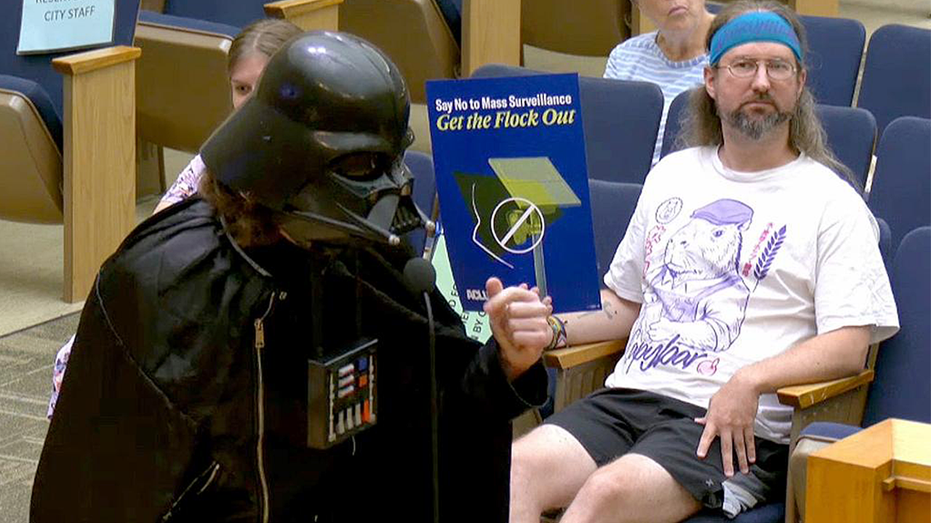
A man dressed as the Star Wars villain Darth Vader appeared at a San Diego City Council committee meeting to mockingly defend Flock surveillance technology. Speaking through the council chamber microphone with the character’s trademark heavy breathing, he portrayed the cameras as tools for the fictional Emperor. His remarks also highlighted concerns about license plate tracking, data retention and the monitoring of children and residents. San Diego police use Flock automated license plate readers at approximately 500 locations across the city.
| 1) | A theatrical appearance at the council meeting |
|---|---|
| 2) | The surveillance technology being debated |
| 3) | San Diego’s Flock camera network |
| 4) | Privacy concerns and police safeguards |
| 5) | The separate Flock Nova pilot agreement |
A theatrical appearance at the council meeting
The costumed speaker appeared Wednesday before San Diego’s Public Safety and Livable Neighborhoods Committee. He approached the public podium wearing Darth Vader’s black armor and helmet, while amplified breathing effects added to the performance. Committee members addressed him as Darth Vader as he used the Star Wars setting to criticize officials’ support for surveillance technology.
He said the cameras would help the fictional Emperor locate rebel forces and track Luke Skywalker. The performance was aimed at council members and the public during an ongoing debate over whether automated surveillance tools provide public safety benefits at an unacceptable cost to privacy.
This is what the emperor needs. This technology will help us find the rebel scum and the hidden base on Hoth.
The surveillance technology being debated
The remarks focused on Flock products, which include automated license plate readers, video cameras and audio-detection systems. The plate readers record license plate numbers and associated vehicle characteristics, including make, model and color. Some systems can also identify features such as bumper stickers and aftermarket modifications.
The speaker extended the fictional analogy to everyday movements, describing travel from playgrounds to pools and gyms as a form of tracking. He also made a personal joke about needing the cameras to stalk an ex-girlfriend. His comments were designed to ridicule the breadth of information that critics believe these systems can collect.
The Emperor is a fan of Flock, and we must continue utilizing Flock technologies so that we can follow and surveil the rebel scum as they move from playground to playground, from playground to pool, from pool to gymnasium.
San Diego’s Flock camera network
The San Diego Police Department reported using Flock automated license plate recognition cameras at approximately 500 locations citywide. Police say the system supports official law enforcement work, including locating vehicles connected to investigations. The cameras are part of a broader national debate, with activists and some public officials seeking alternatives to automated tracking systems.
The citywide network is supplemented in public discussions by a crowdsourced map maintained by an anti-surveillance project. That map includes additional camera entries, but it is not an official city inventory. The distinction is significant because the police department’s reported camera count and independently collected information do not necessarily measure the same network.
Privacy concerns and police safeguards
Critics argue that repeated plate scans can reveal patterns in where people travel, even when individuals are not suspected of a crime. During the meeting, the speaker addressed City Council member Jennifer Campbell and accused the council of asking residents to trust officials while approving surveillance technology. He compared her political persuasion efforts to Jedi mind tricks.
How will the people trust this City Council when this City Council continues to vote for surveillance technology that imprisons them? Ms. Campbell, you must work on your Jedi mind tricks.
The police department says access to its automated license plate reader database is limited to authorized personnel. It also says data is retained for up to 30 days and automatically deleted unless preserved as evidence in an active investigation. Those policies are intended to limit long-term storage, although local activists continue to question how the technology is governed and overseen.
The separate Flock Nova pilot agreement
In December 2025, the police department signed a one-year pilot agreement for Flock Nova, a separate investigative platform designed to integrate data from multiple sources. The agreement became part of the local debate because of concerns about combining information from different surveillance systems.
The department later said it was not using the platform and did not plan to integrate its license plate reader data into it. The clarification distinguishes Flock Nova from the Flock license plate reader cameras already used at locations around San Diego, while public criticism of surveillance technology continues.
| Number | Key Point |
|---|---|
| 1 | A Darth Vader impersonator used Star Wars references to mock Flock surveillance cameras. |
| 2 | San Diego police report approximately 500 Flock camera locations citywide. |
| 3 | Police say authorized personnel can access the database and that data is generally retained for up to 30 days. |
| 4 | Flock Nova was covered by a separate one-year pilot agreement signed in December 2025. |
Summary
The theatrical council appearance underscored the tension between law enforcement’s stated use of automated license plate readers and privacy advocates’ concerns about persistent location tracking. San Diego police maintain that access controls and limited retention govern their camera data, while critics continue to seek greater restrictions and alternatives. The separate Flock Nova pilot adds another layer to the debate, though police say they are not using it or integrating it with their license plate reader data.
Frequently Asked Questions
What happened at the San Diego council meeting?
A man dressed as Darth Vader addressed the Public Safety and Livable Neighborhoods Committee and used Star Wars references to mockingly defend Flock surveillance technology.
How many Flock cameras does San Diego police use?
The police department reported using automated license plate recognition cameras at approximately 500 locations citywide.
How long is license plate reader data retained?
Police say the data is retained for up to 30 days and automatically deleted unless it is preserved as evidence in an active investigation.
Is Flock Nova being used in San Diego?
The department said it was not using the separate Flock Nova platform and did not plan to integrate its license plate reader data into it.