
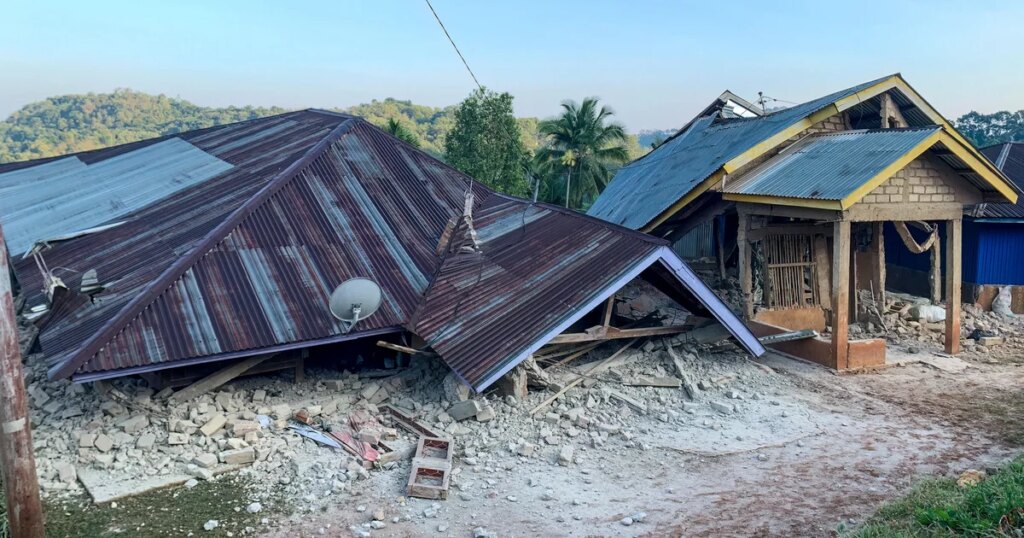
A powerful magnitude 7.7 earthquake hit off the coast of Indonesia on Saturday morning, resulting in the collapse of buildings and leaving at least 20 people dead. The seismic event struck the Flores region at 5:58 a.m. local time, sending residents into a panic as they scrambled for safety. Although officials initially issued a tsunami warning, it was later lifted when no significant sea-level changes were detected.
| Article Subheadings |
|---|
| 1) Overview of the Earthquake’s Impact and Immediate Response |
| 2) Injuries, Casualties, and Damage Reports |
| 3) Actions Taken by Local Authorities |
| 4) Eyewitness Accounts and Community Reactions |
| 5) Broader Implications and Future Preparedness |
Overview of the Earthquake’s Impact and Immediate Response
The devastating earthquake struck while many residents in East Nusa Tenggara province were still asleep or preparing for the day. With its epicenter located approximately 42 miles north-northwest of Ende, the tremors were felt widely across the region. As a major geological event, feeling the seismic intensity created immediate fear, propelling residents to flee in search of safety.
Authorities reacted swiftly to the situation. The Indonesian Meteorology, Climatology, and Geophysics Agency promptly issued a tsunami warning shortly after the quake. They warned coastal residents to migrate to higher ground as a precaution against potential tidal waves. However, after monitoring the situation, the agency downgraded the warning as it was reported that there were no significant changes in sea levels. This update allowed residents to return to assessing damage in their communities without fear of imminent tsunami threat.
Injuries, Casualties, and Damage Reports
Initial reports indicate that at least 20 people have lost their lives, with casualties occurring primarily in Sikka and Manggarai regencies. Rudi Darmoko, the police chief in East Nusa Tenggara, confirmed details of the fatalities, highlighting the structural collapse of buildings as a significant factor in the loss of life. The intense shaking and subsequent aftershocks also exacerbated the situation, leading to injuries and chaos throughout the impacted areas.
Reports of severe infrastructural damage have emerged from across the affected regions. In Sikka regency, resident Yohanna Embu noted the substantial destruction, particularly pointing out the damage to the waiting room at the Maumere port terminal. Furthermore, many residents have reported widespread damage to both public and private buildings, including schools and hospitals. The complications from power outages have greatly impeded communication and information dissemination, with local officials struggling to confirm reports of disaster accurately.
Actions Taken by Local Authorities
In the wake of the disaster, local authorities have mobilized emergency response teams to search for survivors and assess damage across the most affected areas. Efforts are being hindered by communication silos resulting from utility outages, but local leaders and volunteers have begun coordinating to assist those in need. Rudi Darmoko emphasized the urgency of these efforts in light of ongoing risks posed by aftershocks following the initial earthquake.
Additionally, medical staff have had to adapt rapidly to emergency conditions, with hospitals evacuating patients as a precaution. Equipment such as beds and IV stands were moved outdoors to create makeshift treatment areas, acknowledging that the structural integrity of hospital buildings might not guarantee safety for patients and staff. During this period, local police and disaster response teams continue to clarify casualties and damage reports as they aim to provide timely assistance.
Eyewitness Accounts and Community Reactions
Eyewitness accounts from locals provide a personal glimpse into the earthquake’s impact. Students at St. Peter Major Seminary in Sikka experienced sheer horror as they fled a collapsing roof during morning Mass. Rev. Guidelbertus Tanga, the seminary rector, shared that panic erupted amongst students and nuns as they rushed to safety. The suddenness of the disaster left long-lasting emotional impacts on the community, which had already been grappling with periodic seismic activities inherent to the region.
Amidst chaos, community spirit has emerged as people unite to offer support and aid to one another. In reflecting on her experience, resident Yohanna Embu stated, “Many buildings here were damaged, but we have come together.” Such sentiments highlight resilience amid adversity, emphasizing a collective commitment to support recovery efforts and help rebuild the devastated community.
Broader Implications and Future Preparedness
This significant seismic event brings to light essential discussions about earthquake preparedness in an area that is no stranger to seismic activity. The Indonesian archipelago is situated on the Pacific Ring of Fire, known for its propensity for earthquakes and volcanic eruptions. As such, government officials are once more tasked with reviewing and improving building codes, emergency response plans, as well as public education on earthquake safety.
Long-term recovery will require not only immediate aid but also a re-evaluation of infrastructure resilience. Policymakers are urged to prioritize investments in disaster risk reduction, advancing public awareness campaigns to empower communities to react effectively during emergencies like this catastrophic quake. The tragedy serves as a reminder that strategic planning and preparedness are crucial not only for mitigating loss of life but also for minimizing economic setbacks following such natural disasters.
| No. | Key Points |
|---|---|
| 1 | A magnitude 7.7 earthquake struck off the coast of Indonesia, resulting in significant casualties. |
| 2 | Local authorities issued and later lifted a tsunami warning following the quake. |
| 3 | There were power outages that complicated communication and emergency response efforts. |
| 4 | Eyewitness accounts reveal panic among residents and structural damage across Sikka and Manggarai regencies. |
| 5 | The earthquake highlights the need for improved disaster preparedness and infrastructure resilience in the region. |
Summary
The recent earthquake in Indonesia serves as a stark reminder of the region’s susceptibility to seismic activity and the urgent need for effective disaster preparedness. With lives lost and infrastructure damaged, the focus now turns to recovery efforts and strengthening resilience against future seismic threats. Authorities and communities are called to respond collectively to rebuild and learn from this tragedy, ensuring enhanced protective measures for the populations living in such high-risk zones.
Frequently Asked Questions
Question: What are the main safety measures during an earthquake?
Safety measures include dropping to the ground, taking cover under sturdy furniture, and holding on until the shaking stops.
Question: How can communities prepare for earthquakes?
Communities can prepare through public education campaigns, regular drills, and ensuring buildings meet safety codes.
Question: What should individuals do after an earthquake?
Individuals should check for injuries, avoid damaged areas, listen to emergency services for updates, and await further instructions.