
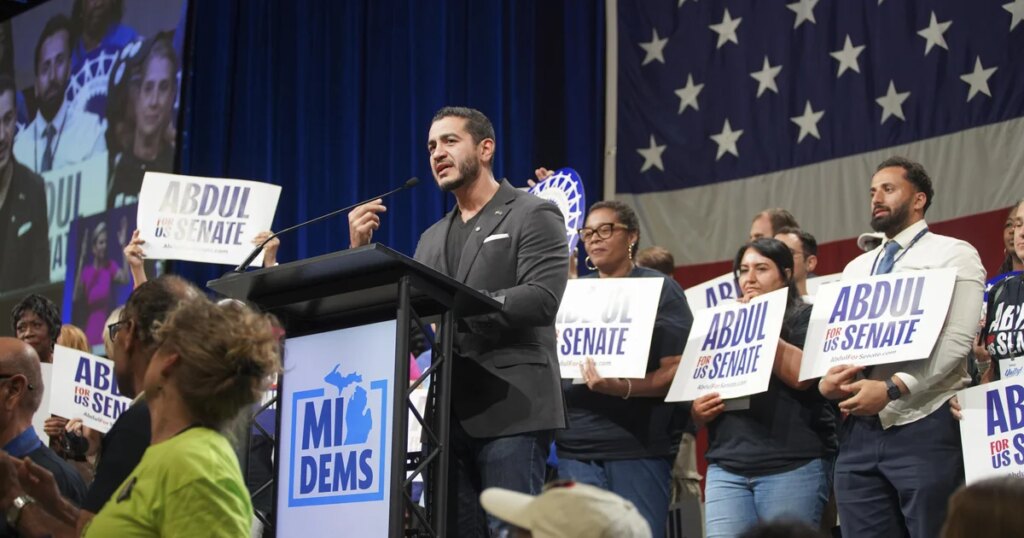
Democratic U.S. Senate nominee Abdul El-Sayed addressed a significant controversy by apologizing to Michigan’s Jewish Democratic Caucus for comments he made following an attack on a synagogue in March. He expressed regret that his statements may have been interpreted as justifying violence, insisting that was not his intention. This apology comes as part of his efforts to unite the Democratic Party after a divisive primary race and to clarify his stance amid allegations of antisemitism.
| Article Subheadings |
|---|
| 1) Background on the Controversy |
| 2) El-Sayed’s Response to the Incident |
| 3) Impact on El-Sayed’s Campaign |
| 4) The Broader Political Landscape |
| 5) Future Implications for the Election |
Background on the Controversy
The controversy surrounding Abdul El-Sayed erupted following a tragic incident in March when a man attacked Temple Israel synagogue in a suburb of Detroit, Michigan. The attack was violent, involving the assailant ramming his car into the building and subsequently opening fire on a security guard, leading to his own suicide. The individual behind this attack, identified as Ayman Mohammad Ghazali, was reportedly suffering from deep emotional trauma after losing four relatives in an Israeli airstrike just a week prior.
El-Sayed, who had been closely monitored during the fallout of this incident, made comments that sparked significant backlash. In a video released shortly after the attack, he condemned the violence but added a statement that “hurt people hurt people.” This remark was seized upon by critics who felt it unjustly offered a rationale for Ghazali’s violent outburst. The comments incited existing tensions in his political landscape, particularly in the context of antisemitism allegations leveled against him during his campaign for the U.S. Senate.
El-Sayed’s Response to the Incident
In response to the political turmoil following his March comments, Abdul El-Sayed publicly apologized during an address to the Jewish Democratic Caucus on August 29, 2026, at the Michigan Democratic Nominating Convention in Lansing. He stated, “My comments may have been misconstrued to justify something I did not mean to justify,” indicating his concern that his initial remarks had been interpreted in a way that could be deemed offensive or dismissive of the pain caused by the attack.
During his apology, El-Sayed emphasized, “To anyone who feels like my comments might have been hurtful, I’m really sorry. That was not my intention.” He acknowledged the sensitivity surrounding the issue and expressed a desire to separate his campaign from the divisive nature of the comments. El-Sayed aimed to clarify that while he sought to provide context about the assailant’s motivations, he now recognized the inopportune timing of such remarks.
Impact on El-Sayed’s Campaign
The apology marks a critical moment for El-Sayed as he seeks to unify factions within the Democratic Party, particularly following a contentious primary against U.S. Representative Haley Stevens. Despite coming out on top in the primary, El-Sayed has faced ongoing scrutiny from various sectors of the electorate. Allegations of antisemitism linger in the background, complicated by his association with controversial figures like political commentator Hasan Piker.
Campaign strategists note that his ability to effectively manage these controversies will be crucial for his election efforts against his Republican opponent, Mike Rogers. The political dynamics in Michigan are complex, and any misstep could significantly impact voter perception in the lead-up to the general election. El-Sayed’s apologies and clarifications are thus seen not merely as damage control but as essential steps in fostering a cohesive party platform.
The Broader Political Landscape
The political landscape in Michigan leading into the Senate race is particularly contentious. The state has been a pivotal battleground, reflecting broader national divisions within the Democratic and Republican parties. El-Sayed’s candidacy is part of a larger narrative playing out across the United States, where candidates often grapple with contentious social issues, including racism and antisemitism, as they vie for public support.
Moreover, the dynamics within the Democratic Party have been fraught, particularly with rising factions emphasizing progressive platforms clashing against more traditional party views. El-Sayed’s handling of this incident may serve as a microcosmic reflection of these broader tensions. Party officials are watching closely, as El-Sayed’s ability to navigate these complexities will influence not only his campaign but also the future direction of the Democratic Party in Michigan.
Future Implications for the Election
Looking ahead, the implications of El-Sayed’s actions and the controversies surrounding them could be profound. As he faces Mike Rogers, who will likely capitalize on any perceived vulnerabilities stemming from El-Sayed’s comments, the race for control of the Senate becomes a microcosm of larger national battles regarding race, identity politics, and the role of violence in political discourse.
The Democratic establishment is keenly aware that the outcome of this Senate race could have rippling effects, including the implications for congressional control in a critical election cycle. As El-Sayed seeks to reconcile his past comments with a radio-silence atmosphere within the party, the stakes grow higher, not just for him but for Democrats aiming to solidify their standing in joint legislative chambers.
| No. | Key Points |
|---|---|
| 1 | Abdul El-Sayed apologized for controversial remarks regarding a synagogue attack. |
| 2 | The attack, committed by Ayman Mohammad Ghazali, followed personal tragedy from Israeli airstrikes. |
| 3 | El-Sayed’s comments linked to allegations of antisemitism are a point of contention in his campaign. |
| 4 | The political landscape in Michigan is polarized, impacting campaign strategies. |
| 5 | The Senate race will determine control, crucial in the upcoming election cycle. |
Summary
In summary, the unfolding narrative around Abdul El-Sayed reflects the complexities of modern political campaigning, particularly in contexts fraught with sensitive issues such as violence, trauma, and racial tensions. His recent apology illustrates an attempt to mitigate backlash and unify his party in a critical Senate race that could have lasting implications for Democratic control at the national level. As the election approaches, the effectiveness of his navigation through these controversies will likely play a pivotal role in shaping not only his political future but also the broader electoral landscape.
Frequently Asked Questions
Question: What sparked the controversy around Abdul El-Sayed?
The controversy arose from comments made by El-Sayed in response to a violent attack on a synagogue, where he stated that “hurt people hurt people,” which critics felt was unjustified.
Question: What was Ayman Mohammad Ghazali’s motivation for the attack?
Ghazali reportedly lost four relatives in an Israeli airstrike shortly before the attack, suggesting deep personal trauma as a motivating factor.
Question: How might this controversy affect El-Sayed’s campaign?
El-Sayed’s handling of the situation could significantly impact voter perception, potentially attracting or alienating support as he competes against his Republican opponent in a crucial Senate race.