
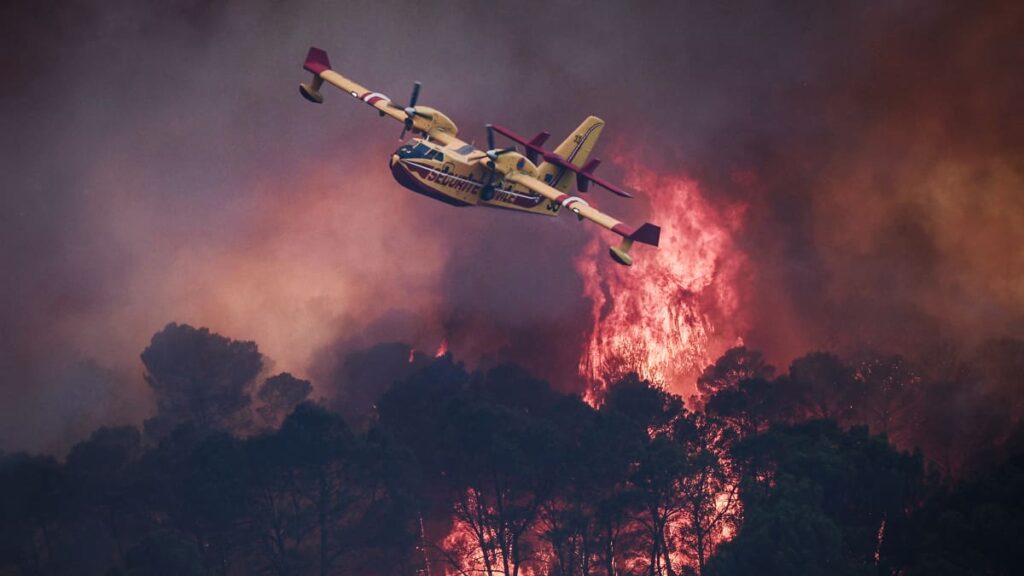
Europe is accelerating efforts to protect transport networks, airports and businesses from increasingly severe heat. Recent heat waves, wildfires and drought have exposed infrastructure risks across the continent, where temperatures are rising faster than the global average. Eurostar is designing new trains for temperatures as high as 55 degrees Celsius, while airports and rail operators are testing measures to limit heat damage. Experts warn that adaptation must be combined with deeper efforts to reduce fossil fuel use.
| 1) Transport systems prepare for higher temperatures |
| 2) Airports and railways apply emergency cooling measures |
| 3) Wildfires highlight the limits of adaptation |
| 4) European policy shifts toward climate resilience |
| 5) Businesses and insurers face a growing heat risk |
Transport systems prepare for higher temperatures
Eurostar has changed the design requirements for its next fleet after recent heat waves showed that existing assumptions may not be sufficient. The operator plans to equip up to 50 Celestia trains with air-conditioning systems capable of operating at temperatures of 55 degrees Celsius, or 131 degrees Fahrenheit. The trains are scheduled to enter service in 2031 and operate into the 2060s, making long-term climate conditions a central part of the investment decision.
The original plan called for trains able to operate in temperatures of up to 45 degrees Celsius. The higher specification is intended to help passenger services remain reliable as extreme heat becomes more common across the routes linking major European cities.
Airports and railways apply emergency cooling measures
At Oslo Airport in Norway, intense heat pushed asphalt temperatures toward 52 degrees Celsius. Airport workers and fire crews used water to cool aircraft stands and taxiways and reduce the risk of heat-related damage. Each cooling operation used about 13,000 liters of water, with the process repeated hourly during the hottest periods.
Sweden has taken a different approach. Stockholm’s public transport operator SL painted vulnerable railway tracks white to reflect sunlight and lower the risk of rail displacement or buckling, commonly called sun kinks. Similar methods have been used on exposed rail sections in Spain and Italy, showing how operators are applying local measures to protect networks from heat-related disruption.
Wildfires highlight the limits of adaptation
Wildfires in France and Spain forced more than 330,000 people to evacuate in one week as both countries prepared for a fourth heat wave of the summer. The destruction in Le Porge, in southwestern France, underscored how extreme heat can combine with drought and dry vegetation to create a rapidly escalating emergency.
Oxford energy and climate policy professor Jan Rosenow said the fires reflected warnings that climate change would increase the frequency and severity of extreme weather.
“Adaptation alone is not a viable strategy as the extreme fires show us.”
The central cause of the climate crisis remains the burning of coal, oil and gas, according to established climate science.
European policy shifts toward climate resilience
Europe has warmed at roughly twice the global average since the 1980s, according to the European Union’s Copernicus Climate Change Service. Under a high-emissions scenario, extreme heat days could double or triple across central Europe by 2050. Areas that currently experience five to 10 such days annually could face 20 to 30 days within a single generation.
Climate risk modelling director James Brennan said southern Europe faces the most severe outlook, with parts of the Iberian Peninsula, southern Italy and Greece projected to exceed 40 to 55 extreme heat days per year. The European Commission said it plans to present an integrated framework for climate resilience and risk management, covering areas including energy, infrastructure, transport and health.
Businesses and insurers face a growing heat risk
Extreme heat can damage equipment, reduce efficiency and increase maintenance and downtime. Supply chain interruptions, pressure on electricity grids and effects on workers can amplify the impact for companies. Unlike storms or earthquakes, these losses often build gradually, making heat a less visible but persistent business threat.
Lena Fuldauer, head of resilience and business development at Allianz Risk Consulting, described extreme heat as a “quiet catastrophe.” Research cited by Fuldauer found that nearly half of 854 European cities either broke or approached their heat-stress records during the June 2026 heat wave, with a peak of 48 degrees Celsius recorded at Casteltermini in Italy. She said the insurance industry must work with governments and international organizations because insurers cannot address the problem alone.
| Number | Key Point |
|---|---|
| 1 | Eurostar’s new trains are being designed for temperatures up to 55 degrees Celsius. |
| 2 | Oslo Airport used repeated water-cooling operations to protect heat-affected surfaces. |
| 3 | White-painted rail tracks are being used to reduce buckling risks. |
| 4 | Extreme heat days are expected to rise sharply in Europe by 2050 under high emissions. |
| 5 | Businesses, governments and insurers are being urged to develop joint resilience measures. |
Summary
Europe’s response to extreme heat is moving from emergency intervention toward long-term infrastructure planning. New train specifications, cooled airport surfaces and reflective railway tracks can reduce immediate disruption, but the expansion of wildfires and record heat shows that technical adaptation has limits. Coordinated public and private investment, alongside reductions in fossil fuel emissions, will be necessary to protect essential services and communities.
Frequently Asked Questions
Why is Europe particularly exposed to extreme heat?
Europe has warmed at about twice the global average since the 1980s. Climate projections indicate that extreme heat days will increase across the continent, with southern Europe facing the greatest exposure.
How are transport operators adapting?
Eurostar is designing trains for temperatures up to 55 degrees Celsius. Stockholm’s public transport operator has painted vulnerable rail tracks white, while Oslo Airport has used water to cool heat-affected asphalt.
Can insurers solve the heat-related risks alone?
No. Insurance specialists say companies, governments and international organizations must work together to develop scalable resilience measures because heat affects infrastructure, workers, supply chains and power systems simultaneously.