
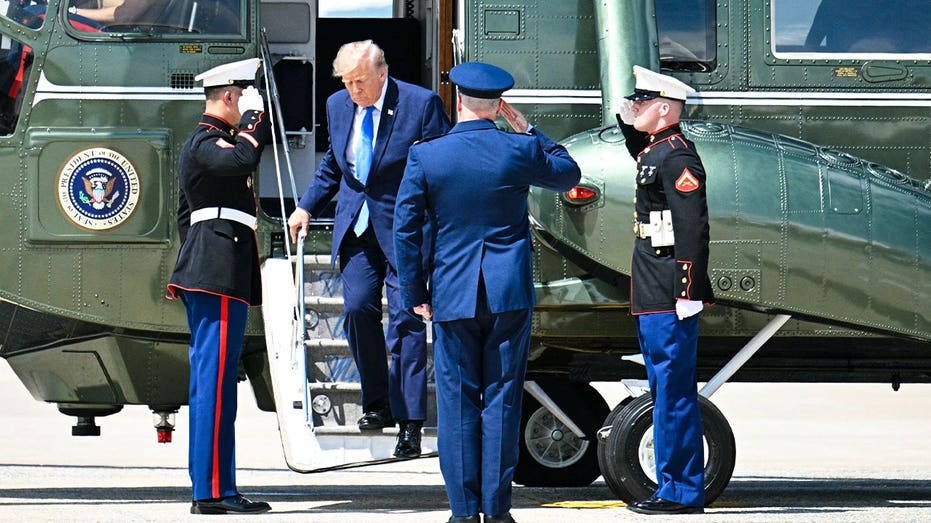
The Federal Aviation Administration is reviewing a potential safety protocol violation involving Marine One and a commercial aircraft near Ronald Reagan Washington National Airport. The incident occurred Tuesday, August 4, 2026, as President Donald Trump departed the White House by helicopter for a planned trip to Los Angeles. The FAA said the aircraft experienced a momentary loss of separation but moved away from one another, and officials said Trump was never in danger.
The review comes as federal officials examine aviation safety concerns involving aircraft spacing and runway operations. Investigators are expected to determine whether procedures were followed and whether corrective action is needed.
| 1) | Incident near Reagan National Airport |
| 2) | FAA preliminary safety assessment |
| 3) | White House response on presidential safety |
| 4) | Meaning of a loss of separation |
| 5) | Next steps in the investigation |
Incident near Reagan National Airport
The incident took place Tuesday as Marine One carried President Donald Trump from the White House area toward Joint Base Andrews in Maryland. Trump was scheduled to continue his journey to Los Angeles after transferring to Air Force One. At approximately the same time, a commercial aircraft departed Ronald Reagan Washington National Airport, creating the situation now under review.
The FAA has not publicly identified the commercial airline, flight crew or the precise location and altitude involved. The agency said air traffic control was communicating with both aircraft during the period when the required spacing was not maintained.
FAA preliminary safety assessment
The FAA said its preliminary review found a momentary loss of separation, followed by the aircraft continuing to move away from each other. The agency is examining whether a newly established safety protocol was violated and whether the event resulted from an air traffic control decision, flight path timing or another operational factor.
“Based on our preliminary safety review, there was momentary loss of separation, after which the aircraft continued to move away from one another.”
The FAA said it will continue reviewing the event and will apply appropriate corrective measures if its findings show that changes are required. The statement did not characterize the incident as a collision or near collision.
White House response on presidential safety
The White House said the president was not placed in danger. Kush Desai, a White House spokesman, emphasized the experience of the Marine One crews and said the helicopter’s pilots maintained the aircraft’s safety throughout the flight.
“Marine One flights are piloted by some of the best aviators in the world, and at no point was the president in harm’s way.”
The FAA also reiterated that assessment in its statement. The U.S. Secret Service directed questions about the event to the White House and the FAA, leaving the aviation agency responsible for the operational review.
Meaning of a loss of separation
A loss of separation occurs when aircraft do not maintain the minimum distance required under FAA rules. For aircraft flying at the same altitude within 40 miles of an Airport Surveillance Radar antenna, the applicable standard cited in the report is at least three miles of lateral separation.
Such an event does not necessarily mean that aircraft were on a collision course. It does mean that the required protective buffer was breached, prompting an investigation into what happened, how long the deviation lasted and whether controllers and pilots responded appropriately.
Next steps in the investigation
The FAA will review radar information, communications between air traffic control and the two flight crews, and the applicable operating procedures. Investigators will also assess whether the new safety protocol was followed and whether additional training, procedural changes or other corrective action is warranted.
The review is taking place amid broader concern about aviation safety. Transportation Secretary Sean Duffy has warned that FAA data shows more reported loss-of-separation events and runway incursions involving aircraft. The agency has not announced a deadline for completing its examination of the Marine One incident.
| Number | Key Point |
|---|---|
| 1 | The FAA is reviewing a possible violation of a new safety protocol. |
| 2 | Marine One and a commercial aircraft experienced a momentary loss of separation. |
| 3 | Officials said President Donald Trump was never in danger. |
| 4 | The FAA said air traffic control was in contact with both pilots. |
| 5 | The agency may impose corrective measures after completing its review. |
Summary
The FAA is investigating whether a new safety protocol was breached when Marine One and a departing commercial aircraft briefly failed to maintain required separation near Reagan National Airport. Although the event triggered a formal review, the FAA and White House said the aircraft moved apart and President Donald Trump was not endangered. Further findings will determine whether operational or training changes are necessary.
Frequently Asked Questions
What happened near Reagan National Airport?
A commercial aircraft departed as Marine One, carrying President Donald Trump, was leaving the Washington area. The FAA said the aircraft briefly did not maintain the required separation distance.
Was President Donald Trump in danger?
The White House and FAA said Trump was never in danger. They said the aircraft continued moving away from each other and that controllers were communicating with both pilots.
What does loss of separation mean?
It means aircraft have breached the minimum spacing required by aviation regulations. Within 40 miles of an Airport Surveillance Radar antenna, aircraft at the same altitude must generally remain at least three miles apart under the standard cited in the report.
What will the FAA do next?
The FAA will continue examining radar data, communications and procedures before deciding whether corrective action, including operational or training changes, is needed.