
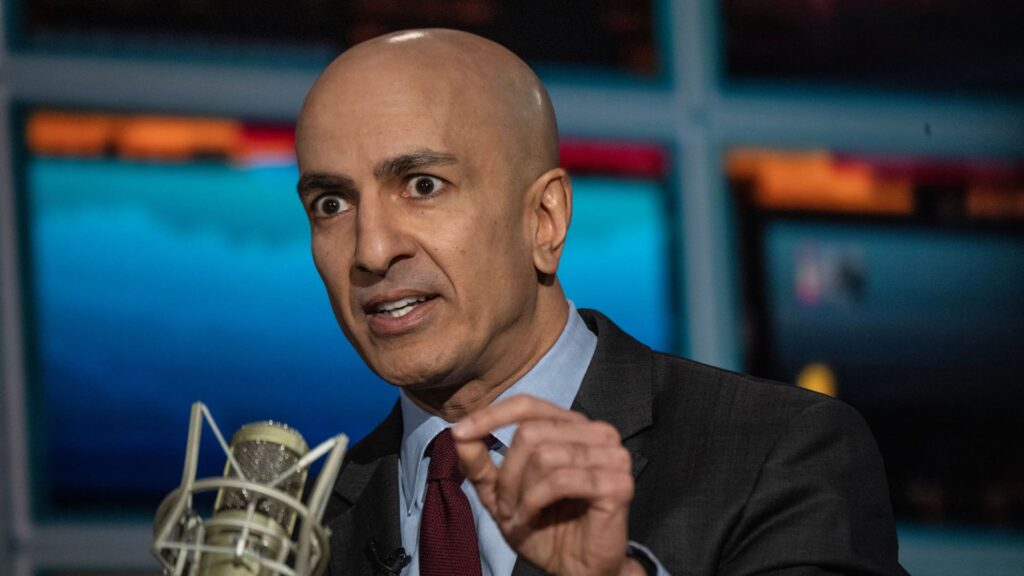
Minneapolis Federal Reserve President Neel Kashkari expressed concerns on Wednesday regarding ongoing inflation, despite recent data showing lower-than-expected price growth. Speaking in an exclusive interview, Kashkari underscored that inflation remains a significant issue, emphasizing that the core personal consumption expenditures price index (the Fed’s preferred inflation gauge) registered a 3% annual increase. Additionally, he discussed the implications of the current economic climate, particularly in light of advancements in artificial intelligence and the recent monetary policies enacted by the Federal Reserve.
| Article Subheadings |
|---|
| 1) Inflation Remains a Concern |
| 2) The Role of the Federal Reserve |
| 3) Economic Resilience in Focus |
| 4) The Impact of AI on the Economy |
| 5) Future Outlook and Considerations |
Inflation Remains a Concern
In a recent interview, Federal Reserve President Neel Kashkari highlighted that inflation continues to be a pressing concern, despite recent economic data suggesting a cooling trend in price growth. The revelations follow the release of August’s core personal consumption expenditures price index, a key inflation measure used by the Federal Reserve. The data indicated that this core index had risen by 3% on an annual basis, lower than what many economists had forecast. Kashkari noted, “Inflation is still too high,” underscoring the persistent economic challenge that influences monetary policy decisions. Whether inflation metrics fall below expected thresholds, Kashkari indicated that his perspective regarding the inflation environment remains unchanged.
The Role of the Federal Reserve
As recent trends in inflation have developed, the Federal Reserve has attempted to address these issues through monetary policy adjustments. In early September, the central bank implemented its first interest rate hike in three years, a move that was deemed necessary to mitigate higher-than-preferred inflation rates. Kashkari suggested that while the labor market appears stable, it does not exhibit traits of exuberance. The labor market dynamics play a vital role in determining the effectiveness of the Federal Reserve’s monetary policies. The recent labor statistics might paint a resilient picture; however, Kashkari remains cautious about the long-term implications of inflation trends on employment and consumer spending.
Economic Resilience in Focus
Despite the inflationary pressures, Neel Kashkari emphasized the resilience of the U.S. economy in the face of recent challenges. The data points released on the same day of his interview illustrated robust consumer spending and a healthy expansion of gross domestic product (GDP). This resilience has led Kashkari to adjust his estimates for the neutral funds rate to 3.25%. He articulated that the neutral rate is temporarily high due to elevated demand for investment capital, particularly linked to the burgeoning artificial intelligence sector. Such evaluations underline the balancing act the Federal Reserve must perform; taking into consideration the evolving economic landscape influenced by innovative technologies while maintaining stability in price metrics.
The Impact of AI on the Economy
Artificial intelligence has emerged as a catalyst for potential economic transformation, and Kashkari recognizes its dual-edged nature. While he acknowledges the potential for AI to enhance productivity within the economy, he raises concerns about the sustainability and effectiveness of corporate investments in this sector. In his view, if the massive investments made in AI do not yield the expected productivity gains, it could lead to malinvestment, subsequently affecting the broader economic landscape. Kashkari stated, “If this ends up being massive investment that is not nearly as productivity enhancing as we assume, then this will have been malinvestment.” The implication of this perspective is immense, as it could lead to a recalibration of how resources are allocated within the economy during periods of monetary tightening.
Future Outlook and Considerations
Looking towards the future, Neel Kashkari noted the complexities surrounding interest rate adjustments and their impact on various economic sectors. While recent interest rate hikes may not significantly curb investment in AI and other fast-growing sectors, there exists an expectation that these changes in borrowing costs might stabilize other areas of the economy. The Federal Reserve’s dual mandate—to promote maximum employment and to maintain stable prices—remains in play as the central bank navigates through these multifaceted challenges. The overall concern about inflation, coupled with potential structural changes from technological investments, sets the stage for an intricate economic landscape that policymakers must address moving forward.
| No. | Key Points |
|---|---|
| 1 | Inflation persists at a rate of about 3%, prompting ongoing scrutiny from the Federal Reserve. |
| 2 | The Federal Reserve implemented its first interest rate hike in three years to combat rising inflation. |
| 3 | There is cautious optimism regarding the resilience of the U.S. economy, as reflected in consumer spending and GDP growth. |
| 4 | Advancements in artificial intelligence present potential economic productivity boosts but also risks of malinvestment. |
| 5 | Future economic outlook hinges on careful monitoring of inflation and potential impacts from technological sectors. |
Summary
The insights shared by Neel Kashkari emphasize the multifaceted challenges facing the U.S. economy, particularly regarding inflation and the implications of rapid advancements in technology. As the Federal Reserve navigates these issues through monetary policy adjustments and interest rate modifications, the importance of balance becomes clear. Policymakers must address inflationary pressures while fostering an environment conducive to targeted economic growth. The upcoming months will be critical in determining how well these challenges can be navigated as the economy continues to evolve.
Frequently Asked Questions
Question: What is the core personal consumption expenditures price index?
The core personal consumption expenditures price index is a measure of inflation that excludes volatile food and energy prices. It is the Federal Reserve’s preferred gauge for tracking price changes in the U.S. economy.
Question: How does inflation impact the economy?
Inflation affects purchasing power, consumer spending, and overall economic stability. High inflation can erode savings, increase costs for businesses, and lead to adjustments in interest rates by central banks to maintain price stability.
Question: What role does artificial intelligence play in the economy?
Artificial intelligence is increasingly seen as a transformative force in the economy, with the potential to enhance productivity and drive innovation. However, it also raises concerns about investment efficacy and the risk of misallocation of resources.