
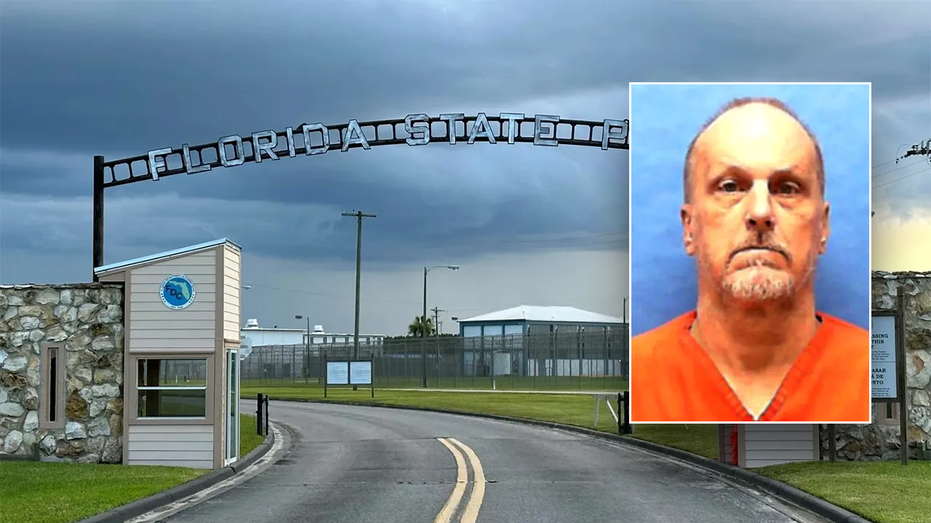
Florida executed James Robertson, 63, on Tuesday after he admitted killing his sleeping cellmate in 2008 to obtain a death sentence. Robertson received a three-drug injection at Florida State Prison and was pronounced dead about 10 minutes later. He declined to deliver a formal final statement. The execution took place as Florida continues an accelerated pace of capital punishment.
| Article Subheadings | |
|---|---|
| 1) | Execution at Florida State Prison |
| 2) | Motive and murder of his cellmate |
| 3) | The victim’s family remembers the loss |
| 4) | Florida’s lethal injection protocol |
| 5) | Florida’s broader execution schedule |
Execution at Florida State Prison
James Robertson was put to death on Tuesday, October 13, 2026, at Florida State Prison. State officials said he received a three-drug injection and was pronounced dead approximately 10 minutes after the lethal injection began. The procedure followed his guilty plea to first-degree murder and his decision to waive appeals.
When asked whether he had any final words, Robertson replied, “Nah, I’m straight,” and did not provide a longer statement. His execution proceeded after Florida officials defended the state’s procedures, contrasting them with a failed Tennessee execution two weeks earlier involving Christa Pike.
Motive and murder of his cellmate
Robertson strangled his cellmate, Frank Hart, while Hart was sleeping in 2008. Robertson told investigators that he committed the killing specifically because he wanted a death sentence rather than spending the rest of his life in prison. He subsequently pleaded guilty to first-degree murder and waived further appeals.
Robertson had entered prison at age 17 in 1980 after burglary and assault convictions. Later convictions for escape, battery and weapons offenses extended his incarceration. Hart had been imprisoned since 2003 after a sexual battery conviction and was eight days from his expected release when he was killed.
The victim’s family remembers the loss
Rebecca Hart, the victim’s daughter, spoke outside the prison after the execution. She emphasized that her father should be remembered as a person rather than only as part of Robertson’s criminal history. Her remarks focused on the continuing impact of the killing on relatives and loved ones.
“When someone you love is taken from you in such a violent way, the world keeps moving, even when a part of yours feels like it has stopped. Other people go on with their lives, but you carry your loss into every tomorrow.”
Her comments underscored the enduring consequences for the victim’s family, even after the state carried out Robertson’s sentence years after the murder.
Florida’s lethal injection protocol
Florida’s Department of Corrections uses a three-drug sequence for executions: a sedative, a paralytic and a drug intended to stop the heart. Before Robertson’s execution, department spokesperson Jordan Kirkland said Florida had a sound lethal injection process and protocol.
Kirkland said the state could not comment on Tennessee’s procedures but would ensure that Florida’s execution was humane and dignified. The assurances came after Pike survived two doses of pentobarbital during a Tennessee execution attempt, was hospitalized and later returned to prison.
Florida’s broader execution schedule
Florida had initially scheduled two executions for Tuesday, but Gov. Ron DeSantis withdrew the death warrant for William Lee Thompson, 74, the previous week. Thompson was sentenced to death for the 1976 kidnapping and killing of Sally Ivester, who was 23. He was also convicted of sexual battery in connection with the case.
The governor did not give a reason for withdrawing the warrant. He had temporarily stayed the execution while Thompson underwent a psychiatric evaluation amid concerns about competency and declining health. His attorneys have said he has dementia and sought a transfer to a medical facility. Thompson remains on death row, and another warrant could be issued.
Robertson was Florida’s 17th execution of 2026, with additional executions scheduled for William Reaves on October 20 and Jesse Guardado on November 5. Florida carried out 19 executions in 2025, a state record since the death penalty was reinstated in 1976. The state also conducted two executions on one day in July, the first such double execution in the country in nearly a decade.
| Number | Key Point |
|---|---|
| 1 | James Robertson was executed at Florida State Prison on October 13, 2026. |
| 2 | He killed Frank Hart in 2008 and said he wanted a death sentence. |
| 3 | Robertson declined to make a formal final statement. |
| 4 | Florida uses a three-drug lethal injection protocol. |
| 5 | The state has continued a high number of executions while scheduling additional cases. |
Summary
Florida executed James Robertson after he killed his cellmate and explicitly sought a death sentence. The case combines a long prison history, the continuing grief of the victim’s family and Florida’s expanding use of capital punishment. The execution proceeded without the complications reported in a recent Tennessee case.
Frequently Asked Questions
Why was James Robertson executed?
He was executed for strangling his cellmate, Frank Hart, in 2008. Robertson said he committed the killing to receive a death sentence.
Where did the execution take place?
The execution took place at Florida State Prison in Florida.
What method was used?
Florida used a three-drug lethal injection consisting of a sedative, a paralytic and a drug intended to stop the heart.
What happened to William Lee Thompson’s scheduled execution?
Gov. Ron DeSantis withdrew Thompson’s death warrant. Thompson remains on death row, and a future warrant remains possible.