
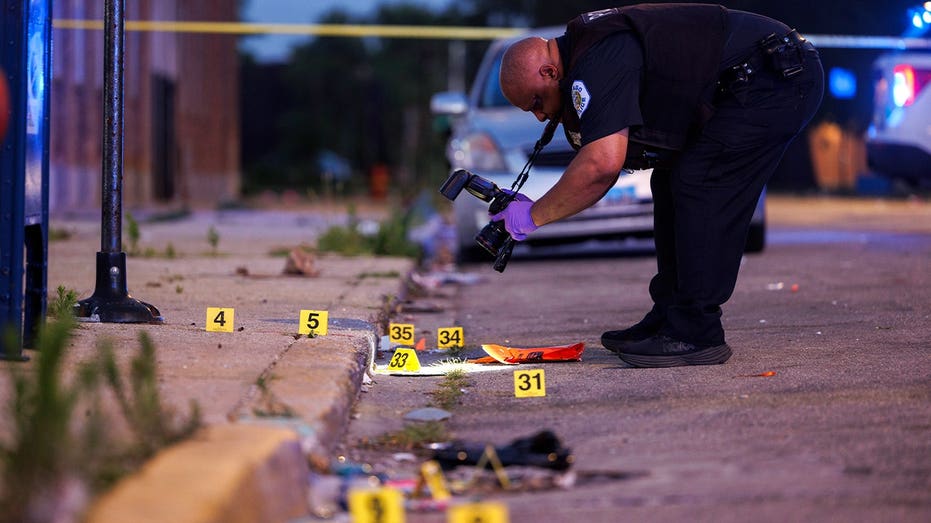
A former Chicago detective says Memphis could offer a model for addressing Chicago’s ongoing violence through closer cooperation among local, state and federal authorities. Memphis recorded a 43.7% decline in homicides during the first half of 2026 compared with the same period in 2025, following the arrival of National Guard members and federal law enforcement agencies. Chicago, meanwhile, is operating with about 2,500 fewer police officers than it had two or three years ago. Nine people were shot across the city on one Monday night, including three fatalities.
| 1) | Memphis reports a sharp homicide decline |
| 2) | Chicago faces a major police staffing shortage |
| 3) | Eugene Roy calls for broader government cooperation |
| 4) | Police visibility is presented as a deterrent |
| 5) | New York’s subway deployment offers another example |
Memphis reports a sharp homicide decline
Memphis recorded 67 homicides in the first six months of 2026, down from 119 during the same period in 2025, according to Major Cities Chiefs Association data. The decline followed an executive order signed by President Donald Trump in September 2025 that authorized a National Guard deployment. Troops arrived in the Tennessee city that fall, alongside federal law enforcement agencies.
Retired Chicago Police Chief of Detectives Eugene Roy identified Memphis as a potential success story because state and federal resources were used in coordination with local authorities. The comparison does not establish that the deployment alone caused the decline, but Roy said the outcome demonstrated the possible value of a coordinated public safety strategy.
Chicago faces a major police staffing shortage
Chicago experienced multiple shootings on one Monday night, with nine people shot across the city and three killed. In one incident, two men were critically injured after gunfire in the Near North Side neighborhood. The violence occurred as the Chicago Police Department operated with approximately 2,500 fewer officers than it had two or three years earlier.
The staffing gap was compounded by a November 2025 decision to pause police academy classes and slow hiring to about 50 recruits per month. The changes were reported as part of an effort to address a $1.2 billion city budget shortfall. Roy argued that the reduction limits the department’s ability to provide the street-level presence needed for prevention and response.
Eugene Roy calls for broader government cooperation
Roy said Chicago officials were not making sufficient use of federal resources while the city faced a shortage of officers. He described cooperation between Chicago and federal authorities on preventative street policing as limited and said local officials could look to Memphis for a different approach.
“Chicago has just 2,500 fewer police officers than it did just two or three years ago. You can’t keep doing more with less. It’s got to come down.”
Roy said a properly coordinated deployment in Chicago could mirror Memphis and other places where federal and local governments worked together. He also acknowledged that such an approach would depend on cooperation among city leaders, the state and federal agencies.
Police visibility is presented as a deterrent
Roy’s argument centers on the idea that a visible police presence can discourage offenses before they occur. He said potential offenders may reconsider robbery, burglary or other crimes when they believe officers are present in the area and likely to intervene.
“The mere presence of police serves as a disincentive to commit crime.”
He described a properly implemented operation as highly valuable, while emphasizing that the results would depend on how the resources were deployed. The proposal would therefore involve more than adding personnel. It would require agencies to coordinate responsibilities and focus officers on areas where prevention is needed.
New York’s subway deployment offers another example
Roy said the use of National Guard members to deter crime is not unprecedented under a Democratic governor. In March 2024, New York Gov. Kathy Hochul deployed at least 1,000 National Guard members to New York City’s subway system after a series of high-profile crimes.
Hochul said the deployment was intended to create a deterrent effect, including by increasing bag checks and the number of personnel in the transit system. Roy cited the action as an example of a state government using National Guard resources for public safety, while noting that Chicago would need its own cooperative plan involving city, state and federal authorities.
| No. 1 | Memphis homicides fell 43.7% in the first half of 2026. |
| No. 2 | Memphis recorded 67 homicides, compared with 119 a year earlier. |
| No. 3 | Chicago has about 2,500 fewer officers than it did two or three years ago. |
| No. 4 | Nine people were shot in Chicago on one Monday night, including three deaths. |
| No. 5 | A former detective says coordinated federal, state and local action could improve prevention. |
Summary
Memphis’s homicide decline has prompted a former Chicago law enforcement official to recommend closer intergovernmental cooperation as Chicago confronts staffing shortages and continuing shootings. The figures provide a basis for comparison, but they do not by themselves prove that National Guard deployments caused Memphis’s improvement. Any Chicago response would require clear coordination, defined responsibilities and consideration of local conditions.
Frequently Asked Questions
How much did Memphis homicides decline?
Homicides in Memphis fell 43.7% during the first half of 2026 compared with the same period in 2025, declining from 119 to 67.
Why is Chicago facing additional policing pressure?
The city has about 2,500 fewer police officers than it had two or three years ago, while academy classes were paused and hiring was slowed to about 50 recruits per month in late 2025.
What approach does Eugene Roy recommend?
Roy recommends a coordinated effort involving Chicago, Illinois and federal authorities, potentially including National Guard support, to increase police visibility and strengthen street-level crime prevention.