
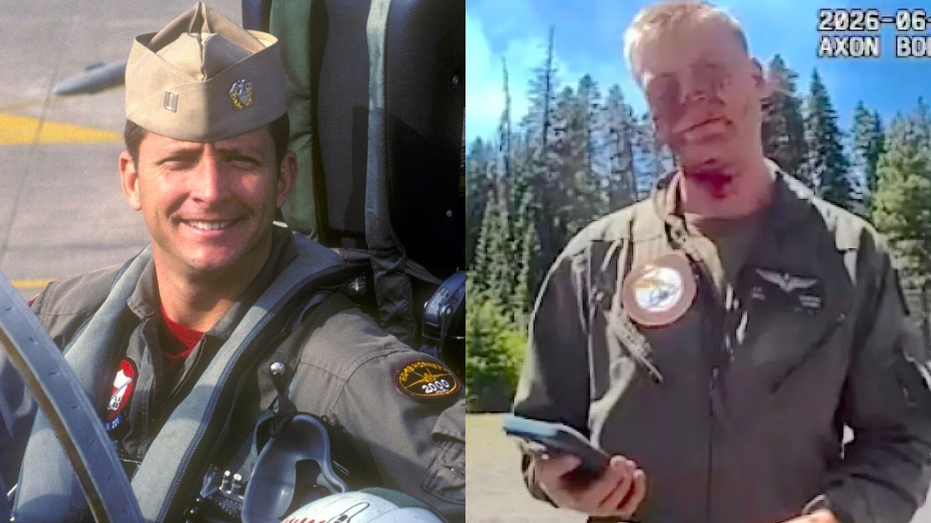
Matthew Buckley, a former TOPGUN pilot and retired Navy F-18 aviator, said a Marine pilot’s calm behavior after ejecting from a crashing fighter jet may have reflected shock, fading adrenaline and intensive training. Marine Corps Maj. Jackson Simon ejected from an F-18 Hornet on June 13, 2026, before the aircraft struck a wooded area near Rimrock Lake in Washington state. Bodycam footage showed Simon walking toward a Yakima County sheriff’s deputy with a bloodied face and appearing composed. Buckley said the ejection itself likely subjected Simon to severe physical forces and left little time for a controlled escape.
| 1) | Why the pilot appeared unusually calm |
|---|---|
| 2) | The physical violence of an ejection |
| 3) | How body position affects survival |
| 4) | What is known about the crash |
| 5) | The review that could determine Simon’s future |
Why the pilot appeared unusually calm
Simon emerged from the wooded crash area and approached a sheriff’s deputy after the F-18 started a small wildfire near Rimrock Lake. His statement, “I’m a little frazzled,” was a restrained description of an event that Buckley characterized as potentially the most violent experience of the Marine’s life. Simon also used the deputy’s cellphone to contact his superiors, saying, “Pilot ejected; pilot safe,” before casually identifying himself and explaining that he had crashed.
Buckley said this reaction could result from several overlapping factors. Fighter pilots are trained to focus narrowly on immediate tasks, while shock and the rapid decline of adrenaline can alter how a survivor appears and feels. The calm behavior therefore does not establish that Simon was unaffected. It may instead show how training and the body’s emergency response helped him function immediately after the ejection.
“If anything’s going wrong, we focus on the task. Everything else goes away,” Matthew Buckley said.
The physical violence of an ejection
Matthew Buckley flew Navy F-18 Hornets during a 15-year career from 1991 to 2006, although he never had to eject. He said ejection seats can expose pilots to approximately 10 to 20 Gs of force. The sudden acceleration can cause serious injuries, and some aviators do not return to flight status afterward.
Buckley said spinal compression can be severe enough to reduce a person’s height. He also noted that many pilots do not remember the full sequence, recalling only the moment they pulled the handle and then waking beneath a parachute. A review of more than a dozen studies involving 1,710 military aircrew ejections found a pooled mortality rate of 10.5%, while 29.8% sustained major injuries. The studies covered ejections recorded between 1971 and 2019.
“When you pull that handle, you have two choices: die or maybe live,” Matthew Buckley said, emphasizing the violence of the maneuver.
How body position affects survival
The pilot’s position before pulling the ejection handle can influence the injuries that follow. Buckley explained that arms should remain close to the body because the sudden airflow can violently pull an extended arm away from the shoulder. Pilots must also keep their legs flush with the seat to reduce the risk of serious lower-body injuries.
He described “seat slap” as a danger that can occur when the legs are not positioned correctly against the hard ejection seat. The impact may break both legs, creating potentially fatal bleeding. These risks help explain why ejection training emphasizes posture, restraint and completing the procedure correctly even when an aircraft is moving at high speed.
What is known about the crash
The crash occurred on June 13, 2026, during low-flying activity near spectators at Rimrock Lake in Yakima County, Washington. Video indicated that Simon’s aircraft was traveling rapidly when it entered the trees and exploded, leaving little apparent opportunity to slow the aircraft before ejecting.
Reports said the aircraft may have clipped power lines before going down, but the Marine Corps has not publicly confirmed that detail. The cause of the mishap remained under investigation. Buckley said a controlled ejection, performed after slowing the aircraft, can reduce the forces involved, but the circumstances shown in the crash video appeared to provide very limited time for such an option.
The review that could determine Simon’s future
Buckley said Simon will likely face a formal review of the actions surrounding the crash. Such a board can make recommendations about an aviator’s flight status after examining the available evidence, including the aircraft’s movements, the pilot’s decisions and the conditions before the ejection.
Possible outcomes could include losing flight certification or continuing to fly under increased scrutiny, depending on the findings. Buckley said determining what happened matters because the F-18 is a highly valuable military aircraft. The Marine Corps had not publicly announced a final cause or outcome at the time described in the report.
| Number | Key Point |
|---|---|
| 1 | Shock, training and fading adrenaline may explain Simon’s composed behavior. |
| 2 | Ejections can expose pilots to roughly 10 to 20 Gs and cause life-threatening injuries. |
| 3 | Correct arm and leg positioning can reduce the risk of severe injury. |
| 4 | The Marine Corps had not confirmed the reported power-line contact or completed its investigation. |
Summary
The incident illustrates the narrow margin between survival and fatal injury during a fighter-jet ejection. Simon’s controlled appearance after the crash may have reflected professional training and an acute physiological response rather than an absence of fear or injury. The final explanation for the crash, and any effect on his flight status, will depend on the Marine Corps review.
Frequently Asked Questions
When did the F-18 crash?
The crash occurred on June 13, 2026, near Rimrock Lake in Yakima County, Washington.
Why did the pilot appear calm?
Buckley said shock, fading adrenaline and training that encourages pilots to compartmentalize emergencies may have contributed to Simon’s calm behavior.
How forceful is an ejection?
Buckley estimated that an ejection can subject a pilot to approximately 10 to 20 Gs, with possible spinal, leg and other serious injuries.
Is the crash cause known?
No. The Marine Corps said the cause remained under investigation and had not publicly confirmed reports that the aircraft struck power lines.