
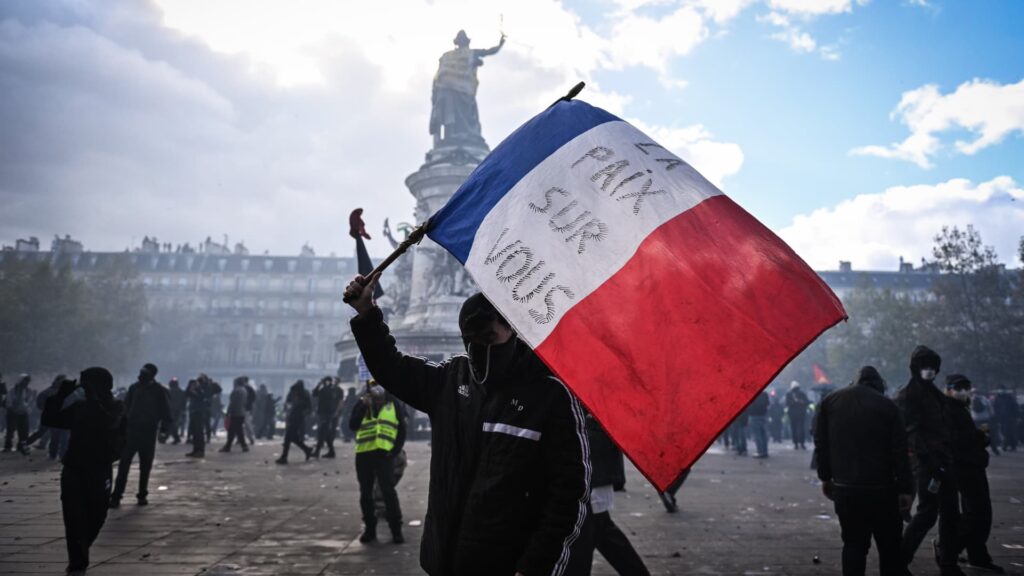
France is currently experiencing significant unrest that has raised concerns among investors regarding the country’s fiscal outlook. As borrowing costs surged to their highest levels since 2002, fears are mounting over the potential impact of ongoing demonstrations on growth, government efficiency, and planned budget savings. Despite the turmoil, credit rating agency Moody’s has maintained its Aa3 rating on France but has issued a negative outlook due to the increasing risk posed by political fragmentation.
| Article Subheadings |
|---|
| 1) Government’s Budget Goals Amid Unrest |
| 2) Economic Growth and Investor Sentiment Risks |
| 3) Sector Vulnerabilities in the Face of Protests |
| 4) Impact on French Luxury and Other Markets |
| 5) Future Path for France’s Economic Recovery |
Government’s Budget Goals Amid Unrest
The French government has set ambitious targets to reduce the budget deficit from a projected 5.4% of GDP in 2026 to 5% by 2027. This goal is amidst a heightened state of unrest, which has complicated governmental efforts. The National Assembly is scheduled to debate tax measures intended to foster savings on October 27. However, the plans face substantial opposition from lawmakers who resist these initiatives.
Officials indicate that austerity measures are crucial to achieving these targets; however, the fragmentation of the political landscape poses significant risks to the functionality of legislative processes. The government’s ability to navigate through opposition will determine its fiscal path. With considerable demonstrations in the horizon, there is uncertainty whether the debates will proceed smoothly in a politically charged environment.
According to Alain Durré, head of EMEA economic research at Natixis CIB, the government is determined to prevent rising borrowing costs from undermining its fiscal objectives, and it may seek legislative shortcuts to push through critical budget decisions. Using Article 49.3, which allows the government to enact a bill without a final vote, stands as a potential strategy, especially given the urgency placed on fiscal reforms by financial market pressures.
Economic Growth and Investor Sentiment Risks
The unrest has sparked great concern among investors regarding its potential impact on France’s economic recovery and growth outlook. Recent demonstrations planned for October 24, followed by a national strike on November 5, paint a picture of sustained disruption that could seriously hinder economic momentum. “
These events further darken an economic outlook that was already unfavorable
“, commented Charlotte de Montpellier, senior economist for France and Switzerland at ING.
Economic growth has already been sluggish, with forecasts for GDP growth being adjusted downwards due to ongoing civil disturbance and geopolitical uncertainties. Durré emphasizes that prolonged unrest raises two critical flags for the market: the risk of dragging down GDP growth further and the increasing probability that political challenges might stymie government plans for essential spending cuts. Failure to meet fiscal targets not only further exacerbates the deficit but potentially derails much-needed economic confidence.
Investor sentiment has been negatively impacted, leading to tactical reallocations in portfolios, causing a spike in yields on French government bonds. According to market analysts, traditional buy-and-hold investors have largely been sidelined, watching for clearer signs of stability before re-entering the market. Concerns raised in previous quarters have now resurfaced, with heightened anxiety regarding the capabilities of France’s institutions to execute reforms effectively in the face of escalating turmoil.
Sector Vulnerabilities in the Face of Protests
French sectors particularly exposed to economic disruption include retail, hospitality, tourism, and transportation. The CAC 40, which is indicative of the market’s health, has declined by 4.5% in the past month due to these continued pressures. Analysts have identified that businesses in retail and hospitality are already feeling the impact, as shops and services experience decreased foot traffic and sales losses.
Local businesses report drastic reductions in patronage, with many establishments unable to recover from losses incurred during protests. As noted by Charlotte de Montpellier, lower customer turnout places immense pressure on their revenue streams, leading to potential closures and layoffs. Additionally, service sectors reliant on tourism, like hotels and restaurants, are facing difficulties as both locals and tourists are discouraged from venturing out, further deterring economic activity.
The transportation industry, vital for the movement of goods and people, faces the threat of disruptions, signaling long-term repercussions for supply chains with rising costs passed down to consumers. Analysts project that if protests continue unabated, the cumulative impact across these crucial sectors could substantially constrain growth and deepen the recessionary pressures facing the economy.
Impact on French Luxury and Other Markets
France’s renowned luxury sector, which significantly contributes to the country’s economic fabric, has also come under pressure. Firms like LVMH operate predominantly with international sales, yet the protests still risk diminishing tourism, a crucial source of reverberating effects on tax-free purchases, which make up approximately 20% of their revenue. The unrest draws attention to a larger issue: while the domestic market accounts for a small portion of luxury goods sales, the fallout from disruptions strikes at the core of overall consumer confidence.
According to Kevin Thozet, highlighted factors such as rising energy costs compounded by political unrest create severe headwinds for consumer sentiment. The grounding of daily activities disrupts spending patterns, profoundly affecting revenue for businesses within this high-stakes sector. Additionally, prolonged uncertainty could deter international visitors, vital for retailers and artisans alike.
Amidst the protests, Carrefour experienced a sharp decline in shares—over 14%—after reducing its profit outlook due to anticipated impacts from the protests. This indicates how far-reaching the concern runs beyond solely the financial sector, highlighting the necessity for corporate vigilance as unrest redefines client engagement strategies.
Future Path for France’s Economic Recovery
Looking ahead, the difficulty of the French government will significantly hinge on its ability to restore investor confidence and stabilize the economic environment. Analysts warn that any failure to manage the ongoing unrest efficiently could push back recovery timelines, making the path to fiscal health exceedingly rocky. The potential waiting period for political stability raises concerns for market players, who worry that the longer France endures instability, the harder it may be for reforms to gain traction.
Achieving fiscal targets will demand robust negotiations and cooperation among factions within the government, presenting a complex dilemma as opposing parties may resist compromise. A coalition approach, or dependency on emergency measures such as invoking Article 49.3, appears necessary to ensure that the government can maintain its credibility in fiscal management.
In summary, the future of France’s economic recovery will depend on how skillfully the government can navigate through political strife while ensuring citizen engagement and addressing the unrest head-on. Stakeholders must monitor these developments closely to gauge viable pathways towards economic revitalization amidst the challenges posed by civil disturbance.
| No. | Key Points |
|---|---|
| 1 | France’s borrowing costs have surged to their highest since 2002, raising investor concerns. |
| 2 | The government aims to cut the budget deficit from 5.4% of GDP to 5% by 2027 amidst ongoing unrest. |
| 3 | Protests are threatening economic growth and investor sentiment, with anticipations of slowing down GDP growth. |
| 4 | Retail, hospitality, and transportation sectors are heavily impacted by ongoing civil action in France. |
| 5 | The luxury sector faces pressure as protests deter tourism and negatively influence revenue structures. |
Summary
As France grapples with civil unrest that affects its fiscal landscape, the complexity of the situation emphasizes the precarious balance between maintaining socioeconomic stability and implementing necessary reforms. The government’s ambitious measures to lower the budget deficit amidst increasing borrowing costs, combined with growing investor wariness, create an urgent need for effective steering of political dynamics. The road toward recovery will be fraught with challenges, with a pressing demand for coherent governance in navigating this tumultuous period.
Frequently Asked Questions
Question: What are the main causes of the current unrest in France?
The unrest has been fueled by multiple factors, including dissatisfaction with government fiscal policies, social inequalities, and increased costs of living, which have prompted widespread protests.
Question: How has the unrest affected France’s economic outlook?
The ongoing protests have created significant uncertainty, impacting consumer confidence and leading analysts to downgrade economic growth forecasts for the coming years.
Question: What measures is the French government considering to address the budget deficit?
The government is considering invoking Article 49.3 to push through key budgetary measures without a final vote and is also exploring executive ordinances to enforce necessary fiscal reforms.