
French authorities have reported a significant escalation in protest violence, leading to the arrest of a record 855 individuals during demonstrations held nationwide on Saturday. These protests were largely fueled by public anger over rising living costs and were part of a resurgence of the “yellow vest” movement, which had originally emerged in 2018. In cities such as Paris, Lyon, and Marseille, clashes erupted between law enforcement and protesters, resulting in multiple injuries and widespread property damage.
| Article Subheadings |
|---|
| 1) Escalation of Protest Violence |
| 2) Nationwide Call to Action |
| 3) Violence Climaxing in Major Cities |
| 4) Background of Protests and Public Sentiment |
| 5) Ongoing Concerns and Future Implications |
Escalation of Protest Violence
On Saturday, French police detained 855 individuals, marking a dramatic increase in protest-related arrests across the nation. The Interior Minister’s office indicated that there has been “a growing number of violent incidents,” involving clashes with law enforcement, looting, and damage to public property. In the Paris region alone, police utilized tear gas and water cannons to manage unruly crowds, particularly in the Place de la République, where protesters armed with fireworks and stones engaged in violent confrontations.
The scenes in Paris were severe, with reports of cars being set ablaze, shops looted, and widespread property damage. Authorities described the protests as a response to heightened public grievances, underlined by frustrations over escalating costs of living. The protests, seen as echoes of the previous yellow vest movement, are indicative of the deep-seated discontent among many citizens regarding government policies and economic conditions.
Nationwide Call to Action
The protests on Saturday were galvanized through social media calls that urged participation from individuals across the socio-economic spectrum. Many protesters donned the fluorescent yellow vests, traditional symbols of the movement that began in 2018. The spontaneous participation indicates a collective sentiment against perceived governmental indifference to the public’s struggles, particularly those pertaining to rising fuel and food prices.
Interior Minister Laurent Nuñez highlighted that the violence, including numerous assaults on police officers, represented a serious escalation of tensions in the public domain. The demonstrations were bolstered by both grassroots movements and established labor unions, with the CGT, one of France’s significant labor organizations, rallying support for demands such as higher wages, lower prices, and greater investment in public services.
Violence Climaxing in Major Cities
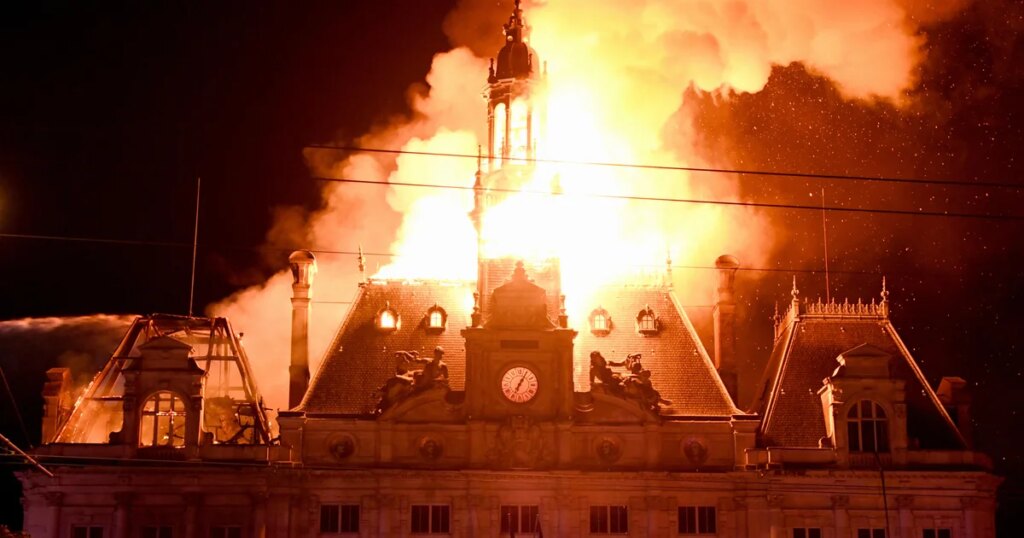
Violent outbreaks were not confined to Paris alone. Cities such as Lyon and Marseille experienced significant unrest, with localized protests leading to severe property damage and clashes with police. Lyon witnessed around 20,000 participants where a fire erupted inside a tourist office, while in Limoges, masked protesters deliberately set fire to the historic town hall, causing devastating structural damage.
In Marseille, confrontations escalated to the point where municipal buildings were damaged, and protesters briefly took control of City Hall. The mayor described the damages as “limited,” but emphasized that such actions were unacceptable. Incidents of violence, including masked groups clashing with law enforcement, were reported in numerous other cities including Rennes, Toulouse, Montpellier, and Grenoble, indicating a widespread and coordinated protest movement across France.
Background of Protests and Public Sentiment
The current wave of protests follows prolonged discontent among French citizens, particularly students who began their demonstrations back in mid-September, often through school blockades. The recent rallies reflect not just economic frustrations but also signify a cumulative estrangement felt by many towards the government. Public sentiment has steadily shifted towards anger and frustration in recent months as inflation rates have surged, impacting essentials such as fuel, food, and energy.
The participation of prominent political figures like far-left presidential candidate Jean-Luc Mélenchon during these protests highlights the intensifying political ramifications of these social movements, as younger generations express their dismay over the perceived injustices in societal structures. Many protesters voiced concerns about policies that seem to favor the wealthier segments of society, which exacerbate the struggles of ordinary citizens.
Ongoing Concerns and Future Implications
The protests are now garnering international attention, as witnesses reported gruesome injuries among demonstrators, particularly among youth, stemming from police response measures. Prompted by these injuries, Minister Nuñez announced the suspension of specific crowd-control measures, including a stun grenade that had severely injured a youthful protester. This development may signal an acknowledgment from authorities regarding the need to balance law enforcement practices with demonstrator safety.
As the protests continue to unfold, the implications for the French government could be substantial. With calls for governmental reforms echoing through the crowds, officials must confront the growing discontent, which if left unaddressed, could spiral into further unrest and influence future electoral outcomes, especially in the lead-up to upcoming presidential elections. The return of the yellow vest movement into the public consciousness underscores the persistent volatility of public sentiment towards issues of social justice and economic inequality.
| No. | Key Points |
|---|---|
| 1 | French police detained a record 855 people amid escalating protests against rising living costs. |
| 2 | Protests were heavily influenced by the yellow vest movement, igniting frustrations over economic inequality. |
| 3 | Major cities like Paris, Lyon, and Marseille witnessed severe clashes, property damage, and looting. |
| 4 | Student protests and labor unions played pivotal roles in mobilizing demonstrators nationwide. |
| 5 | Political implications of the protests could influence future electoral campaigns, reflecting widespread public discontent. |
Summary
The rising tide of protests across France, marked by a significant increase in violence and public unrest, highlights the deep-rooted frustrations within society over economic disparities and governance. As authorities grapple with the implications of these nationwide demonstrations, the situation remains fluid, reflecting both ongoing grievances and the potential for substantial political shifts in the near future. This eruption of public outcry calls for attention not just to immediate economic concerns but also to the broader issues of social justice and representation within the government.
Frequently Asked Questions
Question: What caused the recent protests in France?
The protests were largely driven by public anger over rising living costs, including fuel and food prices, compounded by dissatisfaction with government policies that many feel neglect lower-income citizens.
Question: How did the authorities respond to the protests?
Authorities deployed tear gas and water cannons to disperse violent crowds and detained a record number of individuals amid widespread clashes between protesters and law enforcement.
Question: What is the significance of the yellow vest movement?
The yellow vest movement symbolizes public discontent with economic inequality and social injustice, emerging in 2018 and resurfacing in response to ongoing economic challenges faced by many citizens in France.