
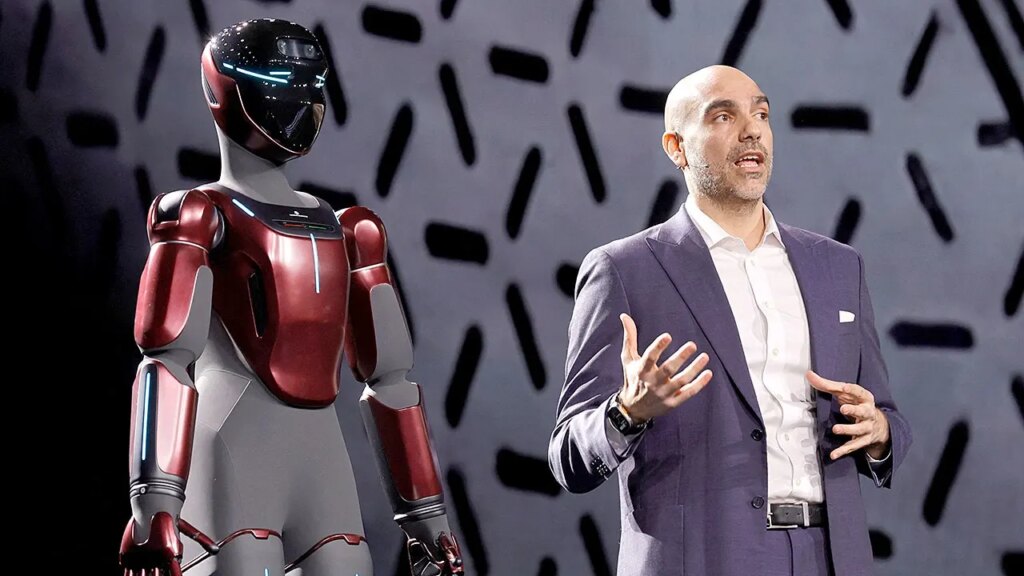
An innovative leap in robotics has emerged from Italian startup Generative Bionics, which recently introduced its Gene.01 humanoid robot. This state-of-the-art machine integrates a unique sensor-filled skin designed to detect nearby individuals, thereby enhancing safety when operating in human environments. By utilizing this advanced technology, the robot aims to minimize the risks associated with human-robot interactions, especially in industrial settings.
| Article Subheadings |
|---|
| 1) Advanced Sensor Technology Behind Gene.01 |
| 2) Implications of Proximity Sensing in the Workplace |
| 3) Revolutionary Training Techniques for Humanoid Robots |
| 4) Developments in Physical AI and its Applications |
| 5) Future Outlook and Partnership Strategies |
Advanced Sensor Technology Behind Gene.01
The Gene.01 robot features sophisticated technology that includes numerous sensors embedded within a flexible, skin-like surface. These sensors enable the robot to detect touch, temperature, proximity, and force, effectively giving it a multi-layered perception of its environment. This design promotes a proactive approach, as the robot can recognize a human’s presence before physical contact occurs, ensuring that it can react swiftly to avoid potential injuries.
When humans near the robot, the proximity sensors provide early warnings allowing the machine to adjust its movements accordingly. This functionality is crucial in environments where heavy machinery operates, and human interaction is unavoidable. Unlike traditional robotic systems that rely heavily on barriers to maintain safety, Gene.01 is designed to operate seamlessly within human-dominated spaces. This shift reflects a growing demand for robots to collaborate safely with people rather than isolate them.
Implications of Proximity Sensing in the Workplace
Integrating proximity sensing technology has significant implications for workplace safety and efficiency. In traditional settings, humanoid robots have typically operated behind protective barriers, limiting their productivity and application. The Gene.01’s design allows it to work alongside human employees, which raises the need for enhanced safety measures. With its proximity sensing capabilities, the robot can navigate zones commonly shared with workers, ensuring minimal risk of collisions.
Proximity sensors enhance the robot’s situational awareness, something visual sensors alone cannot achieve. Cameras may fail to identify someone approaching too closely or obstructions blocking their view. The incorporation of touch, heat, and force sensors helps the robot monitor its immediate environment more accurately, mitigating risks associated with blind spots commonly found in traditional robotic systems. This advancement is crucial for ensuring worker safety in dynamic human-robot interactions.
Revolutionary Training Techniques for Humanoid Robots
The training process of Gene.01 introduces an innovative method that enables workers to physically guide the robot during task demonstrations. This hands-on approach allows the robot to ‘learn’ tasks more intuitively by engaging in direct interaction, as opposed to relying solely on video tutorials. When a worker gently maneuvers the robot’s arm, the system not only records the movement trajectory but also perceives the appropriate amount of force required for each action.
This process addresses a common challenge in robotic training—the subtleties of force application. While a video might show where to place an object, it cannot convey how tightly the robot should grip it. By understanding the physical sensations tied to a specific task, the robot’s training becomes more nuanced and effective. This technique particularly benefits workers who may not have advanced programming skills but possess in-depth knowledge of their job’s practical aspects.
Developments in Physical AI and its Applications
Generative Bionics employs a methodology termed Physical AI in the development of Gene.01. This methodology advocates for an integrated design where the robot’s physical structure and movement controls are developed simultaneously. Rather than treating hardware and software as separate entities, the design emphasizes their interconnection right from the start, enabling a more adaptable and responsive machine.
This interconnectedness provides several advantages, particularly in enhancing the robot’s efficiency. By incorporating human-centric measurements during design—a significant evolution from traditional development practices—engineers can ensure that usability takes precedence over mere mechanical functionality. For instance, optimizing a robot’s walking stability with an understanding of human strain not only improves performance but also increases the user’s confidence in safety measures.
Future Outlook and Partnership Strategies
Generative Bionics is keen on positioning Gene.01 as a versatile platform that can adapt to specific industrial requirements. The company envisions that its humanoid robot could serve multiple sectors, including manufacturing, healthcare, and logistics. To that end, the flexibility of its design allows for modifications based on the unique demands of various tasks—ranging from welding in shipyards to assembly in factories.
In collaboration with Italian shipbuilding company Fincantieri, Generative Bionics has begun exploring its initial industrial application involving welding operations. The partnership aims to assess Gene.01’s capabilities in challenging work conditions that typically demand human intervention. While performance data remains pending, this collaboration marks a significant step towards demonstrating the practical utility of humanoid robots in real-world applications.
| No. | Key Points |
|---|---|
| 1 | Gene.01 utilizes sensor-filled skin to detect nearby individuals, reducing collision risks. |
| 2 | Proximity sensing allows the robot to operate safely alongside human workers, increasing productivity. |
| 3 | Workers can physically guide the robot during training, enhancing its learning process. |
| 4 | The approach of Physical AI integrates hardware and software design for improved functionality. |
| 5 | Partnerships like that with Fincantieri aim to demonstrate practical applications in industrial environments. |
Summary
The introduction of the Gene.01 humanoid robot represents a transformative moment in the landscape of workplace robotics. With its advanced sensor technologies and proximity awareness, this machine is tailored to function optimally in human-dominated environments. As Generative Bionics continues to advance its capabilities and explore practical industrial applications, the potential for enhanced safety and productivity in various sectors becomes increasingly promising.
Frequently Asked Questions
Question: What features distinguish the Gene.01 humanoid robot from previous models?
The Gene.01 robot distinguishes itself through its sensor-filled skin, which enables it to detect touch, temperature, proximity, and force—allowing for safer interactions with humans.
Question: How does the training process work for the Gene.01?
Workers can physically guide Gene.01’s movements during training, which helps the robot learn the nuances of force and movement better than video tutorials alone can provide.
Question: What industries could benefit from the Gene.01 humanoid robot?
Gene.01 is designed for versatility and could find applications in manufacturing, logistics, healthcare, and even shipbuilding, depending on specific modifications and tasks required.