
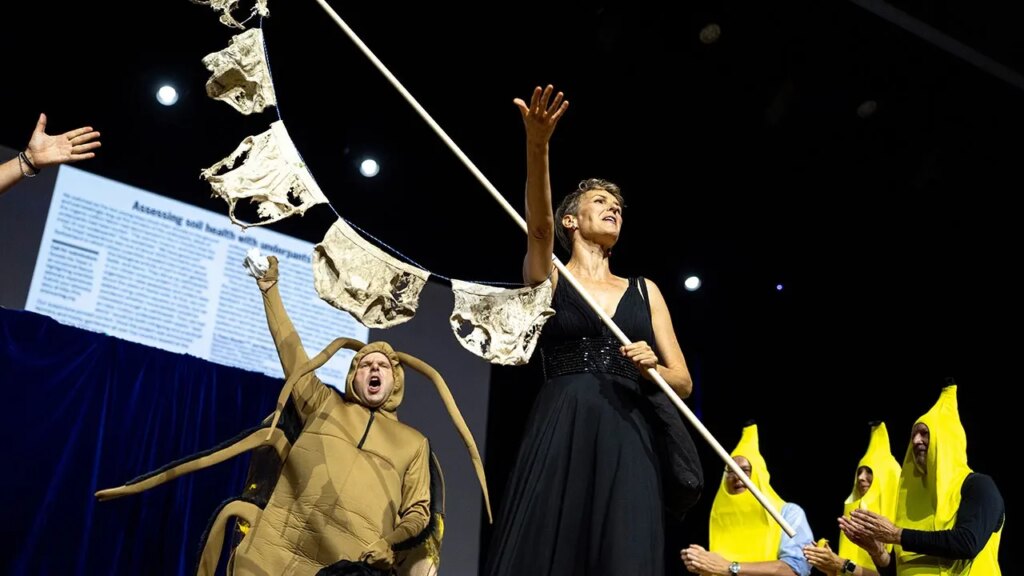
The Ig Nobel Prize ceremony, known for celebrating quirky and unconventional research, took place in Zurich, Switzerland, this week. The awards recognized studies that included exploring the evolutionary history of kissing and investigating soil health through the use of underwear. This year’s event was especially notable as it marked the first time the ceremony was held outside the U.S., drawing attention from an international audience and showcasing the lighter side of scientific inquiry.
| Article Subheadings |
|---|
| 1) Overview of the Ig Nobel Prize Ceremony |
| 2) Unusual Research Studies Celebrated |
| 3) Impact of Wealth on Moral Behavior |
| 4) Unique Trophies and Audience Participation |
| 5) Conclusion and Future Implications |
Overview of the Ig Nobel Prize Ceremony
This year’s Ig Nobel Prize ceremony was held on September 21, 2023, at the Zurich Convention Center, making it a historic occasion due to its relocation outside the United States for the first time. Founded in 1991 by the Annals of Improbable Research, the Ig Nobel Prizes are awarded to researchers whose work is humorous yet thought-provoking, bringing attention to the lighter side of scientific inquiry. The objective behind the event is to encourage public interest in science and encourage research that ignites cheer and amusement.
The decision to hold the ceremony in Zurich stemmed from concerns regarding visa complications that could prevent honorees from entering the U.S. As a result, the International community actively participated, enhancing the diversity of awards presented this year. The event attracted attention from across the globe, and the ceremony has a reputation for spotlighting research that might otherwise go unnoticed, bridging the gap between academia and the public through humor and creativity.
Unusual Research Studies Celebrated
The 2023 ceremony recognized a range of peculiar yet real studies. Among the notable winners was a group of researchers who investigated the quality of soil health by utilizing underwear, a study that humorously highlights the innovative means of assessing environmental conditions. Other winners included scientists who examined various social behaviors, such as the tendency of upper-class individuals to engage in unethical behavior, illustrated by instances of metaphorically “taking candy from a baby.” This investigation underscores a wider societal critique regarding the relationship between wealth, privilege, and ethical decision-making.
Another intriguing research study focused on the evolutionary history of kissing, where a team from the University of Oxford defined kissing as a “non-agonistic interaction” between individuals. This definition not only adds a layer of scientific rigor to what many consider a social act but also places it within a historical context, claiming it resonates with a 21.5 million-year-old tradition, further emphasizing the role of cultural practices in evolutionary biology.
The studies recognized during the Ig Nobel ceremony are not just trivial; they provoke thought and discussion surrounding scientific and social issues. The researchers’ insights shed light on the bizarre and sometimes humorous aspects of human behavior, making these topics relatable to a broader audience who may not typically engage with academic research.
Impact of Wealth on Moral Behavior
One significant takeaway from the ceremony was the revelation that wealth can distort moral behavior. Dr. Paul Piff, a social psychologist from the University of California, Irvine, discussed findings suggesting that increased social status often leads to decreased empathy for others. According to Piff, “The general pattern seems to be that, with wealth and rising power, you become less engaged with the needs of others and less burdened by the needs of social relationships.” This phenomenon highlights a critical societal challenge: the growing divide between the privileged and the less fortunate.
Research findings such as these have crucial implications beyond the comedic lens of the Ig Nobel Prizes. They encourage a discussion about the ethical responsibilities of individuals in positions of power. The study exploring the act of taking candy from a baby serves as a metaphor for such behaviors, emphasizing the need for awareness and intervention as our society grapples with the effects of wealth inequality on social dynamics.
Unique Trophies and Audience Participation
As part of the tradition, recipients of the Ig Nobel Prize are awarded trophies that are quirky in design, resembling a combination of a mushroom and a human foot. This presentation style adds to the light-heartedness of the event, making it a festive occasion characterized by laughter and camaraderie among attendees. Furthermore, audience participation remains a hallmark of the Ig Nobel ceremony, where attendees throw paper airplanes at the honorees as they accept their awards, creating an atmosphere of playful celebration that distinguishes the event from more traditional award ceremonies.
The participatory approach effectively engages the audience, allowing them to share in the humor and joy that the event embodies. It transforms an awards ceremony into a unique experience, celebrated for its eccentricities while still promoting scientific curiosity and creativity.
Conclusion and Future Implications
The Ig Nobel Prize ceremony represents more than just a showcase for humorous studies; it serves as a vital platform for discussing significant societal issues through a comedic lens. By highlighting unconventional research, the ceremony encourages individuals and communities to reflect on the peculiarities of human behavior and the complexities of modern life.
As more attention is drawn to studies that challenge conventional thinking, it becomes imperative for scientists, policymakers, and the public to consider the implications of such research. The 2023 ceremony serves as a reminder of the importance of creativity and curiosity in academia, urging society to embrace humor while contemplating the deeper meanings behind everyday phenomena.
| No. | Key Points |
|---|---|
| 1 | The Ig Nobel Prize celebrated unconventional research on September 21, 2023, in Zurich, marking its global expansion. |
| 2 | Studies recognized included those on soil health with underwear and the ethical behaviors of the wealthy. |
| 3 | Research highlights a disconnect between wealth and empathy, raising ethical concerns about social responsibility. |
| 4 | Unique trophies and playful audience engagement characterized the ceremony, fostering a festive atmosphere. |
| 5 | The event emphasizes the need for society to approach scientific inquiry with creativity and humor. |
Summary
The Ig Nobel Prize ceremony serves as a unique celebration of the bizarre and humorous aspects of scientific research, promoting public interest in a variety of topics while also encouraging serious discussions about ethical behavior and societal norms. As it continues to evolve and reach a wider audience, the event has the potential to influence how society perceives academic research, fostering an environment where creativity and humor can coexist with serious scientific inquiry.
Frequently Asked Questions
Question: What is the Ig Nobel Prize?
The Ig Nobel Prize is an annual award recognizing unusual and humorously creative research that often provokes thoughtful discussion in the scientific community and beyond.
Question: Why was the ceremony held in Zurich this year?
The ceremony was moved outside of the United States due to concerns about visa issues that could prevent honorees from attending if held in the U.S.
Question: How are the winners selected?
Winners are chosen based on unique and lighthearted studies that contribute to societal understanding or spark curiosity, evaluated by a committee of scientists and humorists.