
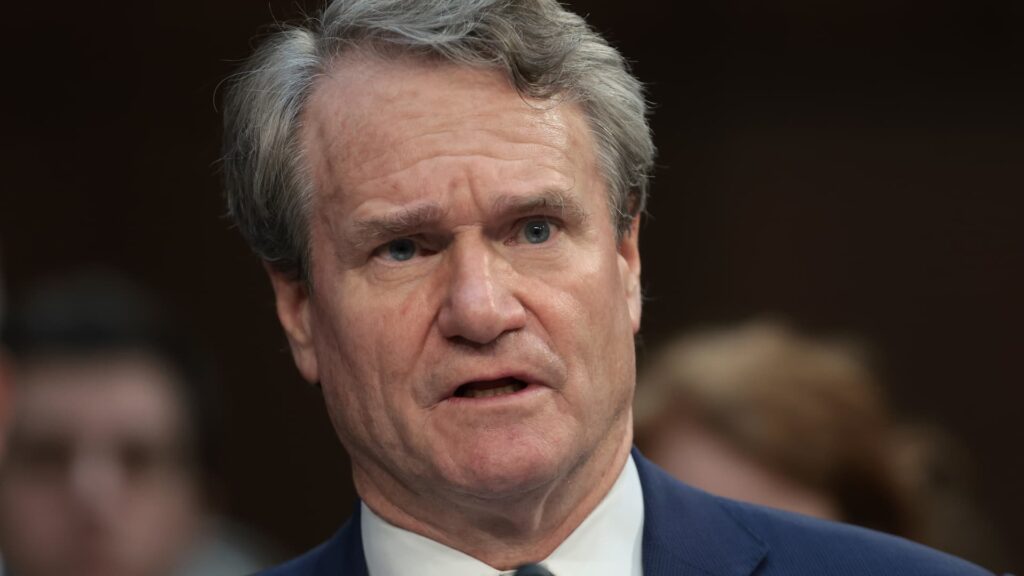
Bank of America is poised for a more muted financial environment following a significant surge in its investment banking and trading sectors earlier this year. CEO Brian Moynihan addressed analysts at a recent conference, forecasting a drop in investment banking fees and flat trading revenue for the upcoming quarter. This cautious outlook has prompted concerns about the sustainability of Wall Street’s recent AI-driven boom, with many stakeholders closely monitoring industry trends as indicators of broader economic shifts.
| Article Subheadings |
|---|
| 1) Bank of America’s Forecast for Investment Banking |
| 2) Impact of AI on Trading and Advisory Services |
| 3) Comparison with Competitors: Citigroup’s Performance |
| 4) Market Reactions and Implications for Investors |
| 5) Future Outlook for Wall Street’s Financial Landscape |
Bank of America’s Forecast for Investment Banking
During a recent conference call, Bank of America’s CEO, Brian Moynihan, shared insights into the company’s financial expectations for the upcoming quarter. He indicated that investment banking fees are likely to tumble more than 10% compared to the third quarter of the previous year. This shift follows a remarkable second quarter where the bank experienced a 50% surge in investment banking fees, underscoring a potentially stabilizing shift in market conditions.
The significant drop projected for investment banking raises questions about the broader economic environment. In particular, Moynihan pointedly noted that the overall market for investment banking is down 10%, a trend that he attributes in part to Bank of America’s positioning within more active sectors. As the second-largest bank in the United States by assets, any fluctuation in its revenue could serve as a bellwether for other financial institutions.
Impact of AI on Trading and Advisory Services
The rise of artificial intelligence (AI) has dramatically reshaped the landscape of trading and advisory services in recent years. Companies have increasingly leveraged AI technologies to enhance trading strategies and offer sophisticated advisors for high-net-worth clients. However, Moynihan’s cautious statements suggest that the bloom may be off the rose for a sector that had previously enjoyed an assertive uptick spurred by these advancements.
Market analysts observe that the anticipated decrease in investment banking activity may indicate that the initial frenzied pace attributable to AI might be stabilizing or even retracting. This downturn raises critical reflections regarding how sustainable and long-lasting the advantages gained from these technologies truly are. Investors will need to remain vigilant as they navigate the evolving landscape influenced by technological advancements, economic indicators, and regulatory developments.
Comparison with Competitors: Citigroup’s Performance
In contrast to Bank of America’s bleak forecast, Citigroup appears to be trending toward more positive financial outcomes. CFO Gonzalo Luchetti, also addressing analysts, indicated that Citigroup is on track for “low-single-digit” revenue growth in investment banking for the third quarter, along with “mid-single-digit” growth in trading. While both firms share the same financial environment, Citigroup’s contrasting figures may indicate different internal strategies affecting their respective standings.
The comparison highlights how different business models and operational strategies play significant roles in affecting performance outcomes. Citigroup claims it may still capitalize on strong trading activity as they approach the end of the quarter, suggesting that their management effectiveness could mitigate broader financial pressures presented in the industry.
Market Reactions and Implications for Investors
Following Moynihan’s comments, Bank of America’s shares fell by 5% in afternoon trading, exemplifying the immediate impact of projections on investor sentiment. Significantly, such market reactions can influence decision-making among institutional and retail investors alike, often serving as a litmus test for confidence in the financial sector as a whole.
Investors will be keen to analyze further data forthcoming from Wall Street regarding trading and investment dynamics. The discerning of increased volatility, especially when it comes from established players like Bank of America and Citigroup, could signal a shift in investment strategies, focusing on sectors less affected by economic headwinds. The expectation is that shareholders will weigh potential risks against longer-term prospects for recovery and growth.
Future Outlook for Wall Street’s Financial Landscape
As we move toward the conclusion of the year, the financial landscape remains precarious yet full of potential for recovery and transformation. The concerns expressed by Moynihan are indicative of a broader cyclical pattern that could reflect volatile trends in capital markets. Observers are urged to remain attentive to fluctuations in demand across all key sectors, including investment banking, trading, and financial advisory.
Future success will likely depend on how well institutions can adapt to fluctuating market conditions and maintain effective strategies capitalizing on the latest technological innovations. Financial leaders need to navigate these complexities carefully, ensuring they are positioned to leverage opportunities while mitigating risks that could influence their bottom lines. As Bank of America signals a cautious merger of the past months’ exuberance, stakeholders across the sector are urged to prepare for a period marked by adaptation and strategic foresight.
| No. | Key Points |
|---|---|
| 1 | Bank of America anticipates a significant decline in investment banking fees for the upcoming quarter. |
| 2 | CEO Brian Moynihan indicated market conditions are generally down by 10% in investment banking. |
| 3 | Citigroup appears to be outperforming with low-single-digit revenue growth projections. |
| 4 | Market reactions showed a 5% decline in Bank of America shares following the announcement. |
| 5 | The outlook suggests a need for both adaptability and prudent management in the face of changing market conditions. |
Summary
The recent statements by Bank of America’s leadership regarding projected declines in investment banking fees indicate a substantial shift in the financial landscape. As firms navigate an evolving market shaped by technological advancements and investor sentiment, the performance of both Bank of America and its competitors like Citigroup will be closely monitored. The outlook highlights significant challenges ahead but also underscores the potential for resilience through strategic adjustments and adaptability.
Frequently Asked Questions
Question: Why is Bank of America predicting a decline in investment banking fees?
Bank of America anticipates a decline in investment banking fees due to a general downturn in the investment banking market, which is currently down by about 10%. This follows a strong second quarter and reflects changing economic conditions.
Question: How does Citigroup’s outlook compare to that of Bank of America?
Unlike Bank of America, Citigroup is projecting low-single-digit revenue growth in investment banking and mid-single-digit growth in trading, suggesting a stronger performance despite similar market pressures.
Question: How do market reactions affect Bank of America’s stock price?
Market reactions to financial forecasts can significantly impact Bank of America’s stock price. Following CEO Brian Moynihan’s cautious outlook, the shares dropped by 5%, illustrating how investor sentiment aligns closely with financial predictions.