
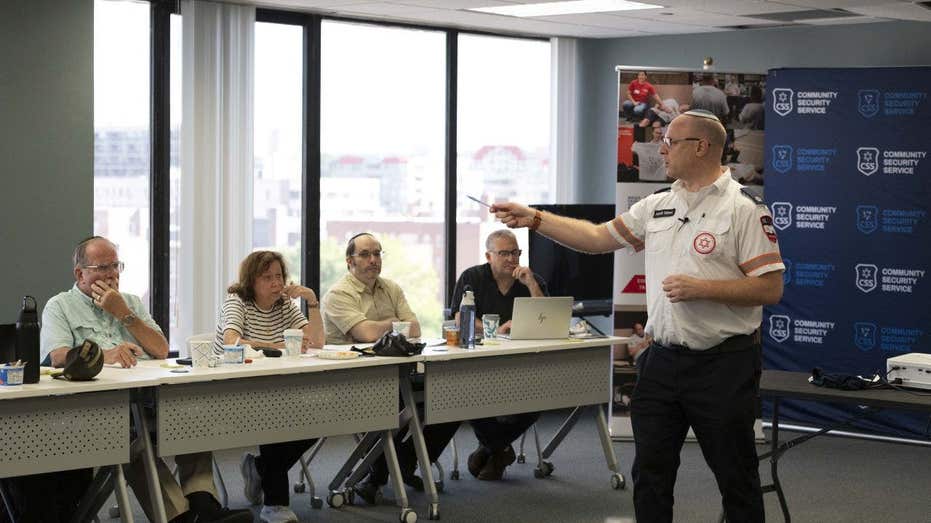
Jewish communities across the United States are strengthening security and emergency preparations ahead of Rosh Hashanah and other High Holidays. Magen David Adom, Israel’s emergency medical service, has partnered with the Community Security Service to train synagogue security volunteers. The First 7 Minutes courses focus on first aid, communication with emergency responders and assistance during the crucial period before professional help arrives. The effort comes as Jewish communities report heightened concerns about antisemitism and potential attacks.
The training is led in part by senior paramedic and international affairs representative Aryeh Myers, who has conducted sessions for Jewish, Christian and non-religious groups in the United States and elsewhere.
| 1) | High Holiday security preparations |
| 2) | What the First 7 Minutes training teaches |
| 3) | Why Israeli emergency experience matters |
| 4) | Broader concerns about antisemitism |
| 5) | Concerns among Jewish educators |
High Holiday security preparations
Synagogues and Jewish communities around the United States are reviewing security procedures before Rosh Hashanah and the wider High Holiday period. The preparations involve volunteers who may be responsible for protecting congregants, identifying emergencies and coordinating with police, firefighters and medical teams. The goal is to improve readiness during large gatherings, when a rapid and organized response could be especially important.
The training partnership brings together Magen David Adom and the Community Security Service, a U.S.-based organization that supports synagogue security. Sessions have been held for volunteers across the country as community members respond to what they describe as a more threatening environment.
What the First 7 Minutes training teaches
The First 7 Minutes course addresses the period immediately after an attack and before first responders reach the scene. Volunteers learn basic first aid, how to communicate essential information to emergency personnel and how to support responders once they arrive. The instruction is designed for community members who may be first to encounter casualties or need to relay accurate information during confusion.
Myers has delivered the course to Jewish, Christian and non-religious groups in the United States and other locations. He said the training focuses on mass-casualty response and practical steps that civilians can take without replacing professional emergency services.
“There is this heightened sense of concern, of worry that these attacks are now a question of when rather than if,” Myers said.
Why Israeli emergency experience matters
Magen David Adom’s role reflects Israel’s extensive experience responding to medical emergencies, terror attacks and war situations. Myers said the organization’s expertise ranges from childbirth assistance to incidents involving multiple casualties. That experience informs the procedures shared with U.S. volunteers.
The approach emphasizes preparation, clear communication and cooperation with arriving responders. Volunteers are taught how to provide immediate assistance and avoid creating additional risks while emergency agencies establish control of the scene.
“The advantage that Magen David Adom brings is unfortunately having that level of experience, that we have seen multiple mass casualty attacks and multi-casualty attacks and have learned from those,” Myers said.
Broader concerns about antisemitism
The synagogue training is taking place amid broader concerns about antisemitism in Jewish communities worldwide since the October 7 attacks in Israel. In the United States, universities have experienced anti-Israel and antisemitic incidents during the war between Israel and Hamas in Gaza, contributing to concerns about safety and public hostility.
Community leaders say security planning is one part of a wider response. The courses do not address every cause of antisemitism, but they provide volunteers with practical procedures for responding if violence occurs during religious services or other community events.
Concerns among Jewish educators
A recent Anti-Defamation League survey of 307 Jewish members of teachers unions found that many respondents were concerned about how antisemitism was handled in union settings. The organization said some Jewish educators had censored themselves and feared professional or reputational consequences for raising concerns.
Jonathan Greenblatt, the organization’s chief executive, described the findings as a structural and cultural failure. Sydney Altfield, chief executive of Teach Coalition, said the results were troubling because unions are intended to represent and protect all educators.
“What strikes me is that these unions are supposed to be homes for everyone, and [they’re] not being that,” Altfield said.
| Number | Key Point |
|---|---|
| 1 | U.S. synagogues are increasing security preparations before the High Holidays. |
| 2 | First 7 Minutes courses teach first aid and coordination with emergency responders. |
| 3 | The training draws on Magen David Adom’s experience with mass-casualty incidents. |
| 4 | Jewish communities continue to report concerns about rising antisemitism. |
Summary
The U.S. synagogue training initiative is intended to give volunteers practical skills for the first minutes of a mass-casualty emergency. It combines Israeli emergency-response experience with local community security planning at a time when Jewish institutions are preparing for major religious gatherings and monitoring wider antisemitism concerns.
Frequently Asked Questions
What is the First 7 Minutes training?
It is a course that teaches volunteers how to provide basic first aid, communicate with emergency responders and assist them after an attack.
Who is providing the training?
Magen David Adom is conducting the training in partnership with the Community Security Service for security volunteers at synagogues and other groups.
Why are synagogues increasing preparations now?
Communities are preparing for Rosh Hashanah and other High Holidays while responding to heightened concerns about antisemitism and possible attacks.