
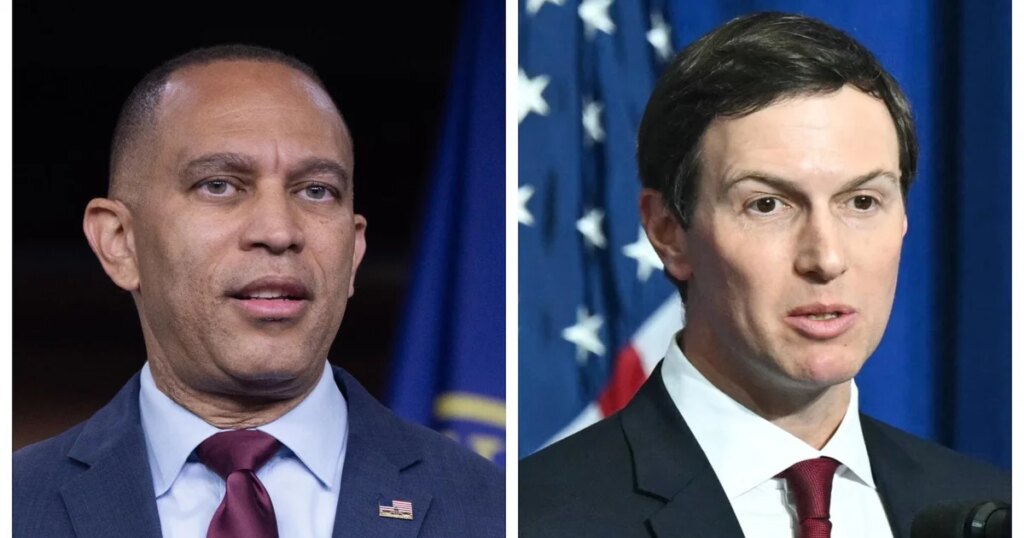
Recently, House Minority Leader Hakeem Jeffries held a significant meeting with Jared Kushner, a senior adviser to former President Donald Trump, to discuss various pressing issues, including the affordability crisis. As the upcoming midterm elections loom, this private dialogue could elucidate potential bipartisan paths in Congress, particularly as Democrats strive to regain control of the House. The discussions come at a time when partisan rhetoric is at an all-time high, with both sides positioning for an impactful electoral outcome.
| Article Subheadings |
|---|
| 1) Meeting Context and Purpose |
| 2) Implications for Party Dynamics |
| 3) Past Collaborations and Relationship Dynamics |
| 4) Reactions from Party Leaders |
| 5) The Bigger Picture: Governance and Extremism |
Meeting Context and Purpose
The meeting between Hakeem Jeffries and Jared Kushner took place in New York City, occurring less than three months before the midterm elections scheduled for November. This meeting holds significant implications as Democrats seek to reclaim the House of Representatives, with Jeffries poised to potentially take over as Speaker should they achieve a majority. He emphasized that Kushner requested the meeting primarily to address the affordability crisis, which has become a central concern for many Americans grappling with rising living costs.
The discussion reportedly traversed multiple topics, such as housing, immigration, and broader economic issues, marking an unusual moment of dialogue between a Democratic leader and a prominent figure linked with the Trump administration. By invoking bipartisanship in a time of heightened partisanship, both figures might be searching for unexpected solutions that would resonate positively with their respective bases while addressing pressing national challenges.
Implications for Party Dynamics
The political climate leading up to the midterms is rife with tensions, characterized by a fierce battle for public sentiments across both parties. As Democrats, led by figures like Jeffries, prepare strategically for the elections, they are keenly aware of the challenges posed by Republican campaigns that paint them as extreme. Kushner’s involvement, despite his lack of a formal role in the current administration, signifies a potential avenue for dialogue that could either bridge gaps or highlight stark divisions.
Jeffries has made it abundantly clear that accountability is paramount, especially concerning the Trump administration’s policies and decisions. He asserted in a recent statement, “No one is going to get a pass. We’re going to hold every single member of the Trump cartel accountable, beginning on day one,” emphasizing the Democrats’ commitment to a combative stance against what they perceive as detrimental governance. The juxtaposition of Jeffries’ willingness to engage in discussions while advocating for accountability illustrates the complex fabric of contemporary American politics.
Past Collaborations and Relationship Dynamics
Historically, Hakeem Jeffries and Jared Kushner have worked together, most notably on criminal justice reform during Trump’s first term. Such previous engagements suggest a foundation of cooperation that may have facilitated their recent meeting. Kushner’s advisory role in diplomatic negotiations and Jeffries’ position as a leading voice within the Democratic caucus present an interesting dynamic—two figures from opposing sides meeting with the aim of finding common ground.
Despite past collaborations, both leaders have exchanged critiques highlighting the adversarial nature of their respective roles. Jeffries has not hesitated to label the Trump administration’s qualities as problematic while Kushner’s responses reflect a more diplomatic tone, suggesting that while they may share certain goals, their methodologies differ significantly. In the current climate, any collaborative efforts need to overcome skepticism and public perception shaped by their broader political affiliations.
Reactions from Party Leaders
The meeting has evoked varied responses within the political sphere. Mike Johnson, the newly appointed House Speaker, expressed his first awareness of the meeting through news coverage, stating, “I don’t know what that’s about.” His remarks underline the factionalism that can exist even within the same political party, highlighting that not all members might be in agreement with such bipartisan attempts. Johnson’s lack of prior knowledge might further complicate intra-party dynamics as factions emerge regarding how to handle relations with Democrats.
Reactions from the Democratic side are predictably supportive of Jeffries’ engagement with Kushner, viewing it as a necessary step towards fostering dialogue in an increasingly divided government. However, the effectiveness of such discussions is yet to be seen, especially with the upcoming elections potentially overshadowing any genuine collaborative efforts. The implications of these interactions may not only shape the electoral landscape but also lay the groundwork for future legislative endeavors.
The Bigger Picture: Governance and Extremism
In a larger context, the meeting between Jeffries and Kushner reflects a broader conversation about governance in today’s polarized political environment. Jeffries has articulated a clear stance against what he terms “the my-way-or-the-highway approach” adopted by some Republicans, arguing that such extremism fails to serve the needs of the American populace. The landscape is rife with challenges that necessitate bipartisan solutions, yet the chasm separating the two parties often feels insurmountable.
As this meeting unfolds amid challenging social and economic realities, it highlights a potential shift in how lawmakers might engage with one another in the era of hyper-partisanship. Both Jeffries and Kushner could influence future discussions that transcend traditional boundaries and alter perceptions of cooperation amid dissent. It remains crucial for both parties to navigate this terrain thoughtfully as they aim to resonate with voters who are eager for effective governance.
| No. | Key Points |
|---|---|
| 1 | The meeting aimed to address the affordability crisis affecting American citizens. |
| 2 | Jeffries emphasized accountability for Trump administration members, highlighting ongoing partisan tensions. |
| 3 | Kushner and Jeffries collaborated on criminal justice reform in the past, setting a precedent for potential dialogue. |
| 4 | Reactions from party leaders show varying levels of support and skepticism regarding bipartisan efforts. |
| 5 | The meeting reflects the challenges of governance in a hyper-partisan environment and the need for collaborative solutions. |
Summary
The meeting between Hakeem Jeffries and Jared Kushner demonstrates a complex arena of contemporary politics where dialogue exists amid division. The discussions held significant relevance as both parties gear up for the crucial midterm elections, which will ultimately shape legislative priorities and strategies moving forward. As politicians navigate these waters, the potential for bipartisan cooperation appears essential in addressing national issues while simultaneously considering the underlying tensions that continue to define American political culture.
Frequently Asked Questions
Question: What were the primary topics of discussion during the meeting?
The primary topics included the affordability crisis, housing, immigration, and the broader economic challenges facing the nation.
Question: Why is the timing of this meeting significant?
The meeting is significant as it takes place just months before the midterm elections, where Democrats are aiming to regain control of the House, thus influencing future legislative actions.
Question: How do both leaders’ past collaborations impact their current relationship?
Past collaborations on initiatives like criminal justice reform imply a potential for cooperation; however, their political rhetoric and party positions highlight the complexities in fostering bipartisan dialogue in the current climate.