
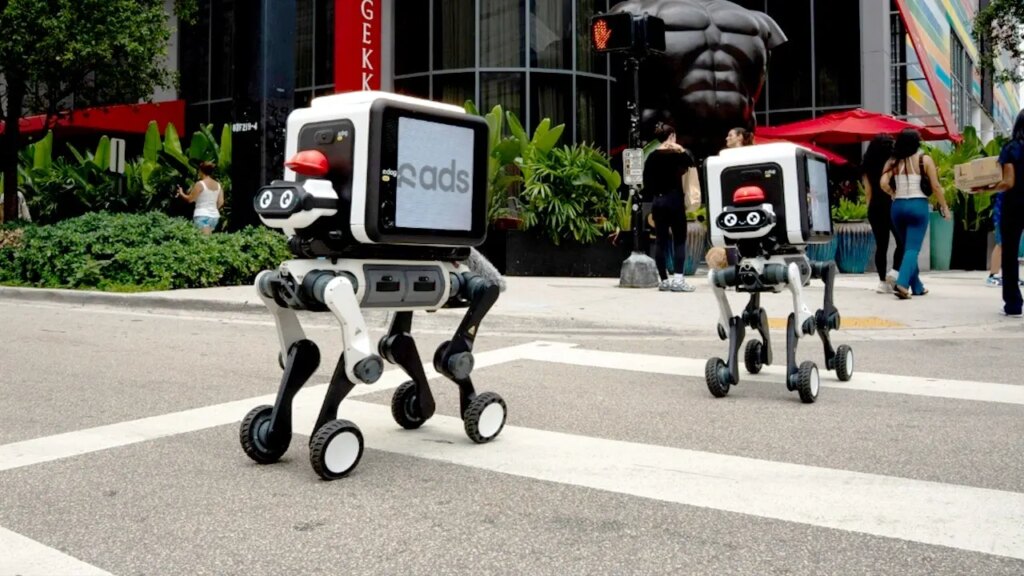
The emergence of delivery robots has revolutionized logistics and convenience, with innovative designs aimed at overcoming traditional barriers. One such innovation, Robot.com’s new four-legged delivery robot named R-dog, is engineered to navigate challenging terrains like stairs and curbs—a task often problematic for wheeled robots. Not only does R-dog facilitate package delivery, but it also enhances its utility by displaying advertisements during its journeys, blending functionality with marketing opportunities.
| Article Subheadings |
|---|
| 1) Introduction to R-dog |
| 2) Addressing the Staircase Problem |
| 3) How R-dog Delivers Packages |
| 4) The Role of Advertising |
| 5) Launch Timeline and Future Prospects |
Introduction to R-dog
R-dog represents the latest technological advancement from Robot.com, a company based in San Francisco, which has made significant strides in the field of autonomous delivery systems. Unveiled on August 11, the R-dog aims to address one of the significant challenges in the delivery process: the final stretch to a customer’s door. Conventional delivery robots, which primarily use wheels for movement, often fail on uneven surfaces or when faced with obstacles like curbs and stairs. R-dog’s design incorporates a hybrid model that combines wheels and articulated legs, enabling it to traverse a variety of terrains seamlessly.
The robotic delivery dog is not simply about functionality; its aesthetics are also purposely designed. It resembles an actual dog, complete with a tail, which helps in garnering positive interactions in public settings. The design is intended to make R-dog approachable and relatable, thus easing any potential apprehensions from the public when it is seen on the streets. This friendly appearance serves a practical purpose as well, as it invites interactions with pedestrians, especially when accompanied by its innovative advertising features.
Addressing the Staircase Problem
The common issue surrounding delivery robots is their limitations on varied terrains, particularly when it comes to climbing stairs or navigating curbs. Traditional delivery methods relying on wheeled robots excel on smooth surfaces such as sidewalks but struggle when the environment becomes unpredictable. R-dog seeks to remedy this by offering a design that adjusts seamlessly to the environment. According to Robot.com, the robot is engineered to cover an approximate final distance of 330 feet, overcoming obstacles that typically halt wheeled robots.
The innovative structure of R-dog is such that each leg ends in a wheel; this design allows R-dog to roll efficiently on flat surfaces, while the articulated legs provide the flexibility required to tackle more challenging terrains. The implementation of this dual system makes R-dog ideally suited for delivery scenarios in various environments, including urban areas, college campuses, and residential neighborhoods, which have inconsistent terrain and various entryways.
How R-dog Delivers Packages
R-dog is not just an ordinary delivery robot; it incorporates a cargo compartment capable of holding multiple items, be it food orders from restaurants or packages from e-commerce platforms. Its design features an unattended auto drop-off system that allows packages to be delivered automatically without requiring human supervision. Upon reaching its designated drop-off point, R-dog effectively releases the package, resembling the amusing visual of a dog “pooping out” a delivery. Despite the humor in this imagery, this method of delivery could significantly enhance efficiency, allowing R-dog to depart for its next assignment without any human intervention.
While the robot is capable of carrying multiple items, there are questions concerning how R-dog determines the correct package when multiple deliveries are loaded. This aspect remains a focus of development for Robot.com as they continue refining the prototype, particularly regarding the robot’s internal storage mechanisms and package sorting capabilities.
The Role of Advertising
R-dog is poised to redefine how delivery services operate by integrating advertising into its delivery process. Equipped with two video screens linked to Robot.com’s advertising platform named R-ads, R-dog can display targeted advertisements while en route to a delivery location. The incorporation of advertisements enhances the robot’s revenue streams by potentially earning money from two sources—delivering goods and running advertising concurrently. This innovation not only benefits the company but could also invoke an engaging atmosphere for pedestrians as R-dog navigates neighborhoods.
From the perspective of advertisers, R-dog presents a unique opportunity to capture consumer attention in an unconventional format. People are likely to be more intrigued by a four-legged robot than static billboards or other traditional advertising mediums. Moreover, R-dog offers the potential for interactive engagement, as the robot is designed to respond naturally to human interaction. This conversational capability could foster a more engaging and memorable experience for onlookers compared to passive advertisement displays.
Launch Timeline and Future Prospects
Looking ahead, Robot.com plans to commercially launch R-dog in 2027. Initially targeting college campuses, the focus seems to be on logistics and public convenience where R-dog can efficiently navigate foot traffic and varied terrains. While no specific campuses or locations have been disclosed, the robotic delivery system’s deployment in dense environments such as these makes sense, as they are ideal testing grounds that present a mix of delivery challenges based on foot traffic and infrastructural arrangements.
Robot.com is not a stranger to the robotics field; it has been operational since 2017, currently deploying over 500 robots in North America and the MENA region. With practical experience accumulated from existing delivery robots, such as the R-kiwi and R-cargo, Robot.com’s venture into canine-like delivery solutions seems promising. They are keen on learning from past deployments to ensure a smoother rollout of R-dog, revealing that the foundation already sits on established technology that contributes to its efficacy.
| No. | Key Points |
|---|---|
| 1 | R-dog is designed to overcome obstacles like stairs and curbs that traditional delivery robots struggle with. |
| 2 | The robot’s cargo compartment allows it to deliver multiple packages autonomously. |
| 3 | R-dog can display advertisements through integrated screens while making deliveries, creating an additional revenue stream. |
| 4 | Robot.com is targeting a 2027 launch, focusing first on college campuses as viable environments for deployment. |
| 5 | The company has a significant existing fleet of delivery robots, providing a strong foundation for the success of R-dog. |
Summary
The introduction of R-dog marks an important step in the evolution of delivery technology, presenting innovative solutions to longstanding logistical challenges. By combining the capability of navigating complex terrains with the functionality of package delivery and advertising, Robot.com is set to transform conventional expectations around autonomous delivery systems. As the prospects for R-dog unfold, anticipation will surround not only its technological efficacy but also the privacy implications and user engagement that come with integrating advertising into delivery services.
Frequently Asked Questions
Question: What are the main features of the R-dog?
The R-dog features a combination of wheels and articulated legs that allow it to navigate various terrains, including stairs and curbs, while carrying multiple packages autonomously.
Question: How does R-dog integrate advertising?
R-dog is equipped with video screens connected to an advertising platform, allowing it to display adverts during its deliveries, which creates an additional revenue stream.
Question: When will R-dog be available for commercial use?
Robot.com has targeted a 2027 launch for the R-dog, with an initial focus on deploying it on college campuses.