
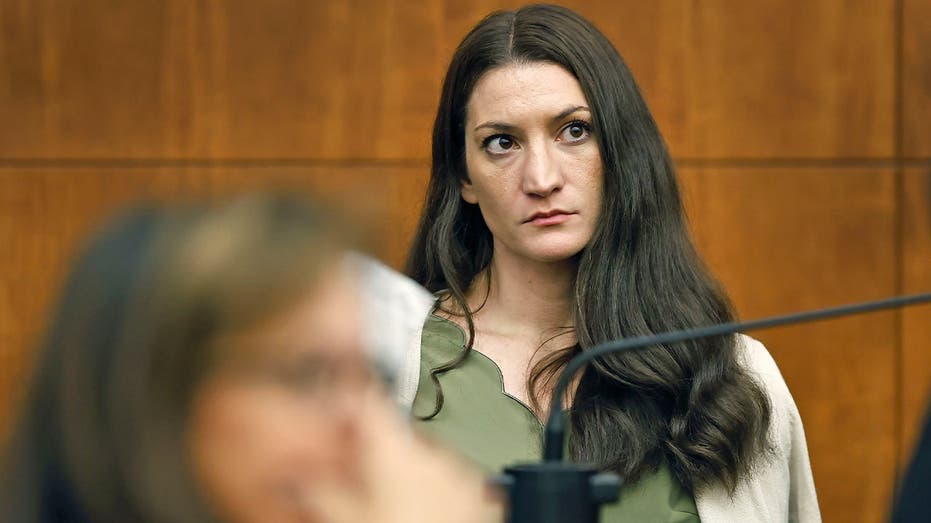
A prosecutor’s question about whether murder is a “mortal sin” was struck from the record Tuesday during Lindsay Clancy’s murder trial in Plymouth, Massachusetts. The question was directed at Susan Clancy, Lindsay Clancy’s Catholic mother-in-law, as prosecutors sought to challenge the defense claim that Clancy was suffering from postpartum psychosis. Clancy faces three first-degree murder charges in the 2023 deaths of her children, Cora, Dawson and Callan.
| 1) | Prosecutor raises religious question during testimony |
| 2) | Judge removes the question from the record |
| 3) | Mother-in-law describes Clancy’s mental health decline |
| 4) | Family testimony supports the defense theory |
| 5) | Defense case is expected to continue Wednesday |
Prosecutor raises religious question during testimony
Assistant District Attorney Shanan Buckingham asked Susan Clancy whether she knew that murder is considered a “mortal sin” in Catholic teaching. The question came during testimony in Plymouth Superior Court on Tuesday, August 18, 2026. Prosecutors were examining whether Lindsay Clancy understood the wrongfulness of her conduct, a central issue in their effort to rebut the defense argument that she was experiencing postpartum psychosis.
Susan Clancy was called as a witness because of her relationship with the defendant and her observations of Lindsay’s behavior before the deaths. The witness did not answer the question before the court intervened. The exchange formed part of the prosecution’s broader presentation after prosecutors concluded their case Monday morning.
Judge removes the question from the record
After Susan Clancy did not respond, Judge William Sullivan immediately called a sidebar conference with the lawyers. He then struck the prosecutor’s remark from the record. The ruling prevented the question itself from standing as evidence for jurors to consider.
The brief exchange occurred as the trial focused on Clancy’s mental state. The defense maintains that severe postpartum psychosis affected her ability to understand her actions when her three children were killed inside the family’s Duxbury home in 2023. Clancy, 36, has pleaded her case before a jury on three counts of first-degree murder.
Mother-in-law describes Clancy’s mental health decline
Susan Clancy told jurors that she became concerned about Lindsay’s mental health during the 2022 holiday season. She said Lindsay contacted her in November and reported insomnia, loss of appetite, anxiety and sadness. According to the testimony, Lindsay was seeking help while caring for her young children.
“Lindsay was struggling. We were all very concerned. She was very nurturing, very loving. She was a wonderful mother. Wonderful.”
Susan Clancy’s testimony portrayed Lindsay as both a devoted parent and a woman whose condition appeared to be worsening. She described the concerns within the family but did not testify that she believed the children were in danger at that time.
Family testimony supports the defense theory
The defense has presented testimony from family members about Lindsay’s symptoms in the months before the January 2023 killings. Paula Musgrove, Lindsay’s mother, also described mental health problems and told jurors about a text message sent on October 20, 2022.
“Mom, will you please come up and stay with me for a bit? I’m really sick. Something is wrong. I had horrible insomnia all night, and I just don’t know how I am going to get through the day. … It’s just really scary, and I don’t want to be alone.”
Musgrove testified that she was not concerned about the children’s safety when she received the message. The defense is using the family accounts to show that Lindsay’s symptoms were serious and consistent with its claim that postpartum psychosis affected her judgment and behavior.
Defense case is expected to continue Wednesday
The defense team is scheduled to continue presenting its case Wednesday morning in Plymouth. Its objective is to persuade jurors that Lindsay Clancy was suffering from severe postpartum psychosis when she strangled her children. The prosecution, meanwhile, has sought to establish that Clancy knew what she was doing and understood the nature and wrongfulness of her conduct.
The testimony of family members is expected to remain important as jurors weigh competing accounts of Clancy’s mental state. The case concerns the deaths of Cora, Dawson and Callan, all younger than 6, whose bodies were found at the family’s Duxbury residence in 2023.
| Number | Key Point |
|---|---|
| 1 | A prosecutor asked Susan Clancy about the Catholic concept of mortal sin. |
| 2 | Judge William Sullivan struck the question from the record. |
| 3 | Family members described insomnia, anxiety, sadness and other concerns before the deaths. |
| 4 | The defense is presenting the testimony to support its postpartum psychosis argument. |
Summary
Tuesday’s testimony highlighted the competing interpretations of Lindsay Clancy’s state of mind before the deaths of her children. Prosecutors questioned whether she understood the wrongfulness of her actions, while defense witnesses described a significant deterioration in her mental health. The defense is scheduled to continue presenting evidence as the jury considers the murder charges and the competing accounts of postpartum psychosis.
Frequently Asked Questions
What question did the prosecutor ask Susan Clancy?
Assistant District Attorney Shanan Buckingham asked whether Susan Clancy knew that murder is considered a “mortal sin” in Catholic teaching.
What did the judge do after the question was asked?
Judge William Sullivan called a sidebar and struck the prosecutor’s remark from the record after Susan Clancy did not answer.
What is the defense arguing in the trial?
The defense argues that Lindsay Clancy was suffering from severe postpartum psychosis when she killed her three children and could not properly understand her actions.