
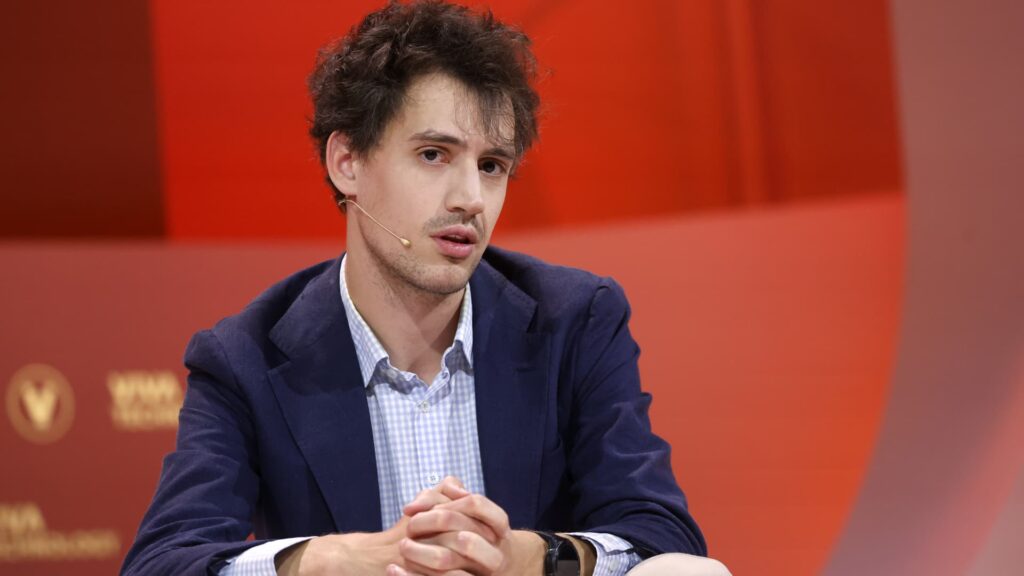
Artificial intelligence startup Mistral has unveiled a new suite of models as it aims to keep pace with industry giants like Google, OpenAI, and DeepSeek. The French company, founded in 2023, is stepping up its game amid rising competition and rapid technological advancements in the AI landscape. Mistral’s latest offerings include a large multimodal and multilingual model, along with a smaller model tailored for robotics and drone applications.
This announcement comes shortly after model releases by leading AI labs, indicating a heated race to maintain a competitive edge in both research and commercial applications. With substantial funding backing its operations, Mistral is positioning itself as a major player in the European AI sector.
| Article Subheadings |
|---|
| 1) Mistral’s Model Innovations: A Game Changer |
| 2) Significant Financial Backing and Growth Trajectory |
| 3) Strategic Partnerships and Business Expansion |
| 4) Competitive Landscape and Future Challenges |
| 5) Predictions for the AI Industry: Mistral’s Role |
Mistral’s Model Innovations: A Game Changer
Mistral recently introduced a groundbreaking large model, touted as the “world’s best open-weight multimodal and multilingual” model. Designed to cater to a variety of applications, it stands out with its robust capabilities that allow for advanced AI assistance in both enterprise settings and everyday applications. This model is engineered for versatility, making it suitable for AI assistants, complex enterprise workflows, and scientific workloads. Moreover, the new smaller model, designated as Ministral 3, is lightweight yet powerful enough to fit into devices like drones, robots, and smartphones.
The introduction of these models signals Mistral’s commitment to pushing the technological envelope in AI. This is not only a response to the needs of large enterprises but also aligns with the growing trend towards decentralizing AI capabilities, allowing businesses of various sizes to leverage advanced AI without incurring prohibitive costs. The emphasis on smaller models helps in reducing operational costs while maintaining high-performance standards geared toward specific tasks. As Mistral states, “Small models deliver advantages for most real-world applications: lower inference cost, reduced latency, and domain-specific performance.”
Significant Financial Backing and Growth Trajectory
Mistral’s growth has been significantly bolstered by a substantial funding round that raised 1.7 billion euros. This influx of capital enables the startup to invest in advanced research, new technology development, and market expansion. Notably, Dutch chip equipment maker ASML was instrumental in this funding, contributing 1.3 billion euros. This financial backing has positioned Mistral with an impressive valuation of 11.7 billion euros.
The financing provided by key players like Nvidia, along with support from previous backers like Microsoft and Andreessen Horowitz, illustrates the increasing confidence in Mistral’s business model and its potential to disrupt existing AI paradigms. Such financial resources equip Mistral to not only develop innovative products but also to sustain growth in scalability and operational efficiency, vital for thriving in a competitive landscape.
Strategic Partnerships and Business Expansion
As it gears up for future growth, Mistral has entered into several strategic partnerships, most notably with HSBC. This collaboration gives the multinational bank access to Mistral’s AI models for a variety of applications, including financial analysis and translation tasks. Such partnerships help in showcasing the practical implementation of Mistral’s technology in real-world scenarios, thereby enhancing its market presence.
Furthermore, Mistral is keen on exploring mergers and acquisitions (M&A) as a means to accelerate growth. By seeking partnerships with other entities in the technology space, Mistral aims to bolster its service offerings and secure a competitive advantage in an increasingly crowded marketplace. The ambition to expand through M&A also reflects Mistral’s awareness of emerging rivals in the AI sector, particularly those setting up operations in Europe.
Competitive Landscape and Future Challenges
Despite Mistral’s promising trajectory, it operates in a challenging landscape, especially against the backdrop of established U.S. rivals like OpenAI and Anthropic. These companies have significantly larger financial resources and are making notable strides in the European market. OpenAI, for example, reportedly sold secondary shares at a staggering valuation of $500 billion. This competitive pressure necessitates that Mistral continue innovating to remain relevant.
Moreover, while Mistral has carved out a space for itself as a leading European AI startup, its current funding reserves are modest when compared to its American counterparts, raising concerns about sustaining long-term competitive advantages. As the AI industry evolves, Mistral faces the dual challenge of continuously innovating while effectively scaling its operations and partnerships.
Predictions for the AI Industry: Mistral’s Role
As the AI landscape continues to evolve, Mistral is positioning itself as a pivotal player capable of reshaping how AI solutions are deployed across various sectors. The statement from the company articulates a forward-thinking vision: “The next chapter of AI isn’t just bigger — it’s smarter, faster, and open.” Mistral is focused on building toward an “era of distributed intelligence,” which indicates a commitment to decentralized AI applications that empower smaller enterprises.
In an ever-competitive environment, Mistral’s innovations are likely to influence the broader AI industry by pushing boundaries in open-source frameworks and encouraging collaborative efforts among various stakeholders. The company’s commitment to both research and practical applications positions it strategically for future challenges and opportunities in the rapidly evolving AI sector.
| No. | Key Points |
|---|---|
| 1 | Mistral has launched new AI models aiming for superior performance in multimodal and multilingual capabilities. |
| 2 | The startup raised 1.7 billion euros in funding, with ASML providing significant contributions. |
| 3 | Strategic partnerships, like the one with HSBC, enable practical applications of Mistral’s technology. |
| 4 | Mistral faces competitive challenges from well-funded U.S. rivals in the AI industry. |
| 5 | The company projects a vision for decentralized AI and open-source collaboration moving forward. |
Summary
Mistral’s recent advancements underscore its ambition to establish itself as a leading force in the competitive AI landscape. With a robust funding base and strategic partnerships, the startup is poised to tackle upcoming challenges while innovating continuously. As the sector evolves, Mistral’s commitment to decentralization and open-source AI may prove crucial to its long-term success and influence in the industry.
Frequently Asked Questions
Question: What is the main innovation Mistral has introduced with its new models?
Mistral has introduced a large multimodal and multilingual model, alongside a smaller model used for robotics and drones, aiming for enhanced performance and reduced operational costs.
Question: Who are some key investors in Mistral?
Mistral has secured significant funding from major players, including ASML, Nvidia, Microsoft, and Andreessen Horowitz, enabling its rapid growth and innovation.
Question: What are Mistral’s strategic goals moving forward?
Mistral aims to expand both through strategic partnerships and mergers and acquisitions while emphasizing the development of decentralized AI solutions and open-source frameworks.