
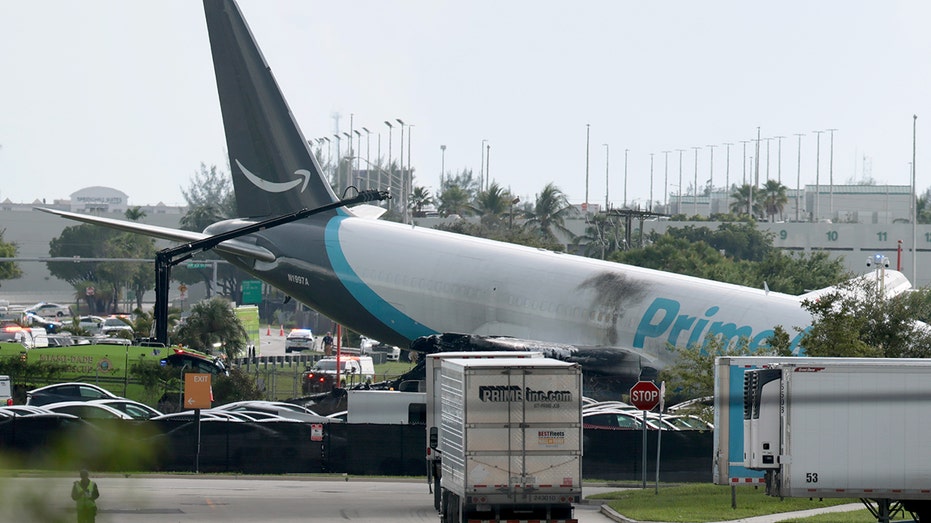
Investigators said recorded data shows the wheel brakes were applied when an Amazon cargo jet overran a runway at Miami International Airport on Sunday. The data showed no indication that the aircraft’s speed brakes or thrust reversers deployed during the landing. The crash killed five people and injured five others after the Boeing 767 struck vehicles near the airport.
The National Transportation Safety Board is continuing to examine the aircraft’s performance, the crew’s actions and the condition of the systems involved. Investigators said they will interview the pilots before reaching conclusions about what occurred.
Officials also said the aircraft carried no hazardous materials. Most of its cargo consisted of contact lenses, with a reported weight of 32,222 pounds, in addition to a flight kit.
| 1) | Recorded data shows missing braking deployments |
| 2) | Investigators seek the flight crew’s account |
| 3) | Runway overrun led to fatal vehicle impacts |
| 4) | Crew experience and aircraft cargo disclosed |
| 5) | NTSB continues examination of the landing sequence |
Recorded data shows missing braking deployments
The NTSB said available recorded data from the Prime Air Boeing 767 showed that the aircraft’s wheel brakes were applied during the landing at Miami International Airport on Sunday, September 6, 2026. However, the data contained no indication that the speed brakes or thrust reversers were deployed. Those systems are part of an aircraft’s landing deceleration process, but investigators have not said why they did not appear in the recordings.
Chihoon Shin, the NTSB investigator in charge, said the agency must review the complete set of recorded parameters to assess how the aircraft performed and which systems were operating. The available information identifies a system response but does not by itself establish the cause of the crash.
Investigators seek the flight crew’s account
Investigators plan to interview the pilots who were operating the cargo flight. Officials have not publicly identified them, and the NTSB said it would not speculate about what should have happened during the landing before hearing their account.
“When we analyze the full list of parameters, we’ll have a better idea of the aircraft’s performance during this landing. Was it normal? Was it not? And what was working and what was not. So I’m not going to speculate on what should have been right now.”
Chihoon Shin said investigators need to understand how the crew manipulated the controls and how those actions relate to the recorded aircraft data. That work is intended to clarify the sequence of events before the runway overrun.
Runway overrun led to fatal vehicle impacts
The aircraft overran the end of Runway 30 while landing at Miami International Airport. It traveled through the airport fence and struck two vehicles before stopping near a parking lot. One van carrying seven people was crushed on airport property, and another civilian vehicle was also hit.
Five people died and five others were injured in the fiery crash involving Prime Air Flight 7598. Investigators examined the wreckage field on the day after the accident as they began reconstructing the aircraft’s path and landing performance.
Crew experience and aircraft cargo disclosed
NTSB Chairwoman Jennifer Homendy said the captain was 55 years old and had 7,145 flight hours, based on information from the pilot’s latest Class 1 medical certificate dated March 31, 2026. The first officer was 37 years old and had 2,655 flight hours, according to a Class 1 medical certificate dated April 13, 2026.
Officials said the aircraft carried no hazardous materials. Most of the cargo consisted of contact lenses weighing 32,222 pounds, along with a flight kit. The cargo information helps investigators document the aircraft’s load as part of the broader accident examination.
NTSB continues examination of the landing sequence
The NTSB’s investigation is focused on what happened during the landing, including the aircraft’s speed, braking systems, control inputs and movement beyond the runway. Investigators will compare recorded data with the pilots’ statements and the physical evidence from the wreckage and runway area.
The agency has not assigned a final cause to the crash. Its investigators are continuing to determine whether the aircraft’s performance was consistent with normal operation, what systems were available or functioning, and how the jet ultimately left the runway and struck vehicles.
| Number | Key Point |
|---|---|
| 1 | Wheel brakes were applied, according to recorded data. |
| 2 | No recorded indication showed that speed brakes or thrust reversers deployed. |
| 3 | The runway overrun killed five people and injured five others. |
| 4 | The cargo included 32,222 pounds of contact lenses and no hazardous materials. |
| 5 | Investigators will interview the pilots and analyze additional data before determining the cause. |
Summary
The NTSB said an Amazon cargo jet’s wheel brakes were applied during its fatal Miami runway overrun, while recorded data showed no deployment of the speed brakes or thrust reversers. The agency is examining the aircraft’s complete data record, physical evidence and crew actions. Investigators have not yet determined why the jet left the runway or assigned a final cause to the crash.
Frequently Asked Questions
Which braking systems were shown to be active?
Recorded data indicated that the aircraft’s wheel brakes were applied. It showed no indication that the speed brakes or thrust reversers were deployed.
How many people died in the crash?
Five people were killed and five others were injured after the aircraft overran the runway and struck vehicles near Miami International Airport.
What will investigators do next?
Investigators plan to interview the pilots and analyze the full set of recorded parameters, the wreckage and other evidence before reaching conclusions about the landing and the crash.