
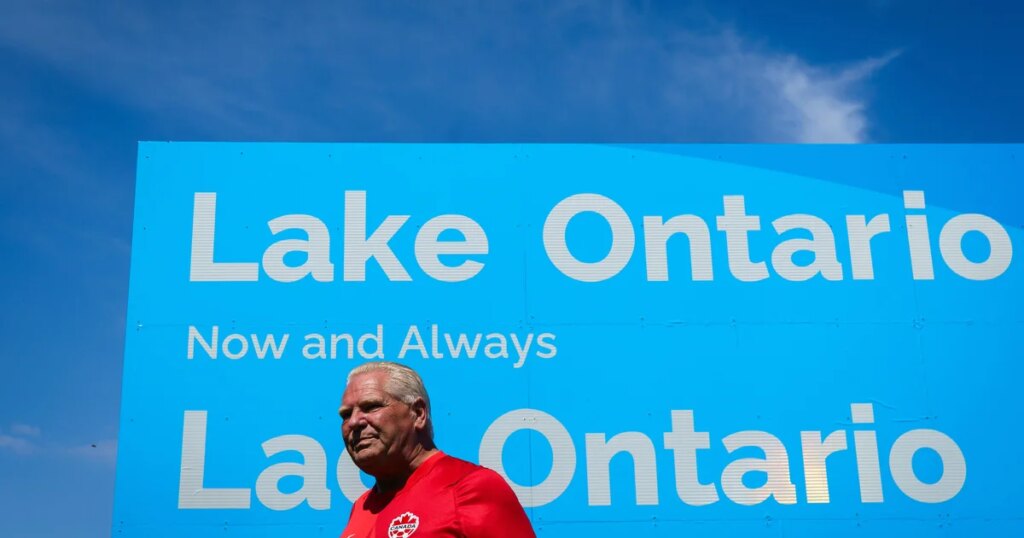
In a bold stand against a recent executive order by U.S. President Trump, Ontario Premier Doug Ford unveiled a new sign at Lake Ontario that proclaims its name unequivocally. The move comes amid a backdrop of increasing tension between Canada and the United States, exemplified by Trump’s order to rename Lake Ontario to “Lake America.” Ford’s action aims to assert the historical significance of the lake’s name while highlighting the ongoing diplomatic rift between the two nations, particularly regarding trade relations.
| Article Subheadings |
|---|
| 1) Premier’s Declaration on Lake Ontario |
| 2) The Indigenous Perspective |
| 3) Trade Tensions Escalate |
| 4) Reactions to Trump’s Order |
| 5) The Future of Canada-U.S. Relations |
Premier’s Declaration on Lake Ontario
During a visit to Fifty Point Conservation Area in Hamilton, Ontario, Doug Ford publicly criticized President Trump’s decision to attempt to rename Lake Ontario, which has long been a significant geographical and cultural landmark between Ontario and New York. “I’m here on the shores of beautiful Lake Ontario, a crown jewel of our province and our country,” he stated in a video message. Ford emphasized that the lake has always been called Lake Ontario and dismissed Trump’s motives as stemming from a broader disdain for Canadian interests. The bold sign, boasting the name “Lake Ontario – Now and Always,” was erected to assert that the lake’s identity would not be altered by political whims.
The Indigenous Perspective
The decision to rename Lake Ontario has not only sparked controversy between governments but also drawn the ire of Indigenous leaders. The name Ontario derives from the Iroquoian word “oniatarí:io,” which translates to “lake of shining waters.” J. Conrad Seneca, president of the Seneca Nation, has condemned Trump’s executive order, describing it as a blatant disrespect for the Indigenous people whose heritage is tied to the lake. Seneca emphasized the need for the preservation of Indigenous culture and names, stating that they represent a significant part of the history of the land long before United States or Canada existed. He also criticized the order for violating treaties acknowledging the rights of Native peoples in the region.
Trade Tensions Escalate
Amid the escalating political rhetoric, the backdrop of a significant trade war complicates the narrative. Trump’s administration recently enforced 50% tariffs on a range of Canadian goods, marking a severe turn in economic relations. These tariffs are anticipated to commence on automotive and steel imports in January, with Trump accusing Canada of unfair trade practices. This development adds further strain on Canada-U.S. relations, which have already been tested in previous negotiations. In response, Mark Carney, Canada’s Prime Minister, announced retaliatory tariffs on U.S. imports, displaying the depth of hostilities that could hinder bilateral dealings moving forward.
Reactions to Trump’s Order
The announcement of the renaming plan received a mixture of reactions from Canadian politicians and citizens alike. Ford has been vocally critical of Trump’s approach, expressing disappointment at how Canada is treated in comparison to global rivals. In an interview, he stated, “He’s treating us like we’re Communist China here,” further emphasizing the importance of the longstanding relationship shared between the U.S. and Canada. As tensions have risen, so too have the exchanges of barbed remarks, with both leaders accusing each other of undermining the alliance’s principles. Ford has labeled Trump as a “dictator,” expressing his frustration with the current state of affairs.
The Future of Canada-U.S. Relations
The future of relations between Canada and the United States hangs in the balance as both nations grapple with rising tensions over tariffs, trade, and political dialogue. With public sentiments swaying towards a more defensive posture, Premiers like Ford are increasingly resolute in asserting Canadian identity and resilience against perceived aggression from southern neighbors. As trade negotiations loom and diplomatic lines fray, it remains to be seen how this conflict will evolve. Efforts by both sides to navigate this complicated landscape will be crucial in determining the trajectory of future interactions and the potential for reconciliation.
| No. | Key Points |
|---|---|
| 1 | Ontario Premier Doug Ford unveiled a sign reiterating the name “Lake Ontario” amidst Trump’s attempt to change it. |
| 2 | The Indigenous perspective, particularly from the Seneca Nation, condemns the renaming as disrespectful to their heritage. |
| 3 | Trade tensions have escalated, with Trump imposing significant tariffs on Canadian goods. |
| 4 | Ford’s strong reactions against Trump highlight the strained relations between U.S. and Canadian leadership. |
| 5 | The future of Canada-U.S. relations is uncertain amidst growing political and economic conflict. |
Summary
The recent events surrounding Lake Ontario encapsulate the broader challenges faced in Canada-U.S. relations. Premier Doug Ford’s resolute defense of the lake’s name serves as a symbolic gesture against perceived disrespect from the U.S. government. With trade tensions escalating, Indigenous voices rising in protest, and sharp political exchanges reinforcing divisions, these developments illustrate the complexities of maintaining a cooperative relationship amid stark disagreements.
Frequently Asked Questions
Question: What prompted the name change initiative for Lake Ontario?
President Trump signed an executive order seeking to rename Lake Ontario to “Lake America,” citing a need for U.S. interests to be prioritized.
Question: How have Indigenous groups responded to the proposed name change?
Indigenous leaders, particularly from the Seneca Nation, have condemned the renaming effort, asserting that it disregards their cultural heritage and violates historical treaties.
Question: What impact have recent tariffs had on Canada-U.S. relations?
The imposition of significant tariffs by the U.S. on Canadian goods has heightened tensions, leading to retaliatory measures from Canada and a general deterioration of diplomatic relations.