
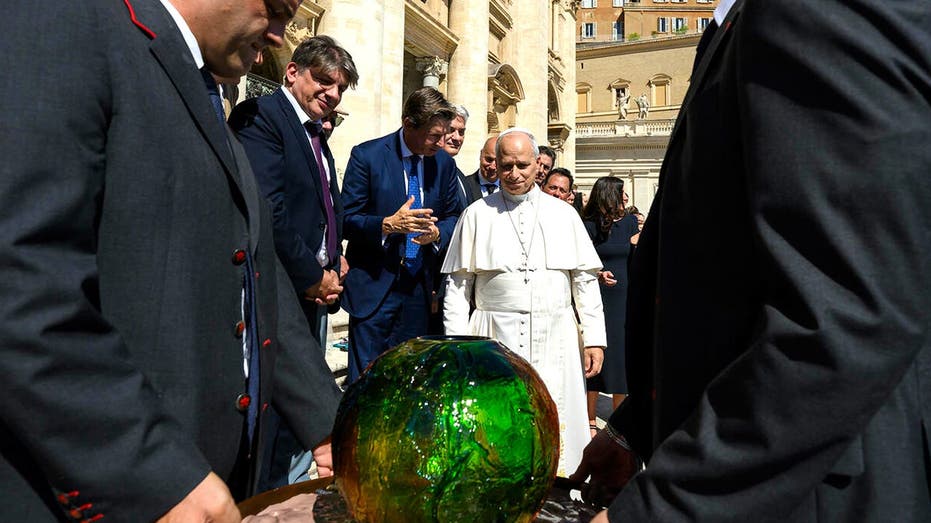
Pope Leo XIV has received a green Murano glass sculpture carrying handwritten passages from his first encyclical, Magnifica Humanitas. The Sphere of Humanity was presented at the Vatican during a General Audience on September 2, 2026, as part of a campaign focused on protecting human dignity amid the expansion of artificial intelligence. The charity behind the artwork is preparing to bring 70 leaders to New York City to begin drafting principles for the responsible development and use of AI.
The initiative, known as the Codex Humanitatis, will examine what should remain distinctly human as automated systems become more powerful and influential. Its organizers say the effort will address accountability, human oversight, information integrity, work, and protections for children and families.
| 1) | A symbolic artwork reaches the Vatican |
| 2) | The message behind the Sphere of Humanity |
| 3) | Seventy leaders prepare for the New York forum |
| 4) | The pope’s warnings about artificial intelligence |
| 5) | From draft principles to broader consultation |
A symbolic artwork reaches the Vatican
Saint Peter for Humanity presented the Sphere of Humanity to Pope Leo XIV during his General Audience at the Vatican on September 2, 2026. The green Murano glass sculpture was created from an original design by Italian architect and designer Gae Aulenti. The presentation connected a physical work of art with a wider debate about the effects of AI on people, institutions, and society.
The charity describes itself as a nonprofit founded on the belief that every person belongs to one human family. Its president and chairman, Olivier Francois, said the organization recognizes the benefits of AI but believes humanity must be included in discussions about the technology’s future.
The message behind the Sphere of Humanity
The sculpture contains four handwritten passages from Magnifica Humanitas, the encyclical released by Pope Leo XIV in May. The passages address human dignity, vulnerability, solidarity, conscience, and the challenges created by artificial intelligence.
“In the era of artificial intelligence, when human dignity is threatened by new forms of dehumanization, ours is the pressing duty to remain profoundly human.”
The artwork was presented as a symbolic expression of the charity’s effort to identify the values that should guide technological progress. Organizers said the discussion is not intended to reject innovation, but to ensure that AI serves people, expands human potential, and advances the common good.
Seventy leaders prepare for the New York forum
Saint Peter for Humanity said it would gather 70 Nobel laureates, artists, thinkers, philanthropists, technology specialists, and AI experts in New York City the following week. Their task will be to begin drafting the Codex Humanitatis, an independent initiative inspired by the pope’s call to safeguard human dignity as AI becomes more influential in daily life.
The central question for participants will be what must remain human as machines become more capable. The organizers plan to work across 10 groups, with discussions covering the future of work, accountability, information integrity, human oversight, and the protection of children and families.
The pope’s warnings about artificial intelligence
In his encyclical, Pope Leo XIV wrote that each generation has a responsibility to shape its era so that human dignity is protected, justice is promoted, and fraternity is possible. He also warned that every period can produce a more inhumane and unjust world.
The pope called for clearly defined responsibility at every stage of AI development and use, from system designers and developers to people who rely on automated decisions. He said opaque internal processes can make it difficult to identify responsibility, correct errors, or provide remedies for harm.
“Calling for prudence, rigorous evaluation and even, at times, a slower pace in adopting AI does not mean opposing progress; instead, it is an exercise of responsible care for the human family.”
He also argued that ethical principles must be supported by legal frameworks, independent oversight, informed users, and political accountability. Without those safeguards, he warned, technological change could be directed primarily by those controlling data, infrastructure, and computing power.
From draft principles to broader consultation
The initial Codex Humanitatis draft is expected to enter a global consultation process after the New York meeting. Saint Peter for Humanity said the text would then be refined into a final set of principles and promoted among governments, companies, and institutions.
The organization also plans to discuss how the principles could be applied in practice, including through engagement at the World Economic Forum Annual Meeting in Davos. The project’s stated aim is to translate broad concerns about dignity and responsibility into standards that can influence how AI is designed, governed, and used.
| 1 | Pope Leo XIV received the Sphere of Humanity at the Vatican on September 2, 2026. |
|---|---|
| 2 | The Murano glass sculpture contains passages from Magnifica Humanitas. |
| 3 | Seventy leaders are expected to help draft the Codex Humanitatis in New York City. |
| 4 | The initiative will focus on accountability, oversight, information integrity, work, and family protections. |
Summary
The Vatican presentation of the Sphere of Humanity has linked Pope Leo XIV’s concerns about artificial intelligence with a broader civil society effort to define human-centered principles for the technology. The forthcoming Codex Humanitatis will seek input from experts across culture, science, technology, and public life before entering a global consultation. Its success will depend on whether its principles can be translated into practical safeguards, laws, and institutional accountability.
Frequently Asked Questions
What did Pope Leo XIV receive?
He received the Sphere of Humanity, a green Murano glass sculpture containing handwritten passages from his first encyclical, Magnifica Humanitas.
What is the Codex Humanitatis?
It is an independent initiative intended to develop principles for ensuring that artificial intelligence serves people and protects human dignity.
Who will help draft the initiative?
Saint Peter for Humanity plans to convene 70 Nobel laureates, artists, thinkers, philanthropists, technology specialists, and AI experts in New York City.
What issues will the draft address?
The stated areas include the future of work, accountability, information integrity, human oversight, and the protection of children and families.