
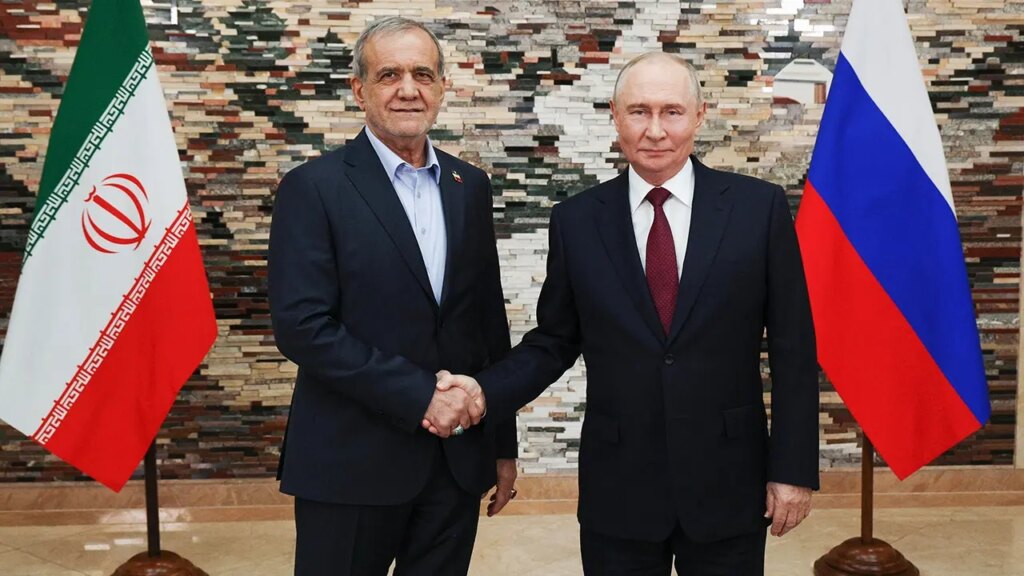
In a significant display of mutual support, Russian President Vladimir Putin recently reaffirmed his commitment to the Iranian regime during a meeting with Iranian President Masoud Pezeshkian at the Shanghai Cooperation Organization (SCO) summit held in Kyrgyzstan. Putin emphasized Russia’s solidarity with Iran amidst external pressures and conflicts, highlighting the intertwined fates of the two nations as they navigate economic hardships and military engagements. Analysts suggest that the partnership has grown notably stronger as both countries find themselves increasingly isolated from the West, compelling them to rely on each other for military and economic support.
| Article Subheadings |
|---|
| 1) Strengthening Ties: The Putin-Pezeshkian Meeting |
| 2) Economic Motivations Behind the Alliance |
| 3) Strategic Military Collaboration |
| 4) The Impact on U.S.-Iran Relations |
| 5) Future Implications of the Russia-Iran Partnership |
Strengthening Ties: The Putin-Pezeshkian Meeting
The recent meeting between Vladimir Putin and Masoud Pezeshkian marks a significant moment in international relations, especially for both Iran and Russia. Taking place on the sidelines of the SCO summit in Bishkek, Kyrgyzstan, on September 1, 2026, this encounter illustrated the deepening commitment between the two countries. Putin publicly expressed Russia’s unwavering support for Iran, remarking that “Russia is standing in full solidarity with the people of Iran.” This sentiment signals a robust political alliance that has been solidified over recent years, particularly in light of geopolitical tensions involving the United States.
During their exchange, Pezeshkian acknowledged the strategic nature of the two nations’ relations, indicating gratitude for Russia’s stance amidst ongoing conflicts and U.S. sanctions. This meeting served not only as a show of solidarity but also as a formative step in establishing a cooperative front against shared adversaries. The reinforcement of ties at such an international forum speaks to the broader implications of how both nations aim to counterbalance Western influence in their respective regions.
Economic Motivations Behind the Alliance
A critical examination of the burgeoning Russia-Iran relationship reveals strong economic undercurrents driving both nations closer together. Both countries find themselves grappling with crippling sanctions and economic challenges, which have become catalysts for collaboration rather than isolation. Retired U.S. Air Force General Philip Breedlove stated that both nations are “broke,” highlighting the economic constraints that necessitate their partnership. Russia, engaged in a war in Ukraine, struggles with sanctions that hamper its military-industrial complex, making Iranian missile production crucial for Russia’s military efforts. Conversely, Iran faces its own economic struggles and seeks military advancements to support its geopolitical ambitions.
The alliance offers both nations a mechanism to circumvent western sanctions. For Iran, Russian support represents a critical lifeline for economic stability and the ability to maintain its military capabilities. Economic cooperation extends to various sectors, emphasizing that the relationship is not limited to military needs but also encompasses trade, technology transfers, and mutual political backing at international forums.
Strategic Military Collaboration
The military component of the Russia-Iran alliance cannot be overlooked, especially in the context of increasing regional tensions. Analysts suggest that the collaboration serves a dual purpose: it fortifies Russia’s arms capabilities while providing Iran with vital intelligence and military support. As both countries face external pressures from the West, their military partnership appears to be a strategic move to consolidate their defenses. Iran relies on Russia for critical technologies that enhance its missile production, crucial to its regional strategies, especially amid rising threats from the United States and its allies.
The shift in the geopolitical landscape has prompted Iran to develop deeper ties with Russia, seeing the latter not only as a military partner but also as an essential ally in defending its interests against prevalent foreign influence. The implications of this partnership extend beyond mere exchanges of weaponry; it fundamentally alters the military balance in the Middle East and creates new dynamics in the face of U.S. military dominance.
The Impact on U.S.-Iran Relations
The realignment of Iran and Russia has profound implications for U.S.-Iran relations. Analysts such as Jason Brodsky, policy director of United Against Nuclear Iran (UANI), shed light on the strategic importance of this partnership for both nations in their attempts to counter U.S. influence. Brodsky has noted that Russia utilizes Iran as a tool against American interests, while Iran sees Russia as an essential ally in navigating its complicated international dynamics. This relationship complicates U.S. efforts to re-establish diplomatic ties with Tehran.
Recent military engagements between the U.S. and Iran, including aerial strikes and maritime confrontations, reflect a heightened state of tension that could be exacerbated by the strengthening of the Russian-Iranian coalition. As U.S. military forces continue to operate in a region heavily influenced by Iranian aggression and bolstered by Russian support, the challenge for the United States lies in recalibrating its strategy to mitigate these escalating conflicts.
Future Implications of the Russia-Iran Partnership
Looking ahead, the implications of a robust Russia-Iran alliance are significant. Experts warn that as both nations continue to integrate militarily and economically, they will likely present a united front against Western powers, particularly the United States. The partnership could embolden both nations to take bolder actions, understanding that they have each other’s backing. As Philip Breedlove noted, the world has a complex issue at hand with Russia’s ambitions, impacting diplomatic relations across the globe.
Further solidifying their partnership, the Tehran and Moscow relationship suggests that the West should prepare for a prolonged period of strategic competition. The assistance that Iran provides to Russian military efforts in Ukraine, coupled with the support Russia offers Iran amid its domestic challenges, creates a formidable alliance poised to challenge U.S. dominance in their respective spheres of influence. As the geopolitical landscape evolves, observers will closely monitor how these nations leverage their partnership to re-shape regional dynamics and press their collective interests.
| No. | Key Points |
|---|---|
| 1 | Vladimir Putin publicly reaffirms support for Iran during a meeting with President Masoud Pezeshkian. |
| 2 | The partnership between Iran and Russia strengthens due to shared economic struggles and military needs. |
| 3 | Military collaboration between Iran and Russia enhances both countries’ capacities in the face of Western adversaries. |
| 4 | The U.S. must adapt its strategy as Iranian-Russian ties complicate diplomatic relations. |
| 5 | The alliance is expected to challenge U.S. influence, altering the geopolitical landscape. |
Summary
The recent meeting between Vladimir Putin and Masoud Pezeshkian signifies a deepening alliance between Russia and Iran, driven by mutual economic hardships and strategic military collaboration. As both nations face substantial external pressures, their partnership is expected to challenge U.S. influence in the region while complicating efforts to diplomatically engage with Tehran. This evolving dynamic is likely to have significant ramifications for international relations, particularly in the context of U.S. foreign policy.
Frequently Asked Questions
Question: What were the main outcomes of the Putin-Pezeshkian meeting?
The meeting reinforced the growing alliance between Russia and Iran, highlighting mutual support against Western pressures and solidifying their commitment to economic and military collaboration.
Question: How is the Russia-Iran partnership affecting U.S. interests?
The strengthened ties complicate U.S. diplomatic efforts with Iran and present challenges to American military strategy in the region, necessitating a reassessment of U.S. responses to Iranian aggression.
Question: Why is the military collaboration between Russia and Iran significant?
This collaboration enhances Iran’s military capabilities through Russian technology and missile production while allowing Russia to bolster its defense against Western sanctions, ultimately altering the military balance in the Middle East.