
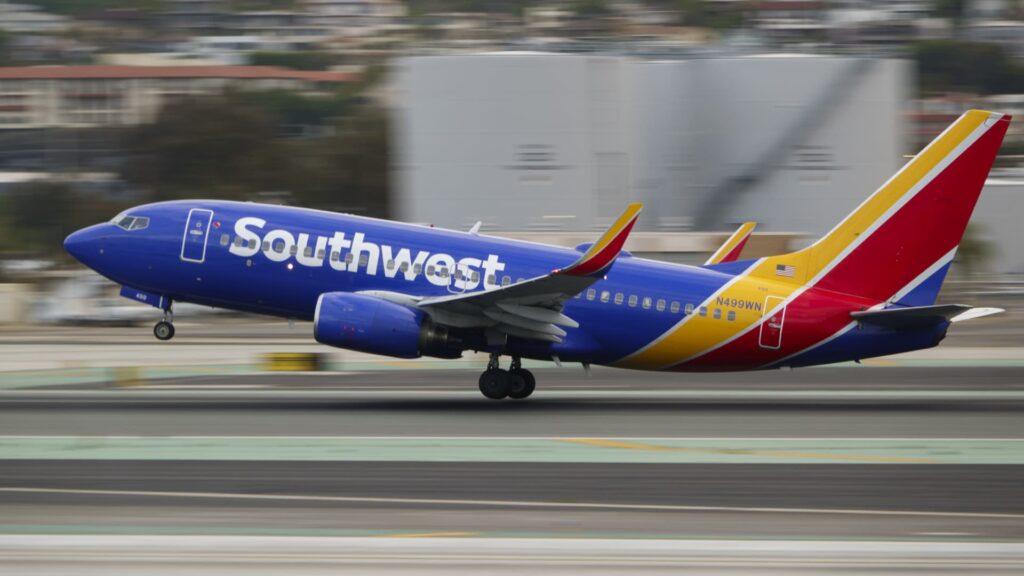
Southwest Airlines recently adjusted its profit forecast downward for 2026 due to rising fuel costs, joining other major U.S. airlines that have made similar announcements this month. Despite the increased fare prices, CEO Bob Jordan indicated that travel demand remains robust, with passengers continuing to book flights. The airline reported significant earnings and revenue growth for the third quarter, although the number of revenue passengers carried experienced a slight decline.
| Article Subheadings |
|---|
| 1) Overview of Southwest Airlines’ Financial Performance |
| 2) Profit Forecast Adjustments and Market Impact |
| 3) Changes in Passenger Fare and Revenue Insights |
| 4) Comparison With Other Major Airlines |
| 5) Future Outlook and Strategic Changes |
Overview of Southwest Airlines’ Financial Performance
Southwest Airlines has reported significant financial results for the third quarter of the year, showcasing resilience amid rising operational costs. The airline’s net income reached $270 million, equating to 55 cents per share, indicating a notable increase from the previous year’s earnings, which were reported at $54 million or 10 cents per share. The revenue surged by over 21% to $8.42 billion, surpassing Wall Street’s expectations which anticipated revenues of around $8.25 billion. This growth reflects the strong demand for travel and the ability of the airline to sustain profitable operations even with higher costs.
Profit Forecast Adjustments and Market Impact
In response to persistent high fuel prices, Southwest Airlines has altered its profit forecasts for the upcoming years. Originally projecting adjusted earnings between $3.25 and $4.25 per share, the airline has revised its expectations to a range of $2.60 to $2.85 per share this year. This adjustment follows the trend set by other major carriers, as both Delta Air Lines and United Airlines have similarly downgraded their profit outlooks amid challenging economic conditions. Analysts suggest that the revised expectations could reflect broader market uncertainties and cost pressures that are affecting the airline industry at large.
Changes in Passenger Fare and Revenue Insights
Southwest’s average passenger fare has seen a dramatic increase, rising nearly 27% compared to the same quarter last year, reaching an average of $231.69. This figure excludes additional fees, which have progressively become a part of the airline’s revenue strategy. Despite the fare hikes, the number of revenue passengers dropped by 3.2% year-over-year, totaling 33.47 million individuals. This decline signals a complex relationship between pricing and demand — while higher fares may boost revenue, they could potentially deter some budget-conscious travelers. The airlines’ management indicated that they are focusing on capacity growth of up to 4% year-over-year while managing fare levels to optimize customer demand.
Comparison With Other Major Airlines
Southwest Airlines is not alone in facing the dual challenge of rising costs and shifting demand. Major competitors Delta Air Lines and United Airlines have also reported cuts to their profit forecasts during their recent earnings calls. While all three carriers have experienced top- and bottom-line misses relative to market expectations, Southwest has positioned itself uniquely, adapting its business model to align more closely with industry practices. This includes charging for previously complimentary services, such as checked bags and seat selections, which were traditionally part of the Southwest value proposition.
Future Outlook and Strategic Changes
Looking ahead, Southwest expects adjusted earnings of between 55 cents and 80 cents per share in the upcoming fourth quarter, with unit revenue poised to grow by up to 21% compared to last year. CEO Bob Jordan emphasized that the airline’s strong demand had allowed it to adapt more effectively to the competitive environment. Strategic shifts like moving away from its long-standing policies on free checked bags and open seating are designed to enhance revenue and sustain profitability in a transforming market landscape, indicating a proactive approach to addressing both operational costs and evolving customer preferences.
| No. | Key Points |
|---|---|
| 1 | Southwest Airlines reported a net income of $270 million for Q3, significantly higher than the previous year. |
| 2 | The airline adjusted its profit forecast for 2026 due to rising fuel prices. |
| 3 | Average passenger fare increased by 27%, highlighting the ongoing cost challenges. |
| 4 | Southwest implemented changes to its business model, including new fee structures. |
| 5 | The growth in revenues reflects robust travel demand, despite a slight drop in passenger numbers. |
Summary
Southwest Airlines faces ongoing challenges in the current economic climate, marked by rising fuel costs which have led to revised profit forecasts. While the airline reported impressive financial performance in terms of revenue and earnings, strategic adjustments to its business model suggest a shift to better compete in a rapidly changing market. The resilience indicated by robust travel demand, despite fare increases, highlights an evolving landscape in the airline industry as carriers navigate various pressures to sustain profitability.
Frequently Asked Questions
Question: How has Southwest Airlines adjusted its profit forecasts?
Southwest Airlines revised its profit forecast for 2026, lowering its expectations from between $3.25 and $4.25 per share to between $2.60 and $2.85 per share due to increased fuel costs.
Question: What is the average fare reported by Southwest Airlines for the third quarter?
The average fare for Southwest Airlines in the third quarter was $231.69, which reflects a significant increase of nearly 27% compared to the same quarter last year.
Question: How does Southwest’s approach to passenger fares differ from its competitors?
Southwest Airlines has made changes to its traditional business model by implementing fees for services that were once free, such as checked bags and specific seat assignments, aligning more closely with industry practices adopted by its major competitors.