
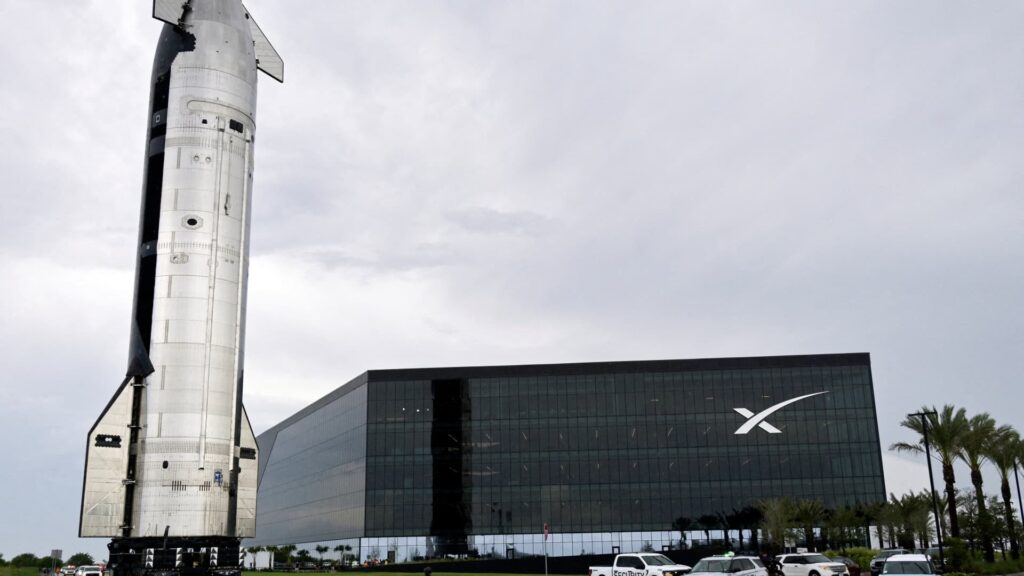
SpaceX is set to launch its groundbreaking Starship rocket on Monday, aimed at achieving its first orbital flight. The launch is scheduled to take place from Starbase, Texas, with a 75-minute window opening at 8:15 a.m. ET. This significant mission comes after receiving the green light from the Federal Aviation Administration for the Starship Super Heavy Flight 14, which is also expected to deploy 26 new Starlink V3 satellites into orbit.
| Article Subheadings |
|---|
| 1) Upcoming Launch Details |
| 2) Significance of Starship |
| 3) Financial Implications for SpaceX |
| 4) Future Missions and Innovations |
| 5) Enhancements in Starlink Technology |
Upcoming Launch Details
SpaceX’s launch of the Starship is scheduled for early Monday morning, with the window starting at 8:15 a.m. ET, which corresponds to 7:15 a.m. in local Texas time. The rocket will take off from the SpaceX facility located in Starbase, Texas. This particular mission marks the 14th test flight for the Starship, which is designed for both crewed and uncrewed operations. The Federal Aviation Administration has granted a license for this launch, which indicates regulatory approvals necessary for such high-stakes tests have been met.
The Starship aims for orbital flight during this launch, a critical milestone for SpaceX’s broader goals in space exploration and satellite deployment. Historically, none of the previous thirteen attempts with Starship were aimed at reaching orbit, signaling the increased ambitions of this current mission. Successful orbital flight could set the stage for a new era in rocket launches, making space more accessible than ever.
Significance of Starship
The Starship is not just a rocket; it is pivotal to SpaceX’s long-term vision, which encompasses a multitude of applications, including but not limited to satellite deployment and interplanetary travel. Elon Musk, the company’s CEO, has consistently underscored the importance of the Starship in advancing human civilization’s presence beyond Earth. He envisions the Starship playing a critical role in the establishment of a human presence on Mars and other destinations throughout the solar system.
Starship’s capabilities extend far beyond what previous rockets could achieve, specifically its reusability and payload capacity. SpaceX claims that the Starship and its associated Super Heavy booster will be able to transport more payload into orbit for less cost relative to any prior launch system. This potential for cost-saving measures can revolutionize the space industry, making space travel and satellite operations more economically viable.
Financial Implications for SpaceX
In June, SpaceX went public in a move characterized as the largest Initial Public Offering (IPO) on record, further bolstering the company’s financial standing in a competitive industry. Currently, SpaceX holds a valuation of approximately $2 trillion, an astounding figure that underscores its significance not just in the aerospace sector but in global tech circles. The company has shown profitability primarily through its Starlink internet service, which has become its largest segment.
On an earnings call back in August, Elon Musk indicated that Starlink has the potential to become a primary provider of internet services across numerous countries where its operations are allowed. The ongoing development and deployment of the Starship will serve as a launchpad for expanding Starlink’s reach, thereby amplifying revenue streams for SpaceX. This commercial strategy aligns with broader tech trends aiming to provide internet access to underserved regions globally.
Future Missions and Innovations
Looking ahead, the Starship is also being prepared for a major test flight for NASA next year, with plans to utilize the rocket to send American astronauts back to the Moon. NASA is collaboratively working with SpaceX on the Artemis program, which aims to advance lunar exploration. This partnership is crucial, as it positions SpaceX as a front-runner in space missions backed by governmental contracts.
SpaceX’s aspirations include not only lunar missions but also the deployment of advanced technologies such as “AI compute satellites.” During a recent appearance at the All-In Summit, Gwynne Shotwell, the COO of SpaceX, indicated plans for launching these satellites into orbit by 2027, thereby integrating artificial intelligence capabilities into space operations. The advent of these technologies could change how data is processed in space and expedite various scientific endeavors.
Enhancements in Starlink Technology
The new Starlink V3 satellites are a significant upgrade from their predecessors, produced at the company’s facility in Redmond, Washington. Equipped with solar arrays capable of generating twice as much power as previous models, these satellites are larger and engineered to enhance data transmission speeds. By introducing innovations in satellite technology, SpaceX aims to improve service reliability and capability for its growing user base.
This upgrade is essential for achieving a robust internet service that caters not only to urban populations but also to remote and underserved areas worldwide. By expanding their infrastructure and improving technology, SpaceX is setting a high standard in the satellite internet market, solidifying its position against competitors like Eutelsat and OneWeb, and ensuring scalable solutions for future connectivity challenges.
| No. | Key Points |
|---|---|
| 1 | SpaceX’s Starship is aiming for its first orbital flight in an upcoming launch. |
| 2 | The launch received regulatory approval from the Federal Aviation Administration. |
| 3 | Starship is integral to SpaceX’s plans for establishing a human presence on Mars. |
| 4 | Recent advancements in financial performance have positioned SpaceX as a leader in the aerospace sector. |
| 5 | The Starlink V3 satellites feature significant technological enhancements over previous models. |
Summary
The upcoming launch of SpaceX’s Starship represents a pivotal moment in modern aerospace exploration, capable of achieving significant advancements in technology and human capability in space. With plans rooted in sustainability, reusability, and expansion of commercial services, SpaceX continues to set ambitious goals for the future. The integration of innovative technologies through the launch of Starlink V3 satellites further enhances the company’s position in providing global connectivity solutions, making this launch more than just a test flight, but a crucial step toward a future filled with possibilities.
Frequently Asked Questions
Question: What is the purpose of the Starship launch?
The primary purpose of the Starship launch is to achieve its first orbital flight, which will signify a critical milestone in SpaceX’s efforts to enable reusable space travel and enhance satellite deployment capabilities.
Question: How does Starlink fit into SpaceX’s overall strategy?
Starlink is a vital component of SpaceX’s strategy, aimed at generating substantial revenue through satellite internet services, particularly in underserved regions around the world.
Question: What improvements have been made in the latest generation of Starlink satellites?
The latest Starlink V3 satellites feature advanced solar arrays that generate twice the power of previous generations, along with larger sizes and enhanced data transmission capabilities, thereby improving overall service delivery.