
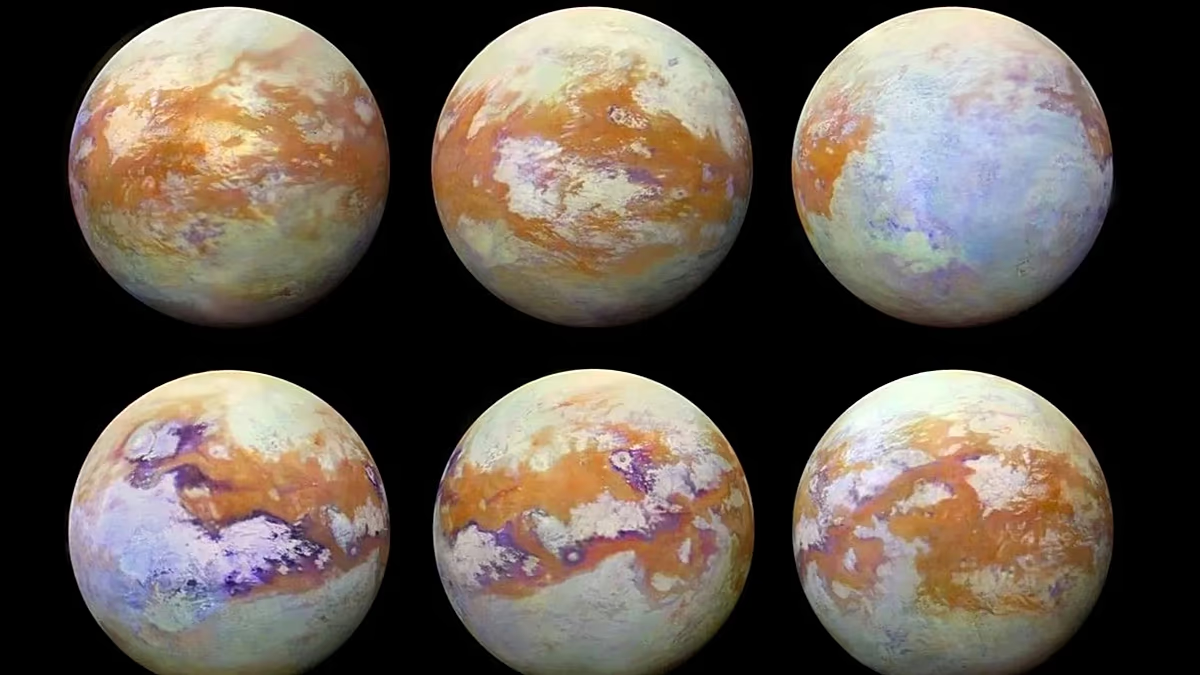
New research from NASA challenges long-held beliefs about Saturn’s largest moon, Titan, suggesting it is not home to a vast liquid ocean but rather slushy layers of ice beneath its surface. The findings could significantly alter our understanding of Titan’s potential to support life, moving away from the oceanic theory that has dominated discussions for the last decade. According to scientists, pockets of liquid water may exist within these layers, providing unique environments where microbial life could thrive.
| Article Subheadings |
|---|
| 1) Rethinking Titan’s Hydrosphere |
| 2) Implications for the Search for Life |
| 3) New Insights into Titan’s Interior |
| 4) Ongoing Skepticism and Future Missions |
| 5) Saturn’s Moon System: A Broader Perspective |
Rethinking Titan’s Hydrosphere
Recent findings from researchers at NASA’s Jet Propulsion Laboratory indicate that Titan, the largest moon of Saturn, does not harbor the extensive liquid layer previously thought to exist beneath its icy surface. Instead, a comprehensive study published in the journal Nature posits that Titan contains slushy ice layers, reminiscent of Arctic sea ice or aquifers, not a vast ocean. This revelation could reshape our understanding of Titan’s geology and hydrology.
The research stems from a meticulous reexamination of data gathered by the Cassini spacecraft, which orbited Saturn for nearly two decades. By analyzing the gravitational interactions between Titan and Saturn, scientists have deduced that the moon’s subsurface structure may contain numerous pockets of liquid water suspended within ice and slush. This redefinition of Titan’s hydrosphere dismisses the long-standing theory of a single, extensive underground ocean, which has been a focal point of astrobiological discussions over the last ten years.
Implications for the Search for Life
While the absence of a vast ocean may initially appear detrimental to the search for extraterrestrial life, researchers assert that this discovery broadens the scope of possible habitats on Titan. As observed by Baptiste Journaux, an assistant professor at the University of Washington and co-author of the study, the new findings suggest that “it expands the range of environments we might consider habitable.”
The study proposes that pockets of liquid water on Titan could feasibly reach temperatures of 21 degrees Celsius, possibly allowing for microbial life. Nutritional concentrations in these localized water pools may provide more favorable conditions for life than would a more diluted ocean environment. This indicates that, while Titan may not possess a traditional ocean, it could still support forms of life that resemble polar ecosystems found on Earth.
New Insights into Titan’s Interior
Lead author Flavio Petricca, a postdoctoral fellow at JPL, explained that Titan’s subsurface water may have undergone freezing in the past and could be in a state of melting or gradual solidification. The study’s results suggest that these icy layers extend over 340 miles deep, with an outer ice shell approximately 100 miles thick covering slush and water pools that delve up to another 250 miles.
A key breakthrough in understanding Titan’s current state stems from enhanced analysis of the moon’s seismic activity, which is influenced by Saturn’s gravitational pull. Titan’s tidal locking means it always presents the same side to Saturn, resulting in significant surface deformation. Tracing the timing of these deformations, researchers measured a 15-hour delay in the rise of Titan’s surface following peak gravitational pull. This delayed response indicates that Titan’s interior is likely composed of viscous slush rather than a liquid ocean, as a liquid would react almost instantly.
Ongoing Skepticism and Future Missions
Despite the promising evidentiary framework provided by the new study, skepticism remains in the scientific community. Luciano Iess from Sapienza University of Rome, who previously advocated for the existence of a hidden ocean, expressed doubt about the conclusions drawn from this study, labeling the evidence as “certainly intriguing” but not sufficient to exclude Titan from being classified alongside other ocean worlds.
Future missions could provide more conclusive insights into Titan’s unique environment. NASA has planned the Dragonfly mission, which aims to deploy a helicopter to Titan in the coming decade. This mission is expected to arrive on Titan by 2034 and may furnish critical data regarding the moon’s geophysical properties and potential habitability. This may transform our understanding of Titan while contributing to the ongoing search for extraterrestrial life.
Saturn’s Moon System: A Broader Perspective
Titan is not the only moon in the Saturn system under scrutiny for potential subsurface water. Other moons, including Enceladus and Mimas, also exhibit signs of water beneath their icy facades, while Jupiter’s Ganymede, a slightly larger moon, is suspected to harbor a concealed ocean. Such investigations into these celestial bodies could shed light on water’s prevalence throughout the solar system, further enriching our understanding of where life could potentially exist.
Saturn boasts 274 known moons, the most in the solar system, making it a fascinating subject for astrobiological research. The continued investigation of Titan and its fellow moons could help refine strategies in the search for life beyond Earth, focusing on a range of environments that may host microbial organisms or other life forms.
| No. | Key Points |
|---|---|
| 1 | Titan may contain slushy ice layers instead of a vast underground ocean. |
| 2 | Pockets of liquid water could exist, potentially supporting microbial life. |
| 3 | Current findings expand the range of environments considered potentially habitable. |
| 4 | Future missions like Dragonfly may provide further insights into Titan’s geology. |
| 5 | Titan’s study may also impact our understanding of other moons in the solar system. |
Summary
The newfound perspective on Titan’s makeup reshapes the landscape of astrobiological research by suggesting a complexity of environments that may allow for life. While skepticism remains regarding the conclusions, the research solidifies Titan’s position as a key player in ongoing investigations into extraterrestrial life. The upcoming Dragonfly mission may reduce uncertainties and provide further clarity about the potential for life on this enigmatic moon.
Frequently Asked Questions
Question: What are the main findings about Titan’s subsurface?
Researchers have concluded that Titan contains slushy ice layers rather than a vast liquid ocean beneath its surface, potentially housing pockets of liquid water.
Question: How do these findings impact the search for extraterrestrial life?
The discovery broadens the range of environments that could be considered habitable, suggesting that life, if it exists, may be more akin to microbial life in polar ecosystems on Earth.
Question: What future missions are planned for Titan?
NASA’s Dragonfly mission is set to launch in the coming decade, with a goal of arriving at Titan by 2034 to gather more information about its geological and hydrological characteristics.