
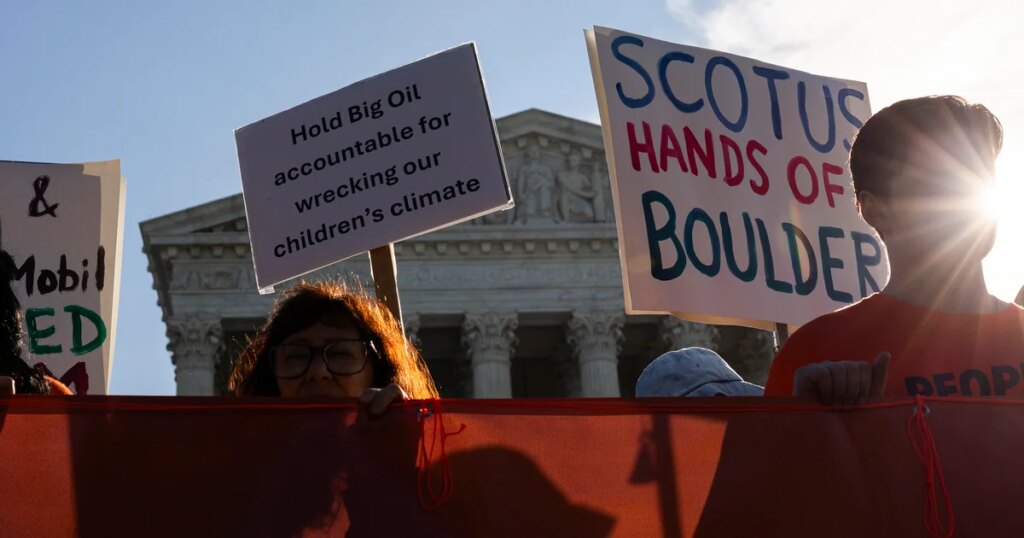
In a pivotal legal battle, the Supreme Court of the United States is addressing a significant climate-related lawsuit initiated by the city and county of Boulder, Colorado against energy giants Suncor Energy and ExxonMobil. The case, known as Suncor Energy v. Commissioners of Boulder County, questions whether local governments can hold these corporations liable for the environmental impacts stemming from greenhouse gas emissions. With the possibility of a 4-4 deadlock on the bench following Justice Samuel Alito’s recusal, the outcome could determine the future of climate-related litigation in state courts across the nation.
| Article Subheadings |
|---|
| 1) Context of the Legal Dispute |
| 2) Boulder’s Case Against the Energy Companies |
| 3) Arguments Presented in Court |
| 4) Implications of Supreme Court’s Decision |
| 5) Public Reaction and Environmental Considerations |
Context of the Legal Dispute
The Supreme Court convened to hear oral arguments in a high-stakes dispute that sits at the intersection of environmental policy and corporate accountability. The case centers around an appeal from Suncor Energy and Exxon, which challenges the ability of Boulder municipalities to sue for damages associated with climate change. This case highlights ongoing tensions between state and federal regulations concerning environmental protection and corporate conduct regarding fossil fuels.
The lawsuit first emerged in 2018, when Boulder accused the two energy companies of contributing to climate change in ways that have directly impacted the community. This legal confrontation is unique in that it potentially sets a precedent for how local governments can engage with major energy corporations on matters of environmental harm and climate adaptation. The Supreme Court’s decision could reshape the contours of this debate and dictate how similar lawsuits are conducted moving forward.
Boulder’s Case Against the Energy Companies
Boulder’s lawsuit aims to obtain damages for alleged past and future harms caused by greenhouse gas emissions from Suncor and Exxon. The city points to escalating issues like increased wildfires, extreme heat, and ecological deterioration that it claims are linked to the companies’ practices. Boulder also asserts that “unchecked” fossil fuel use has resulted from the companies’ misleading marketing strategies, contributing to environmental degradation and climate change.
The case has gone through a series of legal challenges. Initially, Suncor and Exxon attempted to transfer the lawsuit to federal court, but their efforts were rebuffed. When Boulder County District Court dismissed their claims based on federal law preclusions, the companies escalated the matter to the Colorado Supreme Court. That court upheld Boulder’s right to proceed with the case, prompting the current appeal to the United States Supreme Court.
Boulder Mayor Aaron Brockett expressed strong community support for the lawsuit during a recent rally. He stated, “People care very much about climate change in Boulder. They recognize the existential threat that it provides to our society, and so people are very supportive of this lawsuit.”
Arguments Presented in Court
During the Supreme Court discussions, Kannon Shanmugam, representing Exxon and Suncor, contended that the Constitution, along with the Clean Air Act, bars claims intended to address damages linked to interstate greenhouse gas emissions. He argued that Boulder’s approach constitutes an unprecedented attempt to utilize state law to regulate global conduct, which falls outside the jurisdiction of a single state’s authority.
Justice Brett Kavanaugh reinforced this argument, referencing previous Supreme Court decisions that assert that air and water pollution are primarily federal matters. He underscored that the implications of allowing Boulder’s claim to proceed could overwhelm the legal landscape, potentially leading to a surge of similar actions from municipalities across the United States.
In contrast, attorney Kevin Russell, representing Boulder, responded that the case does not seek to mitigate emissions but rather targets the deceptive marketing strategies of the companies. His assertion was that local governments have historically maintained the right to seek reparations for injuries sustained from activities occurring outside their jurisdiction, and he firmly believes that citizens are entitled to hold companies accountable for their actions.
Implications of Supreme Court’s Decision
The ramifications of the Supreme Court’s eventual decision extend far beyond Boulder. If the court rules in favor of the energy companies, it could significantly restrict the ability of local governments to hold corporations accountable for environmental damage, essentially shielding them from future lawsuits of a similar nature. Conversely, a ruling affirming Boulder’s right could pave the way for a wave of climate litigation across the country, empowering municipalities to take legal action against companies whose products contribute to climate change.
Such a decision would impact not only corporate strategies but also legislative efforts regarding environmental policies. The Biden administration has voiced strong support for regulating greenhouse gas emissions, and this case stands as a potential crossroads that could either enhance or hinder those efforts based on the outcome.
Public Reaction and Environmental Considerations
Public sentiment surrounding the case is notably polarized. Environmental advocates hail Boulder’s lawsuit as a critical step in holding corporations responsible for climate change effects, arguing that industries have long operated without sufficient accountability for their practices. Various advocacy groups have rallied around Boulder’s initiative to bring attention to the pressing issue of climate change litigation.
However, opponents are concerned about the implications of establishing a precedent where local governments can initiate lawsuits against major corporations on environmental grounds. Many fear this could lead to a patchwork of regulations and legal challenges across the country that might ultimately exacerbate regulatory uncertainty for businesses.
The Supreme Court’s ruling, expected by summer 2027, will not only determine the fate of Boulder’s lawsuit but could serve as a landmark decision influencing future climate-related litigation. As the case unfolds, it remains a focal point of discussion within environmental law and policies nationwide.
| No. | Key Points |
|---|---|
| 1 | The Supreme Court is reviewing Boulder’s lawsuit against Suncor and Exxon for climate change damages. |
| 2 | Justice Samuel Alito recused himself, creating potential for a deadlock ruling. |
| 3 | Arguments focus on whether federal law protects energy companies from such state-level lawsuits. |
| 4 | The outcome could significantly influence the future of climate change litigation nationwide. |
| 5 | Public opinion is divided, with strong support for Boulder’s efforts among environmental advocates. |
Summary
The case brought forth by Boulder against Suncor and Exxon represents a significant moment in the broader context of environmental accountability and climate change litigation. With the Supreme Court poised to deliver a ruling with far-reaching consequences, the implications of this case could redefine the limits of local jurisdictions in holding corporations responsible for environmental harm. As the legal proceedings continue, stakeholders across the spectrum are keenly aware of the precedent this case could set for future climate-related lawsuits.
Frequently Asked Questions
Question: What is the central issue of the lawsuit by Boulder against Suncor and Exxon?
The central issue is whether Boulder can hold these energy companies responsible for damages caused by their greenhouse gas emissions and the resulting impact on local climate conditions.
Question: Why did Justice Samuel Alito recuse himself from the case?
Justice Alito recused himself due to undisclosed reasons, though it was noted that he holds individual investments in energy companies, potentially creating a conflict of interest.
Question: What might happen if the Supreme Court rules in favor of Boulder?
If the Supreme Court rules in favor of Boulder, it could open the door for similar lawsuits from other municipalities across the United States, thereby increasing the legal accountability of energy companies for their role in climate change.