
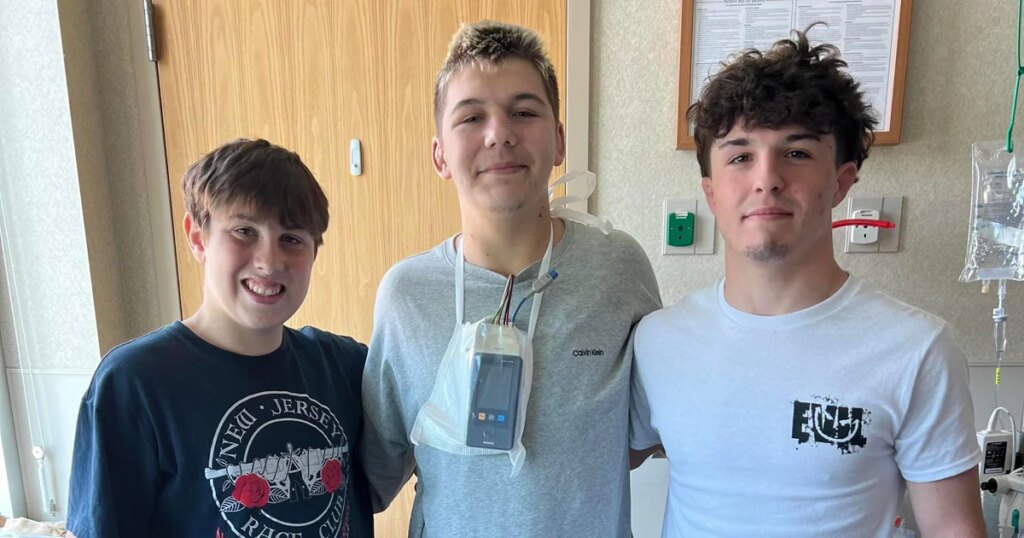
A recent incident involving an 18-year-old high school athlete, J.J. Machnik, has highlighted the critical importance of preparedness in dealing with sudden cardiac emergencies. On May 10, while working out with friends, J.J. suffered a cardiac arrest due to hypertrophic cardiomyopathy, a genetic condition that previously went undetected. Thanks to the rapid response of his friends and the subsequent medical intervention, J.J. is recovering and has shared his journey with the hope of raising awareness about this serious condition.
| Article Subheadings |
|---|
| 1) The Dreaded Phone Call |
| 2) Understanding Hypertrophic Cardiomyopathy |
| 3) Responding to Cardiac Arrest |
| 4) J.J.’s Journey Through Treatment |
| 5) Recovery and Future Outlook |
The Dreaded Phone Call
On the morning of May 10, Laura Machnik went about her daily routine, saying goodbye to her son J.J. before heading to work. J.J., an athletes, was going to work out alongside his friends Trevor Hodgins and Giovanni Scafidi. After checking in to see that he had arrived safely, Laura’s day took a devastating turn. Minutes later, she received a frantic call from Trevor’s mother, informing her that J.J. had collapsed on the treadmill.
In that moment, Laura’s fears surfaced. J.J. had been diagnosed with hypertrophic cardiomyopathy at the age of 14, a genetic heart condition that can trigger sudden cardiac arrest, particularly during physical exertion. As Laura rushed out of work, her mind raced with questions and dread. “Does he have a pulse?” she urgently asked, understanding the gravity of the situation she was about to face.
Fortunately, J.J.’s friends sprung into action. Without waiting for adult supervision, they began CPR and called for emergency services. Their quick thinking would prove crucial in the subsequent medical response.
Understanding Hypertrophic Cardiomyopathy
Hypertrophic cardiomyopathy affects approximately 1 in 500 people and is characterized by the thickening of the heart muscle, which can significantly impair its ability to pump blood effectively. There are two main types: obstructive and non-obstructive hypertrophic cardiomyopathy. J.J. was diagnosed with the non-obstructive form, which allows blood to flow but makes it more difficult for the heart to function efficiently.
His diagnosis stemmed from a routine checkup that yielded abnormal results. This detection became possible thanks to the family history, as J.J.’s father, Jeff Machnik, had also been diagnosed with the condition. Medical professionals generally recommend testing children for hypertrophic cardiomyopathy if a parent is known to have it. This highlights the importance of family medical history in preventing sudden cardiac events.
Recognizing that consistent monitoring and awareness of symptoms are paramount, J.J. went through regular checkups and discussions on physical activities appropriate for his condition. This preparation extended beyond the family, as J.J. made sure his friends and teammates knew how to administer CPR should a crisis strike.
Responding to Cardiac Arrest
As emergency medical responders arrived, they were briefed on J.J.’s medical history and illness, enabling them to act swiftly. Within minutes of the initial collapse, the CPR provided by J.J.’s friends made a significant difference, giving him a fighting chance. According to Dr. Matthew Martinez, J.J.’s cardiologist, “They gave him the best chance to survive,” emphasizing the importance of immediate action during medical emergencies.
While en route to the hospital, J.J. coded twice and needed resuscitation from paramedics. After reaching Morristown Medical Center, he was met by the medical team, where the gravity of his situation became even more apparent. Dr. Amirali Masoumi, who oversaw his care, noted that J.J.’s heart was functioning at only 20% capacity, significantly lower than the normal rate. This posed significant challenges for the clinical team.
The situation necessitated the use of advanced medical interventions, including placing J.J. in an induced coma to preserve brain function during the critical moments following his cardiac arrest. Cooling his body temperature helped protect his brain from potential damage due to reduced blood flow.
J.J.’s Journey Through Treatment
The first few days in the hospital were uncertain, with limited evidence of brain activity. A serious conversation emerged between the medical team and J.J.’s family about potential interventions like a heart transplant if he did not show signs of recovery. Fortunately, as the family prepared for the worst, J.J.’s heart began to spontaneously function again, much to everyone’s astonishment.
Over the course of his stay, J.J. demonstrated incredible resilience. As the days passed, he started to respond. By May 14, just days after his initial collapse, he began to show signs of recovery. “It was extremely rewarding to hear that,” remarked Dr. Masoumi, highlighting the turnaround in J.J.’s condition.
J.J. soon regained consciousness, with newfound energy and determination. His progress was rapid, and he transitioned to physical and occupational therapy to aid in his rehabilitation.
Recovery and Future Outlook
On May 23, just a couple of weeks after being admitted, J.J. was discharged from the hospital, his return a testament to his determination and the interventions he had received. He now has an internal cardiac defibrillator implanted in his chest, built to monitor and correct any arrhythmias that may lead to another cardiac event.
His routine will include continuous monitoring, as he adapts to life post-recovery. Currently, athletics are off the table, but that has not deterred him from participating in other significant events. With school events like prom and graduation looming, J.J. remains fully engaged, celebrating milestones he had feared would slip away.
Reflecting on his harrowing experiences, J.J. has expressed hope and gratitude. “After what happened, which was devastating, it’s been the best it can be,” he noted, emphasizing the positivity that emerged from a challenging ordeal.
| No. | Key Points |
|---|---|
| 1 | J.J. Machnik, an 18-year-old, suffered a cardiac arrest during a workout due to hypertrophic cardiomyopathy. |
| 2 | Immediate CPR from friends played a crucial role in J.J.’s survival before emergency responders arrived. |
| 3 | Hypertrophic cardiomyopathy is a genetic heart disorder that affects roughly 1 in 500 individuals. |
| 4 | J.J.’s treatment involved advanced medical technologies, including an induced coma and a heart-lung machine. |
| 5 | After significant recovery, J.J. is now adjusting to a new lifestyle, including an internal defibrillator for protection against future cardiac events. |
Summary
The story of J.J. Machnik serves as a stark reminder of the unpredictability of health issues, particularly for young athletes. His encounter with hypertrophic cardiomyopathy and the rapid responses of those around him underscore the critical nature of preparedness and awareness. As J.J. moves forward in life, his experience can inspire broader discussions about heart health, particularly in youth sports, and the importance of immediate response mechanisms during emergencies.
Frequently Asked Questions
Question: What is hypertrophic cardiomyopathy?
Hypertrophic cardiomyopathy is a genetic heart disorder that causes abnormal thickening of the heart muscle, affecting its ability to pump blood effectively.
Question: How can sudden cardiac arrest be recognized and treated?
Signs include loss of consciousness and absence of pulse. Immediate CPR and medical assistance are crucial for survival.
Question: What kind of lifestyle changes might someone experience after a cardiac event?
Post-cardiac event, individuals often require regular monitoring, potential lifestyle restrictions, and may need medical devices like defibrillators.