
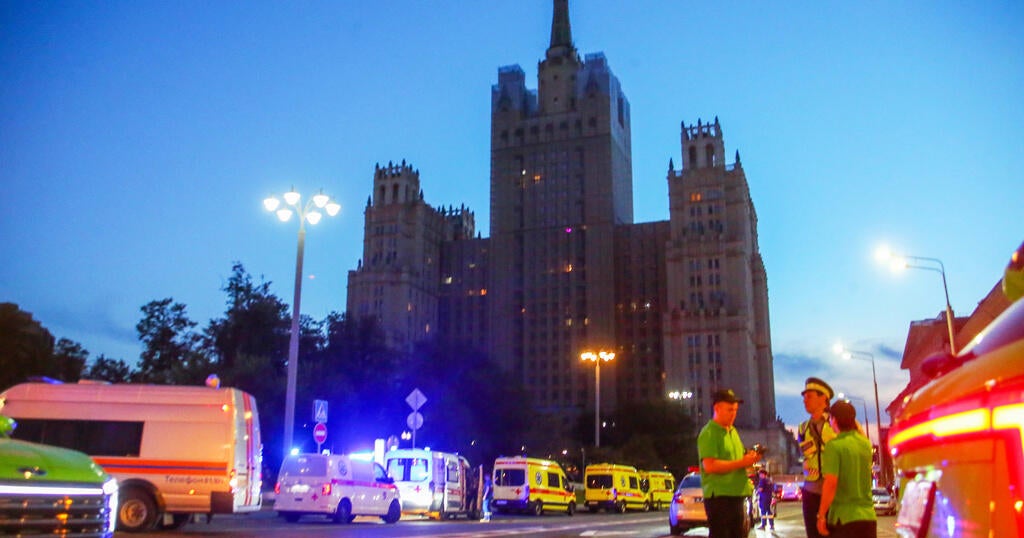
Three people were killed and 21 others were wounded after a homemade explosive device detonated Saturday at a restaurant in Moscow, Russian officials said. The blast occurred at a venue on Kudrinskaya Square, where investigators and forensic specialists were sent to examine the scene. The national anti-terrorism committee said the dead included a woman carrying the device, a security agent who stopped her and a restaurant customer. The incident comes amid a broader history of politically linked attacks and explosions in Russia, particularly since the start of the war in Ukraine in 2022.
| 1) The blast and initial casualty report |
| 2) What officials said about the device |
| 3) The response at Kudrinskaya Square |
| 4) Russia’s recent history of attacks |
| 5) The wider security and political context |
The blast and initial casualty report
An explosion struck a restaurant in Moscow on Saturday, killing three people and injuring 21 others, according to statements attributed to Russian authorities. The incident took place at Kudrinskaya Square, a location in the Russian capital where emergency services and investigators were later seen working. The reported injuries varied in severity, although officials did not provide a more detailed breakdown of the victims’ conditions.
Russia’s national anti-terrorism committee described the incident as a bombing rather than an accidental blast. Its account said a homemade explosive device detonated inside the restaurant. The committee’s statement was reported by a state news agency. The initial information identified the three fatalities as a woman who was carrying the device, a security agent who intervened and a customer who was inside the restaurant.
The circumstances surrounding the woman’s actions, including how the device entered the premises and what prompted the security agent to stop her, were not explained in the available statements. Officials also did not publicly identify the restaurant, the victims or any suspected organizer. At the time of the reports, the account focused on the explosion, the casualties and the early investigative response.
“A homemade explosive device blew up at a restaurant in Kudrinskaya Square in Moscow, killing three people.”
The statement was attributed to the national anti-terrorism committee. It established the committee’s preliminary description of the event but did not provide information about a possible motive, the construction of the device or whether anyone had been detained. Those questions remained part of the investigation described in the initial reports.
What officials said about the device
The national anti-terrorism committee said the explosion was caused by a homemade explosive device. That description indicates that officials believed the blast resulted from an intentionally assembled bomb, but the available account did not specify its materials, size, triggering mechanism or intended target. No claim of responsibility was reported, and no group was publicly linked to the incident in the information provided.
According to the committee, the woman carrying the device was among those killed. A security agent who stopped her also died, as did a customer. The sequence suggests that the device detonated during an encounter inside the restaurant, but officials did not explain the precise timing or the actions immediately preceding the blast. Further forensic work would be required to establish those details.
The committee said that 21 people were wounded. It did not identify the injured individuals or state whether they were restaurant workers, customers, emergency personnel or others in the building. The reported range of injury severity means that the consequences extended beyond the three deaths, but the early account did not offer additional medical information.
The classification of the blast as a bombing also places the incident within Russia’s counterterrorism and criminal investigation framework. However, the initial statements did not announce a formal terrorism charge, name a suspect or identify a motive. Such determinations would depend on evidence gathered at the restaurant and on subsequent investigative findings.
The response at Kudrinskaya Square
Moscow police said investigators and forensic specialists were at the site. Their presence indicated that authorities were documenting the scene, examining the remains of the device and assessing the damage. The available report did not say how long the restaurant or surrounding area was closed, whether nearby buildings were evacuated or whether officials issued broader public safety instructions.
Images posted on Russian Telegram channels showed fire engines and ambulances outside the building. Those images reflected the immediate emergency response after the blast, with rescue and medical vehicles positioned near the restaurant. The reports did not provide a separate account from emergency medical authorities or a detailed description of the building’s condition.
The first response had two overlapping purposes. Emergency personnel needed to treat people wounded in the explosion, while police and forensic teams had to secure and analyze a scene that officials described as a bombing. The presence of a suspected homemade device would also require authorities to determine whether additional hazards remained in or near the restaurant.
The early official account did not disclose whether investigators had recovered surveillance footage, interviewed witnesses or traced the device to a particular person. It also did not say whether the security agent acted alone or as part of the restaurant’s security team. Those details could help clarify the sequence of events, but they were not available in the initial reporting.
Russia’s recent history of attacks
The restaurant bombing occurred against a backdrop of several attacks in Russia in recent years. Since the start of the war in Ukraine in 2022, Ukraine’s secret service has claimed or been accused of involvement in attacks targeting Russian military officers and public figures who supported the conflict. The available account does not establish responsibility for the Moscow restaurant explosion.
In April 2025, Russia blamed Ukraine for the killing of senior general Yaroslav Moskalik in a car bomb. The accusation formed part of the wider pattern of allegations surrounding attacks on Russian officials, although the report did not provide further details about the investigation or any response from Ukraine regarding that case.
In August 2022, nationalist figure Daria Dugina was killed outside Moscow when a bomb attached to her car detonated. Many believed that her father, hardline Russian ideologue Alexander Dugin, was the intended target. The case became one of the most prominent attacks associated with the conflict’s wider political tensions.
In April 2023, pro-Kremlin military blogger Vladlen Tatarsky was killed at a cafe in St. Petersburg when a statuette handed to him exploded. The incident demonstrated how an ordinary object could be used to deliver an explosive in a public setting, although the available report does not connect that attack to the Moscow restaurant bombing.
The wider security and political context
Other attacks cited in the report involved senior military figures and nationalist personalities. In December 2024, a bomb attached to a scooter outside a Moscow apartment building killed Gen. Igor Kirillov, the head of the Russian army’s chemical weapons division, and his assistant. The method differed from the restaurant explosion, but both incidents involved explosive devices in the capital.
In May 2023, pro-Kremlin writer and nationalist Zakhar Prilepin was seriously wounded in a car explosion near Nizhny Novgorod. Another person was killed in that blast. The report also noted that Russia has faced several terrorist attacks in the past, placing the latest incident within a longer national security history rather than treating it as an isolated event.
The political meaning of the Moscow blast remained unsettled in the initial reports. No organization claimed responsibility, and officials had not publicly identified a motive. Although previous attacks in Russia have generated accusations connected to Ukraine and the war, those precedents do not establish who carried out the restaurant bombing or why it occurred.
That distinction is important in assessing the incident. A confirmed account requires evidence about the device, the person carrying it, the intended target and any network behind the attack. Until investigators release more information, the known facts are limited to the location, the reported casualties, the committee’s description of the device and the presence of police and forensic teams at the scene.
The immediate facts provide a basic outline but leave significant questions unanswered. Investigators must determine how the homemade device was assembled, where it came from and whether it was intended to detonate inside the restaurant. They will also need to establish the identities and roles of the victims, confirm the number and severity of injuries and reconstruct the movements of people near the blast.
Authorities have not said whether the explosion was directed at a particular individual, the restaurant itself or a broader public setting. The committee’s account that a woman carried the device into the venue supplies a key part of the sequence, but it does not explain her purpose or whether she knowingly transported it. Those findings would be central to any eventual criminal or terrorism case.
The investigation may also determine whether the incident was linked to any previous attack. The recent cases involving Yaroslav Moskalik, Daria Dugina, Vladlen Tatarsky, Igor Kirillov and Zakhar Prilepin show that Russian authorities have confronted different forms of explosive violence. Similarity in method alone, however, would not prove a connection.
For the public, the immediate priority was medical care for the wounded and the safety of people near Kudrinskaya Square. For investigators, the priority was preserving evidence and identifying those responsible. The initial reports did not indicate whether authorities had made arrests or issued a public warning about additional threats.
| No. | Key Points |
|---|---|
| 1 | Three people were killed and 21 were wounded in the Moscow restaurant explosion. |
| 2 | Russia’s national anti-terrorism committee said a homemade explosive device caused the blast. |
| 3 | The dead included the woman carrying the device, a security agent and a customer. |
| 4 | Police investigators and forensic specialists examined the scene at Kudrinskaya Square. |
| 5 | No responsibility or motive had been established in the initial reports. |
Summary
A homemade explosive device detonated at a Moscow restaurant on Saturday, killing three people and injuring 21. Russian officials said the dead included the woman carrying the device, a security agent who stopped her and a customer. Emergency vehicles attended the scene while police investigators and forensic specialists began examining the evidence. The attack follows several recent bombings and explosions in Russia, but the initial information did not establish a connection to those cases or identify a perpetrator.
The investigation will need to clarify the device’s origin, the intended target, the motive and any possible links to an organization or earlier attack. Until those findings are made public, the confirmed account remains limited to the reported explosion, casualties and official description of the incident.
Frequently Asked Questions
Question: Where did the explosion happen?
The explosion happened at a restaurant in Kudrinskaya Square in Moscow.
Question: How many people were killed and wounded?
Three people were killed and 21 others were wounded, according to Russia’s national anti-terrorism committee.
Question: What caused the blast?
The national anti-terrorism committee said that a homemade explosive device caused the explosion.
Question: Who were the three people killed?
Officials said the fatalities were the woman carrying the device, a security agent who stopped her and a customer.
Question: Has responsibility been established?
The initial reports did not identify a perpetrator, organization or motive, and they did not establish a link to previous attacks.