
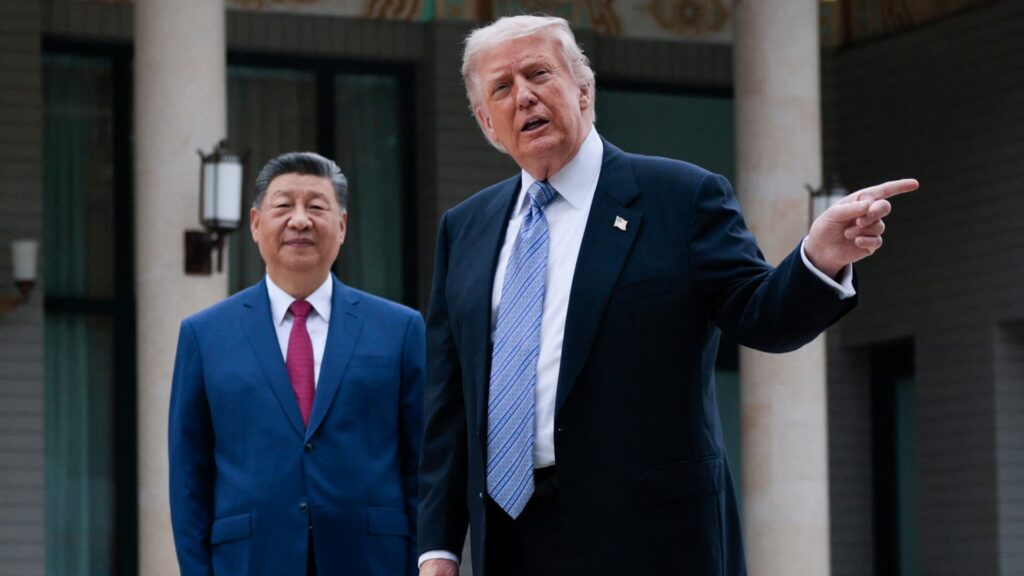
Chinese President Xi Jinping recently concluded his first formal visit to Washington in over a decade, marking a significant diplomatic event characterized by ceremonial grandeur yet yielding limited tangible agreements. The visit, which coincided with U.S. President Donald Trump‘s efforts to maintain a stable political atmosphere ahead of the midterm elections, included formal dinners and public displays but fell short of substantive resolutions on critical issues like trade and artificial intelligence. Experts noted the trip’s focus on maintaining a calm relationship rather than advancing concrete international policy changes, raising questions about the future trajectory of U.S.-China relations.
| Article Subheadings |
|---|
| 1) Trade truce continues |
| 2) ‘Thucydides Trap’ avoided? |
| 3) AI questions linger |
| 4) Fanfare, flattery flow freely |
| 5) Not seen on TV |
Trade truce continues
One of the few tangible outcomes from the recent meeting between Trump and Xi was an agreement to extend their existing trade truce, which was initially scheduled to expire soon. Announced by Treasury Secretary Scott Bessent, the extension pushes the deadline to January 10, allowing for another two months of suspended hostilities that aim to relieve tariff burdens on both sides. This extension is crucial as it reflects a collaborative approach amidst ongoing tensions regarding trade policies and economic fluctuations.
The continuation of the truce means both nations will maintain existing tariffs at lower rates while postponing further escalation, a scenario that many experts anticipated would happen. The decision also benefits the U.S. by serving as leverage in future negotiations, which are expected to take place in the upcoming months. The pressure of looming deadlines may compel both leaders to reach more decisive agreements during their scheduled meetings in November and December.
Such a cautious approach towards trade indicates the complexities each country faces domestically and internationally. Observers noted that the shorter extension may favor the U.S. in negotiations, as it provides a clear motivation for both sides to come to a more stable understanding before the new deadlines. This ongoing engagement indicates a desire to stabilize bilateral trade relations while preparing for more detailed discussions down the road.
‘Thucydides Trap’ avoided?
The term “Thucydides Trap” describes the historical tendency for rising powers to clash with established ones, often leading to conflict. Upon arriving at the White House, Xi Jinping invoked this concept, asserting that it could be overcome. This was a notable shift from prior rhetoric that had left doubt about the ability of the U.S. and China to avoid confrontation. The discussion suggested a key outcome from the summit was a mutual recognition of the need for healthy competition devoid of military aggression.
The concept of competition without confrontation emerged as a focal point during the summit. Xi emphasized maintaining a “race” rather than a “wrestle,” where both nations could strive to improve without the underlying threat of conflict. This sentiment has been reinforced by affirmations from both leaders that they can cooperate on global challenges without resorting to combat. Experts hailed this as a significant political outcome that injects some much-needed certainty into a historically volatile bilateral relationship.
While they discussed various pressing issues, including the ongoing conflict in the Middle East, Trump refrained from making comments regarding Taiwan, a point of contention that typically serves as a flashpoint in U.S.-China relations. Nonetheless, both leaders acknowledged that further discussions on this and other critical matters would be needed to establish a more robust framework for peace and strategic partnership.
AI questions linger
Despite the backdrop of growing concerns surrounding advanced artificial intelligence technologies, the summit yielded scant commitments from either side to address the potential risks posed by AI advancements. Trump indicated he wished to maintain the status quo regarding AI, echoing China’s position, which calls for developing the technology responsibly and under strict human oversight.
As Xi articulated during the meeting, both nations share a responsibility to manage AI effectively, emphasizing cooperation as the path forward. However, the absence of specific plans or commitments raised eyebrows among analysts who argue that the lack of concrete dialogue surrounding such a significant issue is troubling, given AI’s potential impact on global security.
Experts noted that both leaders are navigating complex and competitive political landscapes at home. Still, failing to address the risks associated with unchecked AI growth may lead to heightened tensions in the future, particularly as both nations compete in technological innovation. There remains an urgent need for dialogue that expands beyond leader-to-leader interactions to include institutional frameworks.
Fanfare, flattery flow freely
From the moment Xi Jinping arrived in Washington, he received a lavish reception that set the tone for the high-profile summit. With a red carpet rolled out at Joint Base Andrews and a ceremonial welcome featuring military honors, both leaders engaged in a grand display of diplomacy befitting such a significant meeting.
At the summit’s culminating moments, Trump and Xi participated in a military review complete with music, synchronized performances, and impressive demonstrations of military might. Such opulence is often characteristic of state visits, but observers noted that Trump’s preparations and treatment of Xi exceeded those of many of his predecessors.
The extensive ceremonial focus raises questions about the balance between pageantry and substantive discussions. Analysts recommend that while such fanfare can strengthen personal rapport, the time allotted for meaningful policy dialogues was noticeably reduced in this case. Achieving a harmonious relationship demands more than just ceremonial decorum; it requires actionable commitments that will shape the trajectory of the U.S.-China relationship moving forward.
Not seen on TV
Despite the grand visuals and ceremonial displays, many of the events during Xi’s visit were notably absent from major television broadcasts. This was attributed to a recently lifted suspension of TV coverage that impacted various media outlets, which had found themselves restricted from reporting on certain high-stakes political events.
While a federal court ruled for access to be restored, prominent networks remained cautious and were initially prevented from covering the widely anticipated events surrounding the summit. The Trump Administration faced criticism for limiting access, which many commentators argue undermines transparency and public engagement in significant diplomatic affairs.
Once coverage was fully restored, Trump expressed dissatisfaction about the lack of broadcast coverage during the welcoming ceremony for Xi, implying that the spectacle was “made for television.” The contrasting availability of coverage added a layer of complexity to media narratives surrounding the meeting and the administration, further raising questions about the dynamics of power and transparency within U.S. media politics.
| No. | Key Points |
|---|---|
| 1 | The state visit marked the first formal meeting between Xi Jinping and Donald Trump in over a decade, focusing on trade and diplomacy. |
| 2 | Both leaders agreed to extend the existing trade truce until January 10, illustrating a commitment to avoid immediate escalations in trade tensions. |
| 3 | While discussions included topics like the ‘Thucydides Trap’, significant agreements on pressing global issues, including AI and the Middle East, were not reached. |
| 4 | The pomp surrounding the summit included ceremonial events meant to emphasize the importance of U.S.-China relations, but critics noted a lack of substantive dialogue. |
| 5 | Television coverage limitations during the visit raised concerns about transparency and media access in an era of heightened political tensions. |
Summary
The recent summit between Xi Jinping and Donald Trump highlighted both nations’ inclination towards maintaining diplomatic decorum amidst a complex web of global challenges. While the ceremonial aspects of the visit were grand and well-coordinated, the lack of definitive agreements on key issues raises questions about the trajectory of U.S.-China relationships moving forward. Both leaders face unique political pressures that shape their interactions, making it crucial for them to seek tangible outcomes that extend beyond symbolic gestures.
Frequently Asked Questions
Question: Why is the trade truce significant for both countries?
The trade truce is significant as it allows both nations to avoid escalating tariffs that could severely impact their economies. By extending the truce, both leaders aim to stabilize their economic landscapes and avoid triggering further trade conflicts that could have global repercussions.
Question: What does the ‘Thucydides Trap’ mean in this context?
The ‘Thucydides Trap’ refers to the historical pattern where a rising power threatens to displace an existing power, often leading to conflict. In this context, it underscores the need for the U.S. and China to navigate their competitive relationship without resorting to military confrontation.
Question: What were the key issues surrounding AI discussed during the summit?
While both leaders acknowledged the need for responsible AI development, no concrete agreements were reached on how to handle the risks associated with rapidly advancing AI technologies. The lack of specifics on this vital issue raises concerns about future cooperation in this increasingly critical field.