
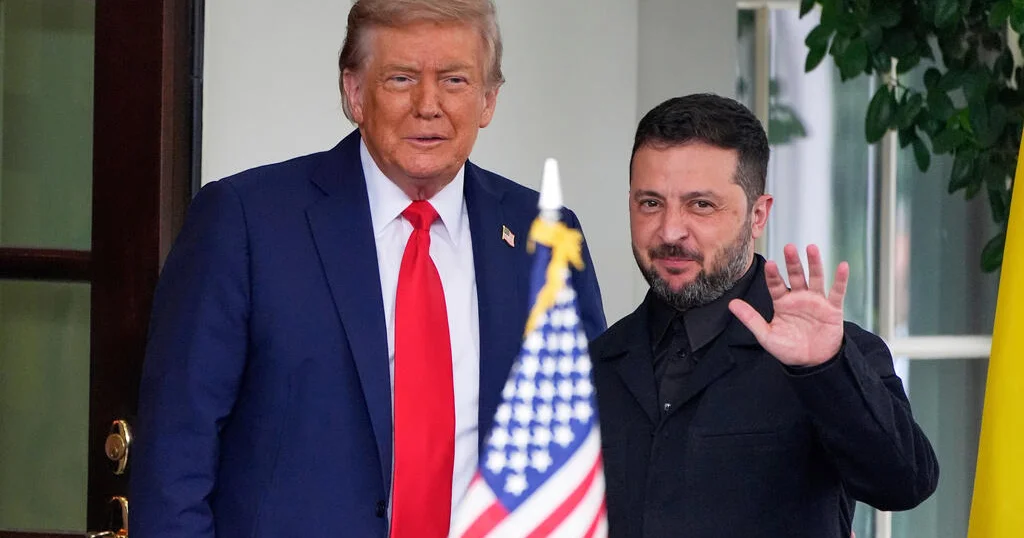
Former President Donald Trump made headlines on Saturday with a controversial statement suggesting that Ukraine needs a new leader, implying that the current president, Volodymyr Zelenskyy, has failed to effectively pursue peace in the ongoing war with Russia. As he addressed reporters before leaving the White House, Trump criticized Zelenskyy for not reaching potential agreements and linked Ukraine’s recent military actions to rising diesel prices affecting U.S. consumers. In the backdrop, Ukraine’s Foreign Minister defended Zelenskyy’s leadership, emphasizing that he remains supported by the Ukrainian populace in their fight against Russian aggression.
| Article Subheadings |
|---|
| 1) Trump’s Call for New Leadership in Ukraine |
| 2) Response from Ukraine’s Foreign Minister |
| 3) Criticism of U.S.-Russia Diesel Deal |
| 4) Human Cost of the Ongoing Conflict |
| 5) Rising Tensions Following Recent Strikes |
Trump’s Call for New Leadership in Ukraine
In a striking statement, former President Donald Trump expressed the belief that Ukraine should appoint a new leader, claiming that Volodymyr Zelenskyy has not done enough to negotiate peace in the ongoing conflict with Russia. Trump’s remarks came as he prepared to depart the White House for a trip to Tennessee, where he reiterated his position on the need for effective leadership to bring about a resolution to the war. The former president was quoted as saying, “I suggest they get a new leader who can make a deal because he could have made many deals and for some reason he never does.”
Trump’s comments reflect a broader criticism of Ukraine’s handling of the conflict, notably following its recent military strikes on Russian oil refineries, which he claimed contribute to high diesel prices in the United States. This introduces the complexity of international relations and domestic economic concerns, particularly as the U.S. approaches midterm elections. Trump’s assertion that Zelenskyy has “lost 30% of your country” aligns with his overall narrative that the current administration has mishandled various issues related to the war.
Response from Ukraine’s Foreign Minister
In direct response to Trump’s statements, Ukraine’s Foreign Minister Andriy Sybiga defended President Zelenskyy, asserting that he retains the trust of the Ukrainian people and has their unwavering support. Sybiga took to social media platform X (formerly Twitter) to express Ukraine’s collective sentiment, stating, “He has the support of the Ukrainian people, and they have the right to decide,” while further emphasizing that international commentary on Zelenskyy only reinforces his leadership capabilities.
This exchange showcases the tensions that arise when external figures weigh in on domestic affairs in foreign countries. Zelenskyy’s government remains focused on resisting Russian aggression and maintaining solidarity among its citizens, despite the war’s toll. By emphasizing the will of the Ukrainian populace, Sybiga aims to counter Trump’s narrative and bolster confidence in Zelenskyy’s leadership amid ongoing conflict.
Criticism of U.S.-Russia Diesel Deal
The former president further stirred controversy with his comments regarding a new diesel fuel deal between the United States and Russia, stating that the agreement would further complicate the geopolitical situation and potentially provide financial assistance to Moscow during its war in Ukraine. Trump announced that Russia would begin supplying significant quantities of diesel fuel to the U.S. market, despite the existing sanctions aimed at crippling Russia’s energy sector as a means to diminish its war capabilities.
Zelenskyy was quick to condemn the deal, describing it as detrimental and a “bankroll” for Russia’s continuing military efforts in Ukraine. He articulated his concerns online, declaring, “It plays into Russia’s hands — allowing it to kill more, wage war for longer.” Former Vice President Mike Pence also criticized the deal, labeling it a betrayal of Ukraine and urging Trump to reverse it to demonstrate U.S. commitment to opposing Russian president Vladimir Putin and his ambitions.
Human Cost of the Ongoing Conflict
As political dialogues unfold, the human damage inflicted by the war in Ukraine continues to be alarming. Recent Russian airstrikes led to the deaths of at least 20 individuals, including children, in the Zaporizhzhia region as civilians faced devastating fallout from the ongoing conflict. The head of the regional military administration, Mykhailo Semikin, reported that these aerial assaults resulted in significant injuries and destruction of residential properties.
These tragic incidents exemplify the grim realities that accompany geopolitical maneuvers, wherein everyday citizens bear the brunt of international decisions. The continuous bombardments across different fronts in Ukraine raise concerns regarding civilian safety and the critical need for diplomatic solutions to prevent further escalation. Reports indicate that the humanitarian crisis is continuing to worsen, underlining the urgency of re-evaluating strategies in order to address the situation holistically.
Rising Tensions Following Recent Strikes
In light of the recent tragedies, Zelenskyy publicly condemned Russia’s actions in a post, linking the aerial bombardments to the easing of pressures through international agreements, particularly regarding the diesel supply deal. He remarked, “Today, Russia expressed its thanks for the lifting of sanctions on diesel exports by dropping five glide bombs on residential buildings.” This connection illustrates the troubling pattern whereby military actions are perceived to be a direct response to the political landscape, underlining the necessity for coordinated international pressure to hold aggressors accountable.
As Ukraine grapples with the consequences of heightened tensions, it remains at the mercy of external decisions that could influence the trajectory of the conflict. These developments warrant a closer examination of the international community’s role and responsibility in mitigating violence and protecting vulnerable populations caught in the crossfire.
| No. | Key Points |
|---|---|
| 1 | Former President Trump suggested Ukraine needs new leadership amid the ongoing conflict with Russia. |
| 2 | Ukraine’s Foreign Minister Sybiga defended Zelenskyy as the rightful leader with the support of the people. |
| 3 | Trump criticized Ukraine’s military strategies while linking them to rising fuel prices affecting the U.S. |
| 4 | Recent Russian strikes led to significant civilian casualties, raising further humanitarian concerns. |
| 5 | Zelenskyy warned that easing sanctions through fuel deals could prolong the conflict and increase civilian suffering. |
Summary
The ongoing conflict in Ukraine escalates as the former U.S. President Donald Trump vocally critiques the current leadership and questions Ukraine’s strategies in negotiating peace. His remarks have drawn varied responses, particularly from Ukrainian officials who emphasize the resolve of their nation amidst adversity. As international stakeholders navigate the complexities of diplomacy and trade, both the human suffering and the urgent need for effective political solutions continue to shadow the unfolding events. The interplay between political assertions and the stark realities of war highlights the multifaceted nature of the situation, as navigating through the geopolitics remains an intricate and pressing challenge.
Frequently Asked Questions
Question: What did Trump suggest regarding Ukraine’s leadership?
Trump suggested that Ukraine needs a new leader, implying that President Zelenskyy has failed to negotiate successfully with Russia, which has prolonged the conflict.
Question: How did Ukraine’s Foreign Minister respond to Trump’s comments?
Andriy Sybiga, Ukraine’s Foreign Minister, defended Zelenskyy, asserting that he has the backing of the Ukrainian people and that external opinions reinforce his leadership effectiveness.
Question: What are the implications of the recent diesel deal between the U.S. and Russia?
The diesel deal has sparked criticism from Ukrainian leaders as it is perceived to financially support Russia’s war efforts, potentially prolonging the conflict and resulting in more civilian casualties.