
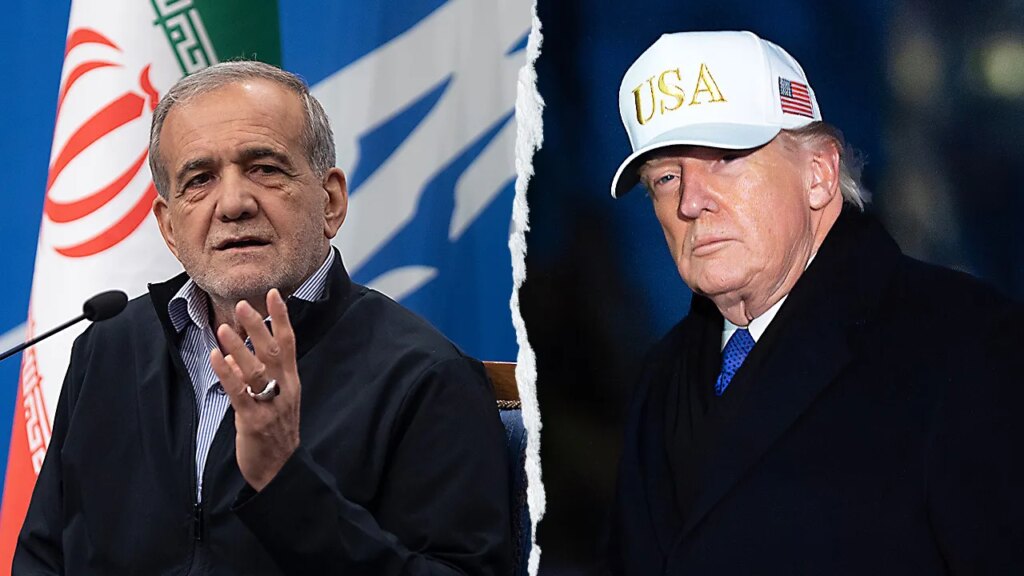
In a tense series of speeches at the United Nations General Assembly, Iranian President Masoud Pezeshkian criticized the United States and Israel for their actions against Iran, while U.S. President Donald Trump responded with a stark warning about Tehran’s choices. The diplomatic exchanges reflect the ongoing complexities of U.S.-Iran relations, characterized by both pointed rhetoric and attempts at behind-the-scenes negotiations. Analysts suggest that both leaders are navigating a delicate balance between confrontation and dialogue in an attempt to strengthen their respective positions in the international arena.
| Article Subheadings |
|---|
| 1) Pezeshkian’s Address: Accusations Against the U.S. and Israel |
| 2) Trump’s Response: Threats and Diplomatic Overtures |
| 3) The Predictability of Their Rhetoric |
| 4) Diplomatic Discussions Amidst the Tensions |
| 5) The Broader Implications for U.S.-Iran Relations |
Pezeshkian’s Address: Accusations Against the U.S. and Israel
During his speech at the UN General Assembly on September 23, 2026, Masoud Pezeshkian accused the United States and Israel of perpetuating violence and aggression towards Iran. He characterized his nation as a victim of unwarranted attacks, stating, “We have only defended ourselves. We are not terrorists.” The president presented a poignant image of a school that he claimed was hit by an airstrike, emphasizing the suffering of innocent Iranian citizens caught in the crossfire of geopolitical conflict. This rhetoric demonstrates Pezeshkian’s strategy to portray Iran not as an aggressor, but as a country defending itself against external threats, particularly those posed by the U.S. and Israel. The speech highlights Iran’s ongoing narrative in international relations, where it seeks to position itself as a resolute and peaceful nation facing unjust aggression.
Trump’s Response: Threats and Diplomatic Overtures
In contrast to Pezeshkian’s accusations, President Donald Trump addressed the assembly with a clear and assertive stance regarding Iran’s future. He underscored his administration’s readiness to escalate military action if necessary, stating, “Or do I annihilate the Islamic Republic, and do it quickly, never giving them a chance to kill and destroy people and countries again?” This declaration reflects both a warning to Iran and a signal of U.S. military readiness. However, Trump also hinted at the possibility of negotiation by mentioning that U.S. officials, including special envoy Steve Witkoff and Jared Kushner, had engaged in discussions with Iranian representatives. This dual approach of both threatening military action and leaving room for diplomatic dialogue mirrors the complexities of U.S. foreign policy with Iran as both nations maneuver for strategic advantage on the global stage.
The Predictability of Their Rhetoric
Political analysts noted that the statements from both Pezeshkian and Trump were somewhat expected given the historical context of U.S.-Iran relations. According to experts, both leaders are entrenched in their respective positions, making their speeches predictable. Behnam Ben Taleblu, a foreign policy expert, indicated that the exchange of barbs is typical given the ongoing tensions. He remarked that despite the fervor of the speeches, both countries’ broader diplomatic strategies remain unchanged. This suggests a return to familiar patterns of confrontation where both sides are more likely to reinforce their narratives rather than seek a resolution. The repetition of these themes serves to galvanize domestic support but may fail to create an environment conducive to meaningful dialogue.
Diplomatic Discussions Amidst the Tensions
Behind this impassioned rhetoric, efforts for diplomacy persist. Reports indicate that U.S. officials had engaged Iranian representatives on the sidelines of the General Assembly to discuss means of de-escalating tensions. These discussions, described as productive, exemplify a willingness from both sides to explore diplomatic pathways. Nonetheless, the reliance on indirect negotiations through intermediaries highlights the mistrust that pervades U.S.-Iran relations. Both countries seem trapped in a cycle of public confrontation while privately seeking ways to ease tensions, further muddying the line between diplomacy and aggression in their exchanges.
The Broader Implications for U.S.-Iran Relations
As both Pezeshkian and Trump continue to leverage their respective platforms to bolster their political positions, the implications for future U.S.-Iran relations remain complex and uncertain. While their public statements may suggest an unwillingness to compromise, the backchannel discussions reveal an underlying acknowledgment of the need to find common ground. Experts caution that should Iran maintain its current policies related to its nuclear ambitions and regional activities, genuine progress may remain elusive. This ongoing dichotomy between aggressive rhetoric and tentative diplomatic efforts underscores a challenging diplomatic landscape where both nations must navigate their way forward carefully amid rising tensions.
| No. | Key Points |
|---|---|
| 1 | Pezeshkian accused the U.S. and Israel of aggression against Iran. |
| 2 | Trump warned of military action while hinting at diplomatic talks. |
| 3 | Analysts found both leaders’ speeches predictable given historical tensions. |
| 4 | U.S. officials engaged in discussions with Iranian representatives at the UN. |
| 5 | Future U.S.-Iran relations remain uncertain amid a cycle of confrontation and diplomacy. |
Summary
The recent exchanges between Presidents Masoud Pezeshkian and Donald Trump during the UN General Assembly illuminated the fraught relationship between Iran and the United States. Pezeshkian’s accusations highlight Iran’s narrative of victimhood, while Trump’s threats underscore ongoing U.S. military readiness. Despite the confrontation, backchannel diplomacy suggests both nations may be exploring potential pathways to de-escalation, albeit hindered by deep-rooted mistrust. The complex interplay of assertive rhetoric and tentative negotiations continues to characterize U.S.-Iran relations, leaving significant questions about their future direction.
Frequently Asked Questions
Question: What were the main accusations made by President Pezeshkian at the UNGA?
President Pezeshkian accused the United States and Israel of orchestrating attacks on Iran, presenting the country as a victim of unwarranted aggression.
Question: How did President Trump respond to Pezeshkian’s speech?
President Trump warned of potential military action against Iran while indicating that the U.S. is open to negotiations under the right circumstances.
Question: What do analysts say about the predictability of the leaders’ speeches?
Analysts suggest that both leaders’ speeches were predictable, reflecting established patterns in U.S.-Iran relations characterized by confrontation and a lack of meaningful diplomatic engagement.