
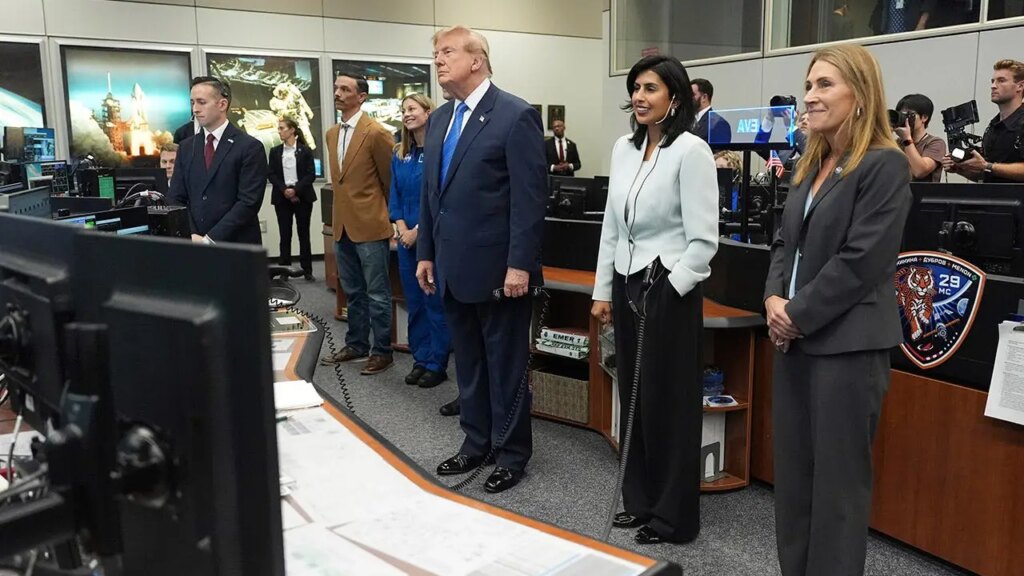
In a significant event at NASA’s Johnson Space Center in Houston, President Donald Trump engaged with astronauts currently stationed aboard the International Space Station (ISS). This interaction followed his earlier recognition of the Artemis II crew, who were awarded the Congressional Space Medal of Honor. During the phone call, which took place on August 28, 2026, Trump expressed his admiration for the astronauts’ work while playfully revealing his own reluctance to travel to space.
| Article Subheadings |
|---|
| 1) President Trump’s Communication with ISS Crew |
| 2) Acknowledgment of the Artemis II Crew |
| 3) Promoting Space Exploration and the U.S. Space Force |
| 4) Future of Space Exploration Initiatives |
| 5) Implications of Space Policy Decisions |
President Trump’s Communication with ISS Crew
On August 28, 2026, President Donald Trump made headlines with a direct phone call to astronauts aboard the ISS, where they were engaged in several ongoing spacewalks. This event marked a notable moment in the American space exploration narrative. The communication took place against the backdrop of a ceremony honoring the Artemis II mission’s crew members, highlighting Trump’s commitment to supporting U.S.-led space initiatives.
During the call, which initiated from Houston, Trump remarked on the excitement surrounding space travel, sparking interest from many Americans. “I wouldn’t do it,” he humorously stated, revealing his reservations about traveling to space while acknowledging those who find it exhilarating.
In the call, astronauts shared their enthusiasm about their work, emphasizing their focus on critical assignments aboard the ISS. The interaction was not only a morale booster for the team but also demonstrated Trump’s support for science and exploration.
Acknowledgment of the Artemis II Crew
Prior to the call with the astronauts, Trump paid tribute to the crew of the Artemis II mission. The astronauts—Christina Koch, Victor Glover, Reid Wiseman, and Jeremy Hansen—each play a vital role in advancing space exploration. At the ceremony, they were awarded the Congressional Space Medal of Honor, a prestigious recognition of their contributions to space science.
Trump’s speech commended the crew as “pioneers,” underscoring their role in inspiring future generations to pursue careers in science and technology. The presentation of the Congressional Space Medal is significant as it represents the collaboration between government and space exploration, enhancing national pride and highlighting American capabilities in aeronautics.
Furthermore, during the medal presentation, Trump made it clear that he intends to foster an environment that supports space exploration. He later offered the astronauts the opportunity to visit the White House upon their return, a gesture aimed at reinforcing their importance and stimulating public interest in space missions.
Promoting Space Exploration and the U.S. Space Force
In a broader context, Trump’s call and the subsequent awards ceremony emphasized his administration’s commitment to space exploration and the newly established U.S. Space Force. The president signed an executive order to create the U.S. Space Force Academy, reflecting ambitions to enhance military readiness in space and train the next generation of leaders in aerospace defense.
During the ceremony, Trump elaborated on his vision, stating, “It will be at that same level when you serve West Point, Air Force, Coast Guard, Navy, Annapolis.” This highlights his intent to align space education with traditional military academies, cementing the status of space as a critical frontier for national defense.
Additionally, this new focus on the Space Force coincides with significant advancements in space technology and exploration, where collaboration among various government agencies and private sectors is vital. The administration’s strategy aims to ensure that the U.S. remains at the forefront of space innovations and international partnerships in space exploration.
Future of Space Exploration Initiatives
Looking ahead, the initiatives launched during Trump’s administration are paving the way for more ambitious space exploration projects. With NASA’s Artemis program, there are plans to establish a sustainable human presence on the Moon and eventually send humans to Mars. This progressive agenda is backed by considerable investments in technology development and launch capabilities.
Astrophysicists and space experts view this trajectory positively, anticipating immense opportunities for advancing scientific knowledge and technological innovation. The Artemis II mission, for instance, serves as a critical step towards human landings on the Moon, setting a foundation for future Mars exploration.
Moreover, there is a growing emphasis on international collaborations in space missions, with partnerships being explored with space agencies worldwide. Countries like Canada and those in the European Union are actively participating in collaborative missions that could enhance research and exploration efforts, fostering global cooperation in the pursuit of discoveries beyond Earth.
Implications of Space Policy Decisions
The recent policy decisions surrounding space exploration have numerous implications, both within the U.S. and on an international scale. With the establishment of the U.S. Space Force, a new dimension has been added to national security strategies. This indicates an evolving perspective on the importance of space as a domain for future conflicts and cooperative endeavors.
Policymakers are now tasked with navigating the challenges of managing resources, ensuring sustainability in space, and maintaining peaceful relations with other nations engaged in space exploration. The upcoming decades are likely to witness debates on space laws and treaties that govern the behavior of countries in outer space.
Additionally, the U.S. impetus towards robust space programs sends a clear message to potential competitors. Nations aiming for significant advancements in space technology may feel pressured to accelerate their own exploration programs, enhancing the global space race.
| No. | Key Points |
|---|---|
| 1 | President Trump engaged with astronauts aboard the ISS, showcasing support for space exploration. |
| 2 | The crew of Artemis II was awarded the Congressional Space Medal of Honor during a ceremony at NASA. |
| 3 | Trump signed an executive order to establish the U.S. Space Force Academy, promoting military readiness in space. |
| 4 | Future space initiatives aim to establish a sustainable human presence on the Moon and beyond. |
| 5 | The establishment of a U.S. Space Force highlights the evolving significance of space in national security strategy. |
Summary
The recent interactions between President Donald Trump and American astronauts underline a renewed commitment to U.S. space exploration and national defense initiatives in the realm of outer space. The recognition of the Artemis II crew serves as a pivotal moment in acknowledging the vital role of astronauts and space missions in inspiring future projects and collaborations. As the U.S. forges ahead with ambitious objectives, it solidifies its international standing in the evolving landscape of space exploration.
Frequently Asked Questions
Question: What is the significance of the Congressional Space Medal of Honor?
The Congressional Space Medal of Honor is awarded to individuals who have made significant contributions to the United States’ space program and achievements in space exploration.
Question: What are the main goals of the Artemis program?
The Artemis program aims to return humans to the Moon, establish a sustainable presence by the end of the decade, and prepare for future crewed missions to Mars.
Question: What role does the U.S. Space Force play in space policy?
The U.S. Space Force is responsible for organizing, training, and equipping military personnel to protect U.S. interests in space, ensuring challenges in space security are adequately addressed.