
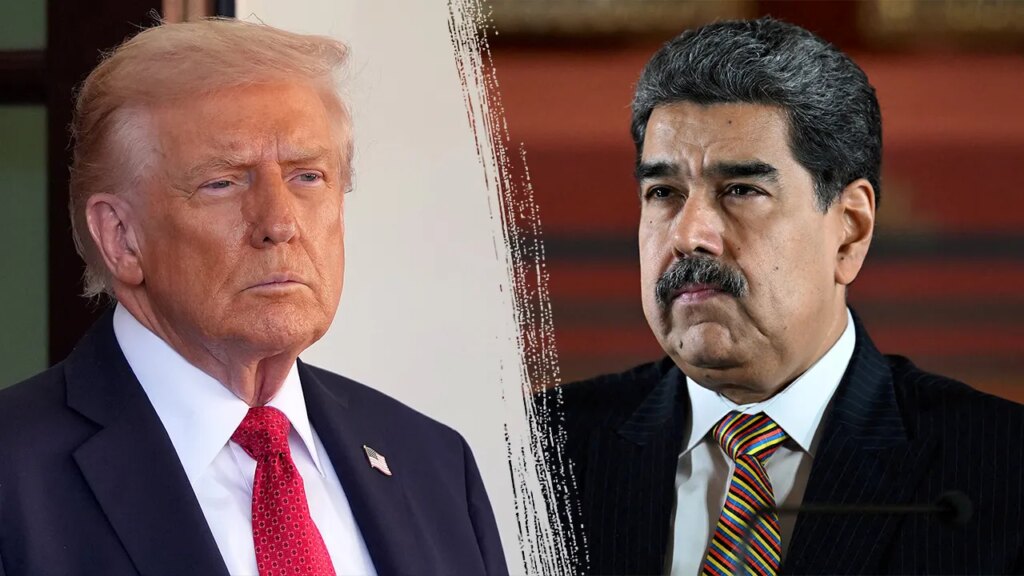
In a recent escalation of rhetoric, President Donald Trump declared Venezuela’s airspace closed, citing the country’s history of sending criminals into the United States. While onboard Air Force One, Trump clarified that this statement should not be interpreted as a sign of imminent military action. This warning follows growing tensions between the U.S. and Venezuela, further complicated by a recent phone conversation between Trump and Venezuelan President Nicolás Maduro.
| Article Subheadings |
|---|
| 1) Trump’s Declaration on Venezuela’s Airspace |
| 2) Tension in U.S.-Venezuela Relations |
| 3) Recent Military Actions Against Drug Traffickers |
| 4) Maduro’s Response to U.S. Threats |
| 5) The Broader Implications of Military Posturing |
Trump’s Declaration on Venezuela’s Airspace
President Trump’s comments regarding Venezuela’s airspace were made during a press conference aboard Air Force One. He stated, “Consider THE AIRSPACE ABOVE AND SURROUNDING VENEZUELA TO BE CLOSED IN ITS ENTIRETY.” His assertion was underlined by a narrative that accused Venezuela of harboring criminals, gang members, and drug traffickers who threaten U.S. safety. This declaration reflects a heightened state of alarm within the White House over Venezuela’s influence on drug trafficking into the United States.
Trump’s comments were also not made in a vacuum. Both historically and currently, Venezuela has been viewed with suspicion by U.S. officials due to its ambiguous international affiliations, particularly with nations that challenge U.S. dominance in the region. However, when pressed about whether the closure signaled potential military action, Trump cautioned against reading too much into the warning, suggesting a more complex geopolitical strategy could be at play.
Tension in U.S.-Venezuela Relations
The relationship between the U.S. and Venezuela has been rocky for years, owing to ideological differences and incidents that have escalated tensions. Recently, Venezuela’s failure to adequately control drug trafficking has added to the discord. The increasing flow of narcotics into the U.S. has sparked criticism from U.S. officials, leading to calls for strong responses and strategic actions.
According to reports, communication between U.S. and Venezuelan officials, including Trump’s phone call with President Maduro, has become more frequent. In this call, Trump confirmed the discussion but refrained from giving any specifics. He characterized the interaction as neutral but failed to disclose the subject matter, further fueling uncertainty about the future of diplomatic relations between the two nations.
Recent Military Actions Against Drug Traffickers
Since September, the Trump administration has ramped up military operations against alleged drug trafficking activities in Latin America. Reports indicate that the U.S. has conducted over 20 military strikes targeting boats suspected of being involved in drug smuggling operations. These strikes have reportedly resulted in the elimination of over 82 suspected narco-terrorists, indicating a robust military stance against drug trafficking in the region.
The U.S. has also increased its naval presence in the Caribbean as part of these operations. Military officials have emphasized the need to prioritize action against threats that emanate from Venezuelan waters, and this has become a critical aspect of the administration’s drug enforcement strategy. The strikes are indicative of a broader commitment to curtail the inflow of narcotics into the U.S., as part of a war on drugs that appears to be intensifying under the current administration.
Maduro’s Response to U.S. Threats
In response to heightened U.S. military presence and threats, President Maduro has maintained a defiant stance against what he terms “imperialist aggression.” Maduro’s recent speeches have rallied Venezuelans to prepare for confrontation, emphasizing resistance against foreign intervention. He has appeared in public events wielding a ceremonial sword that belonged to the independence hero Simón Bolívar, framing the current geopolitical struggle as a fight for national sovereignty.
During a recent rally, Maduro proclaimed, “Let no one make excuses. Failure is not an option. The homeland demands it!” This rhetoric aims to galvanize support within Venezuela, as he presents his leadership as pivotal in confronting external threats.
The Broader Implications of Military Posturing
The current military and rhetorical strategies adopted by both the U.S. and Venezuela carry significant implications not only for their bilateral relationship but also for broader regional stability. U.S. military engagement in Latin America is often met with criticisms and protests, particularly regarding the perception of military interventionism.
Maduro’s alarmist rhetoric and calls for preparedness among his military and civilian supporters echo historical patterns of resistance to U.S. influence in Latin America. The stakes are high, as any miscalculation could lead to escalation that might destabilize the region further, affecting countries beyond just Venezuela and the U.S.
| No. | Key Points |
|---|---|
| 1 | Trump has declared Venezuela’s airspace closed, citing threats from criminals and drug traffickers. |
| 2 | Tensions between the U.S. and Venezuela have intensified due to drug trafficking issues. |
| 3 | The U.S. has conducted multiple military strikes against drug trafficking boats in recent months. |
| 4 | Maduro has responded to U.S. threats by urging Venezuelans to prepare for confrontation. |
| 5 | The military posturing carries implications for regional stability and U.S.-Latin American relations. |
Summary
The recent declarations and military actions by the U.S. regarding Venezuela signal a significant increase in hostilities between the two nations. As both the U.S. and Venezuelan governments adopt more aggressive stances, the potential for conflict looms large. The developments call for careful monitoring as they could affect not only the bilateral relations but also wider Latin American political dynamics.
Frequently Asked Questions
Question: What led to the closure of Venezuela’s airspace declaration?
President Trump issued this declaration as a response to perceived threats from Venezuela, including the alleged export of criminals and drug traffickers into the U.S.
Question: How has the U.S. responded militarily to drug trafficking from Venezuela?
The U.S. has conducted over 20 military strikes against drug trafficking vessels in Latin American waters since September, heightening its military presence in the Caribbean.
Question: What is Maduro’s stance regarding U.S. military actions?
Venezuelan President Nicolás Maduro has condemned U.S. military threats as “imperialist aggression” and has called for Venezuelans to mobilize against potential foreign intervention.