
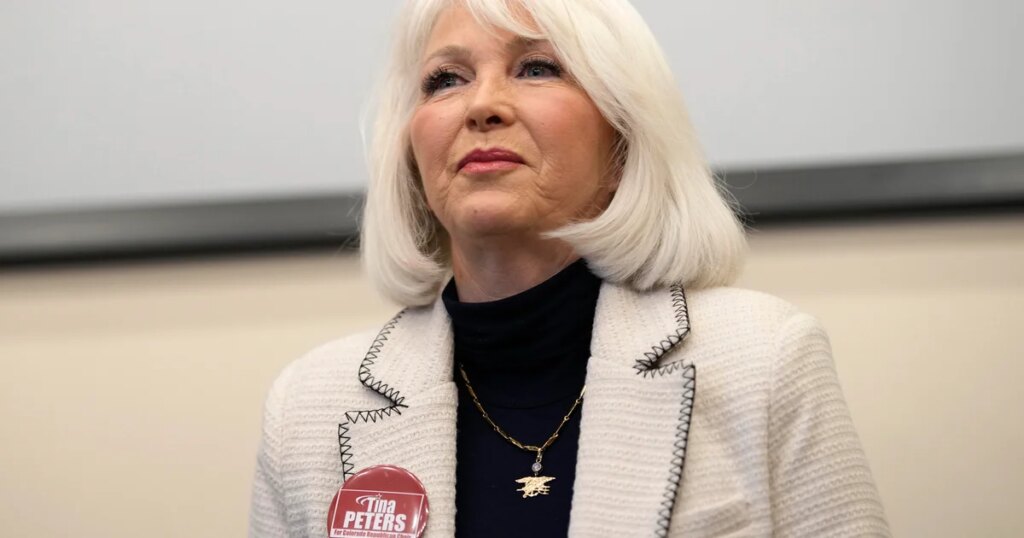
In a significant and controversial move, former President Donald Trump announced on Thursday evening that he would be granting a pardon to Tina Peters, a former county clerk in Colorado who is currently serving a nine-year state sentence. Peters was convicted for her participation in unauthorized access to voting machines, an act Trump claims was a quest for electoral integrity. However, legal experts argue that the presidential pardon power only applies to federal crimes, raising questions about the implications of this decision.
| Article Subheadings |
|---|
| 1) Overview of Tina Peters’ Case |
| 2) Trump’s Claims on Election Integrity |
| 3) Legal Implications of the Pardon |
| 4) Reaction from State Officials |
| 5) The Future of Tina Peters’ Legal Battles |
Overview of Tina Peters’ Case
Tina Peters formerly served as the county clerk in Mesa County, Colorado, where she was convicted last year on multiple charges, including attempting to influence a public servant and conspiracy to commit criminal impersonation. Prosecutors allege that in 2021, Peters collaborated with others to execute a scheme that allowed unauthorized individuals to access voting machines. As a result, sensitive data and images from the county’s voting equipment were later disseminated online, causing a significant breach of electoral security.
Peters was sentenced in October 2024 following her conviction in a state court, where her actions were vehemently condemned. During the court proceedings, Judge Matthew Barrett referred to her as a “charlatan” and expressed his frustration at her defiance in the courtroom. Despite her claims of ensuring electoral fairness, both the judicial sentiments and the evidence presented showcased the gravity of her actions in undermining the integrity of the electoral process.
Trump’s Claims on Election Integrity
In announcing the pardon, Trump characterized Peters as a “Patriot” fighting against perceived voter fraud. He stated, “Democrats have been relentless in their targeting of TINA PETERS,” suggesting that her legal troubles stemmed from her efforts to promote fair elections. However, Peters’ prosecution was carried out by a Republican district attorney, which raises questions about the narrative Trump is promoting.
Trump has long maintained—without credible evidence—that his loss in the 2020 presidential election was a result of widespread fraud. His support of Peters aligns with his ongoing claims about the integrity of the electoral process. Peters, who even ran as a candidate for Colorado secretary of state, has become a symbol among those who endorse the false narrative of election manipulation. The controversy surrounding her case reflects broader issues related to misinformation surrounding electoral systems in the United States.
Legal Implications of the Pardon
The announcement of the pardon brings significant legal questions into the spotlight. Traditionally, presidential pardons are understood to apply exclusively to federal offenses, as outlined in the Constitution. Legal experts contend that Trump’s actions could constitute an unprecedented overreach of federal authority over state judicial matters. Phil Weiser, Colorado’s Attorney General, emphasized that the power to pardon state-level convictions is not within the purview of the president and that this move could set troubling precedents.
Peters’ attorney, Peter Ticktin, however, posits a unique legal theory that argues the president may possess the ability to extend his pardon powers to state offenses, although he acknowledged that this issue has not been adjudicated in any court. Legal analysts remain skeptical, pointing out that allowing a president to intervene in state judicial matters undermines the foundational principle of state sovereignty in the United States.
Reaction from State Officials
The response from Colorado officials to Trump’s pardon announcement has been one of firm opposition. Secretary of State Jena Griswold reiterated that Peters was convicted by a jury of her peers and that Trump lacks the constitutional authority to interfere with state legal matters. Griswold stated, “His assault is not just on our democracy, but on states’ rights and the American constitution.”
Likewise, officials warned that allowing a president to grant pardons in state cases would violate the sanctity of state laws and judicial systems. Many in the legal community view this as a pivotal moment in the ongoing conversation about federalism and states’ rights in America, particularly as it pertains to the governance of election integrity.
The Future of Tina Peters’ Legal Battles
While Trump’s pardon may provide a glimmer of hope for Peters, her legal battles are far from over. Following the rejection of her appeal for release while her conviction is contested, the immediate future remains uncertain. Observers note that the pardon could instigate renewed legal maneuvers on both sides. It may also influence public opinion regarding the ongoing investigations into electoral processes across the country.
In previous years, Trump has intervened in several cases involving individuals who supported his claims about election fraud. His willingness to extend pardon powers to these figures raises questions about the motivations behind such decisions. It remains to be seen how this particular pardon will impact not only Peters’ circumstances but also the broader political landscape surrounding electoral trust in the United States.
| No. | Key Points |
|---|---|
| 1 | The pardon for Tina Peters has raised significant legal and ethical questions about presidential power. |
| 2 | Peters was convicted for serious state crimes, questioning Trump’s justification for the pardon. |
| 3 | Colorado officials have firmly opposed the idea of a presidential intervention in state-level convictions. |
| 4 | Legal experts highlight that Trump’s actions could set a troubling precedent for federal overreach. |
| 5 | The future of Peters’ legal challenges remains uncertain following the pardon announcement. |
Summary
The pardon granted to Tina Peters by former President Trump has ignited widespread debate over the limits of presidential power and the implications for state judicial systems. As legal experts weigh in and state officials respond, the case raises critical questions about election integrity and the impact of misinformation. The ongoing proceedings surrounding Peters will likely influence discussions about electoral trust in the United States for years to come.
Frequently Asked Questions
Question: What crimes was Tina Peters convicted of?
Tina Peters was convicted on multiple charges, including attempts to influence a public servant and conspiracy to commit criminal impersonation, related to unauthorized access to voting machines.
Question: What is the legal basis for Trump’s pardon of Peters?
Trump’s theory of granting a pardon extends to state crimes has no legal precedent and could be seen as an overreach of federal authority, as presidential pardon powers traditionally apply only to federal offenses.
Question: How have Colorado officials reacted to Trump’s pardon announcement?
Colorado officials, including the Secretary of State and Attorney General, have condemned the pardon and stated that it undermines state rights and the constitutional framework regarding judicial independence.