
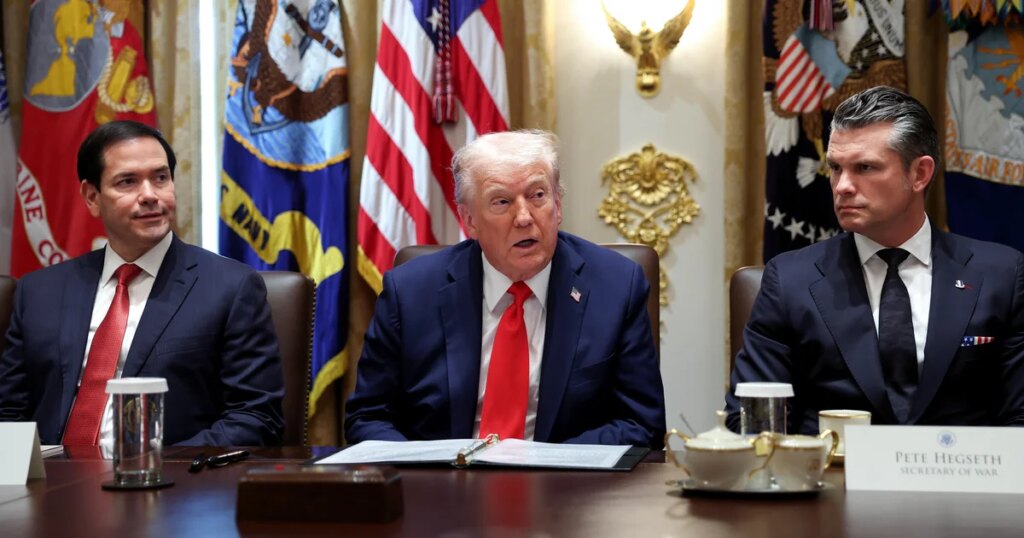
In a critical meeting expected to reshape U.S. actions in Venezuela, President Trump convened with top officials, including Secretary of State Marco Rubio and Defense Secretary Pete Hegseth, to discuss an escalating pressure campaign against the Maduro regime. The meeting comes at a time when military operations targeting alleged drug smuggling boats in the Caribbean are under intense scrutiny, including reports of orders that potentially violate international law. As the situation develops, lawmakers are calling for investigations into military actions that could amount to war crimes.
| Article Subheadings |
|---|
| 1) President Trump’s Meeting with Military Leaders |
| 2) Controversial Military Orders and Allegations |
| 3) Legal Implications of Military Action |
| 4) Political Reactions and Calls for Investigation |
| 5) The Larger Context of U.S.-Venezuela Relations |
President Trump’s Meeting with Military Leaders
President Trump met on a recent Monday afternoon with key members of his national security team to discuss future strategies concerning Venezuela. This meeting is reported to be a decisional one, aimed at addressing the escalating pressure campaign against President Nicolás Maduro and his regime. Aside from Marco Rubio and Pete Hegseth, the gathering included officials who have been integral in shaping U.S. foreign policy in Latin America. This high-stakes meeting is taking place against a backdrop of military posturing, including the deployment of substantial U.S. forces in the Caribbean.
Controversial Military Orders and Allegations
The meeting follows alarming reports regarding the U.S. military’s actions in the Caribbean, specifically concerning an attack on a suspected drug smuggling vessel. It has come to light that Secretary Hegseth allegedly issued a verbal order that resulted in a second strike aimed at eliminating surviving personnel after an initial strike. According to reports, this attack left survivors in peril, prompting further military action that resulted in their deaths. The implications of these actions have led to widespread condemnation and questions about adherence to the rules of engagement.
Legal Implications of Military Action
A group of former judge advocates general raised legal concerns, arguing that the reported orders may amount to war crimes as defined by international laws, including the Geneva Conventions. These laws specify that individuals who are no longer in combat must be treated humanely, and the intentional targeting of such individuals is considered a violation. Following these incidents, questions about accountability and the legality of military operations aimed at drug trafficking in the Caribbean have emerged. Over 80 individuals have reportedly lost their lives in what was termed “Operation Southern Spear,” further complicating the legal landscape surrounding these military interventions.
Political Reactions and Calls for Investigation
As the news unfolded, political reactions from both sides of the aisle intensified. Officials such as Democratic Senator Tim Kaine labeled the reported actions a potential war crime, arguing for Congressional probes into the military’s use of lethal force in international waters. Senate Armed Services Committee members, including Republicans like Mike Rounds and Roger Wicker, were also placed in an uncomfortable position as they sought to uncover the facts surrounding the aggressive military tactics employed against suspected drug traffickers.
The Larger Context of U.S.-Venezuela Relations
The U.S. objectives in Venezuela are complex, entangled with issues surrounding drug trafficking and political stability. The Trump administration has expressed a desire to curb the drug trade that affects the United States while also politically undermining President Maduro, whom U.S. officials have labeled a “terrorist.” Recent military deployments have signaled U.S. intentions to take decisive actions against the Maduro regime and address the drug crisis. However, these strategies, paired with the allegations of misconduct in military engagements, have sparked significant debate about the ethical implications and the potential fallout for U.S.-Venezuela relations.
| No. | Key Points |
|---|---|
| 1 | President Trump met with key national security officials to discuss strategies for addressing the Maduro regime in Venezuela. |
| 2 | Controversial military orders related to a U.S. strike on a drug smuggling vessel are raising allegations of potential war crimes. |
| 3 | Legal experts argue that the reported military actions may violate international laws, particularly related to humanitarian treatment of combatants. |
| 4 | Political figures are calling for investigations into the military’s role in lethal strikes against suspected drug traffickers. |
| 5 | The U.S. aims to curtail drug trafficking and politically undermine Maduro while grappling with the complexities of international law. |
Summary
The recent developments involving President Trump’s decisions on Venezuela spotlight the intricate intersection of military action, foreign policy, and international law. As allegations of war crimes surface and legal experts weigh in, the political ramifications are profound. As the situation unfolds, it is increasingly clear that the actions taken by the U.S. military and the underlying goals in Venezuela will continue to be scrutinized, shaping the dialogue on the future of U.S. foreign relations.
Frequently Asked Questions
Question: What was the purpose of President Trump’s meeting with his national security team?
The meeting aimed to discuss strategies regarding U.S. operations in Venezuela, particularly concerning military actions against the Maduro regime.
Question: What allegations have surfaced regarding the military attacks on drug boats?
Allegations have emerged that military orders were issued which led to the deaths of survivors following an initial strike on a suspected drug smuggling boat, raising concerns about potential war crimes.
Question: What legal issues are associated with the U.S. military’s actions in this context?
Legal experts argue that the military’s actions may violate international humanitarian laws, which mandate humane treatment for those rendered incapable of fighting, and the intentional killing of such individuals is prohibited.