
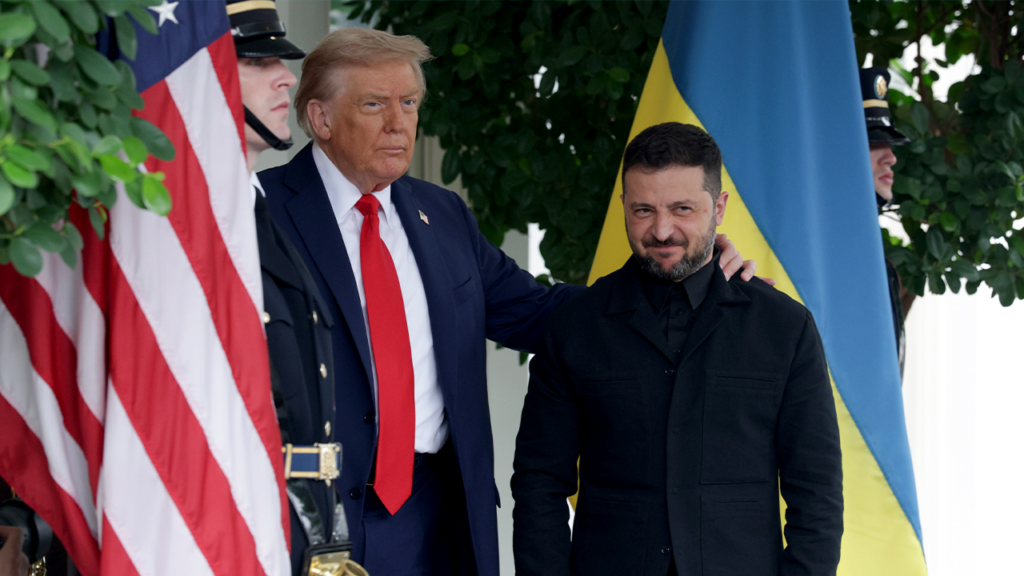
In recent remarks, former President Donald Trump urged Ukrainian President Volodymyr Zelenskyy to refrain from targeting Russia’s diesel refineries amid ongoing military conflict between the two nations. Speaking at the Irish Open, Trump indicated that such actions could exacerbate global diesel shortages already under strain from Russia’s invasion of Ukraine. During his statements, he highlighted the importance of avoiding disruptions that could worsen fuel scarcity internationally.
| Article Subheadings |
|---|
| 1) Trump’s Call to Zelenskyy |
| 2) Impact on Global Diesel Supply |
| 3) Context of Airstrikes and Tensions |
| 4) U.S. Diesel Prices Surge |
| 5) Escalation of Russian Attacks |
Trump’s Call to Zelenskyy
During a press event at his golf club in Doonbeg, Ireland, former President Donald Trump made a significant statement regarding the ongoing war between Ukraine and Russia. Following an inquiry about whether he had recently conversed with Ukrainian President Volodymyr Zelenskyy after a talk with Russian President Vladimir Putin, Trump emphasized the need for Ukraine to halt attacks on Russian diesel refineries. He suggested that such actions were detrimental, stating,
“Zelensky has to do one thing. He has to stop knocking out diesel fuel in Russia.”
This position reinforces the complex dynamics of international relations amidst this prolonged conflict.
Trump further elaborated that Zelenskyy should focus on other military targets within Russia and avoid striking diesel infrastructure, noting the potential ramifications on global fuel availability. He indicated that while it was permissible for Ukraine to engage in strikes against Russian facilities, the targeting of diesel fuel was causing unnecessary harm to global oil supplies. The former president highlighted a conversation he had with Zelenskyy where he advised him to “not hit diesel fuel because that’s hurting the world.”
Impact on Global Diesel Supply
The ramifications of Ukraine’s targeting of Russian fuel infrastructure have drawn heightened attention due to fears of a global diesel shortage. As Ukraine continues its military operations to weaken Russia’s energy capabilities, the international community remains vigilant about the subsequent effects on fuel prices and supply. Trump articulated concerns over the global repercussions of military strategies that impact diesel production, asserting that the conflict’s escalation has wider implications that transcend the immediate battlegrounds.
The ongoing strikes have significantly pressured the Russian diesel supply, leading to reports of fuel rationing within the country and a complete ban on diesel exports imposed in July. This situation has culminated in a substantial drop in available diesel on the international market, putting further strain on other countries that depend heavily on this critical resource. With international markets reacting to these developments, the urgency to manage fuel supplies has become more pressing as the conflict intensifies.
Context of Airstrikes and Tensions
Trump’s statements are set against the backdrop of an intensifying war that has already lasted more than four years, following Russia’s full-scale invasion of Ukraine. Recently, Ukraine has employed long-range strikes against various sites relevant to Russia’s oil and gas infrastructure. These military actions have been a strategic move aimed at diminishing Russia’s revenue sources that fund its ongoing military campaign against Ukraine. As a result, the geopolitical landscape has shifted, with both sides escalating their military activities significantly.
In recent weeks, both Russian and Ukrainian forces have engaged in large-scale drone attacks, further complicating the already volatile situation. Casualties have been reported on both fronts, indicating that the conflict shows no signs of abating anytime soon. As Trump’s remarks spotlight the need for a more calculated approach to military targets, they also reflect the complicated interplay between warfare tactics and global economic disturbances.
U.S. Diesel Prices Surge
The ramifications of the conflict have transcended borders, particularly emphasizing the impact on fuel prices in the United States. As of a recent report, diesel prices in the U.S. reached record highs, climbing above $6 per gallon. This alarming statistic has prompted discussions among policymakers regarding energy independence and the stability of fuel supplies amid global market fluctuations. The correlation between military actions overseas and local economic conditions illustrates the interconnected nature of modern geopolitics and economics.
The increase in diesel prices can be largely attributed to vulnerabilities in the supply chain as well as the disruption caused by the Ukraine-Russia conflict. Economic analysts are warning that if the situation continues without resolution, prices may escalate further, affecting various sectors reliant on diesel for transportation and industry. The current crisis has thus become a focal point for discussions about energy policy and economic strategies within the U.S.
Escalation of Russian Attacks
In response to Ukraine’s ongoing military strategies, Russia has ramped up its aerial assaults on Ukrainian territories. The intensified bombardments feature the deployment of ballistic missiles and drones, underscoring a worrying trend of escalating military responses on both sides. Reports of heavy civilian casualties and continued fighting signal a grim reality for those caught in the conflict.
The situation remains fluid, with each side attempting to establish control and leverage over key territories and resources. Russian and Ukrainian officials have both accounted for substantial retaliatory measures, indicating an inability to reach a diplomatic resolution in the near term. As military engagements escalate, the international community continues to monitor the crisis, searching for pathways to peace while addressing the immediate humanitarian needs and global economic impacts.
| No. | Key Points |
|---|---|
| 1 | Trump advised Ukrainian President Zelenskyy to avoid targeting Russian diesel refineries. |
| 2 | The former president warned that attacks on diesel fuel could exacerbate global shortages. |
| 3 | Ukraine has been striking Russia’s oil infrastructure to undermine its military capabilities. |
| 4 | Diesel prices in the U.S. recently surged to record highs amidst these international tensions. |
| 5 | Russia has intensified aerial attacks on Ukraine in response to sustained military actions. |
Summary
The latest statements from former President Trump highlight the delicate balance in military engagement strategies amid a pressing global energy crisis. By advising caution in targeting Russian energy infrastructure, he underscores the broader implications of warfare on not just national interests but international fuel stability as well. As the situation unfolds, the challenges posed by the ongoing conflict continue to reverberate globally, shaping geopolitical discourse while threatening to destabilize economies reliant on steady fuel supplies.
Frequently Asked Questions
Question: What was Trump’s main message to Zelenskyy regarding military targets?
Trump urged Zelenskyy to avoid targeting Russian diesel refineries, emphasizing that such actions could worsen global diesel shortages.
Question: How has the conflict impacted diesel prices in the U.S.?
Diesel prices in the U.S. have surged to record highs, surpassing $6 per gallon, largely due to disruptions in global supply linked to the Ukraine-Russia conflict.
Question: What recent military actions have escalated tensions between Ukraine and Russia?
Ukraine has engaged in strikes against Russian oil and gas infrastructure, prompting a series of intensified aerial attacks from Russia in retaliation.