
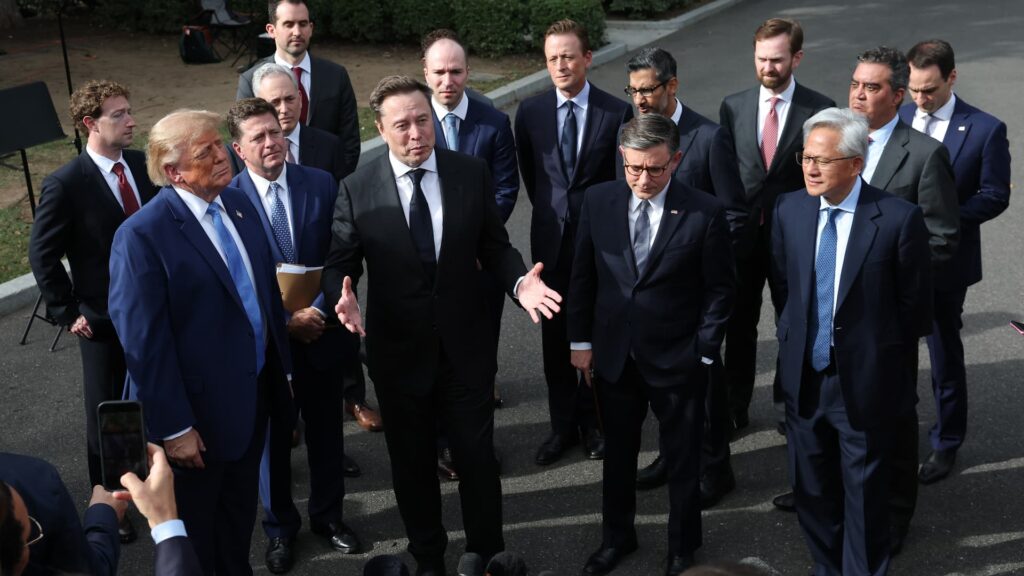
In a recent high-profile meeting held at the White House, President Donald Trump convened executives from major tech companies to discuss the burgeoning field of artificial intelligence (AI). Notably absent from this gathering was Apple, represented by its former CEO, Tim Cook, and his successor, John Ternus. Observers have speculated about the implications of Apple’s absence, given the company’s strategic direction in AI and its historical interactions with the Trump administration.
| Article Subheadings |
|---|
| 1) The Meeting at the White House |
| 2) Apple’s Notable Absence |
| 3) Implications for Apple and AI Development |
| 4) Future of AI Collaboration |
| 5) The Broader AI Landscape |
The Meeting at the White House
On September 29, 2026, President Donald Trump hosted a gathering of key technology executives to discuss the future of artificial intelligence and its implications for the economy and society. Attendees included leaders from prominent tech companies such as Mark Zuckerberg from Meta Platforms, Jensen Huang from Nvidia, and Speaker of the House Mike Johnson. The purpose of the meeting was to forge a consensus around developing AI technologies responsibly and ensuring their alignment with national interests.
The discussions revolved around a variety of topics, including AI safety measures and the ethical considerations that should underlie AI deployments. Following the meeting, the participating companies signed an accord affirming their commitment to these principles. This gathering underscored the Trump administration’s keen interest in fostering a collaborative environment between government and big tech.
Apple’s Notable Absence
Despite the high-profile nature of the meeting, Apple was notably absent. Neither Tim Cook, who recently transitioned from the CEO role to executive chairman, nor his successor, John Ternus, attended. This absence prompted speculation about Apple’s position on AI and its current standing among tech giants pushing the boundaries of AI capabilities. While executives from essential industry players participated in discussions that could shape the future of technology, Apple’s silence was seen as a significant omission.
Some analysts and industry watchers suggested that Apple might have skipped the meeting due to its slower pace in AI advancements compared to other firms actively pushing frontiers in the domain. Investor Brad Gerstner remarked during an interview that Apple’s absence should not be overstated, referring to it as a “nothing burger.” He emphasized that Apple remains informed about AI discussions although it might not be taking center stage.
Implications for Apple and AI Development
Apple is often regarded as a consumer-oriented company. Contrary to the enterprise-focused innovations made by competitors like OpenAI and Anthropic, Apple has concentrated on optimizing existing technologies rather than venturing into groundbreaking AI models. Its AI capabilities, particularly in products like Siri, are primarily designed for efficient operation on Apple’s proprietary hardware, including iPhones and Macs.
In the broader context of AI development, industry competition raises questions about whether Apple can maintain its competitive edge. While the company has recently launched a new version of Siri with AI-powered features, it is still perceived as lagging behind firms like Nvidia. This perception is underscored by the vast investments being made by leading tech companies into AI infrastructure—investments far exceeding those of Apple, which has historically invested less in AI research and development.
Future of AI Collaboration
The discussion on AI safety and alignment at the White House reflects an increasing recognition of how crucial these discussions are to the development of technology that benefits society as a whole. Executives like Sundar Pichai from Google and others openly engaged in shaping policy dialogues, indicative of their willingness to work with government entities to ensure safe AI practices. On the other side, Apple’s reticence to participate in the public dialogues about AI safety may position it at a disadvantage compared to its more vocally engaged competitors.
Historically, Tim Cook has navigated a delicate dance with the administration, balancing corporate interests and governmental expectations. His shift to a role focused on policymaking engagement suggests that Apple intends to sustain its presence in influential circles, albeit with a different emphasis now that leadership has transitioned to John Ternus. The future landscape of AI collaboration remains to be seen, depending on how Apple adjusts its strategy in alignment with evolving industry demands.
The Broader AI Landscape
The AI sector is rapidly evolving, with numerous companies competing to lead the charge in innovation, safety, and ethical considerations. Organizations like OpenAI, Meta, and Google are seen as frontrunners, creating substantial advancements that often reshape public discourse on technology and its implications. Apple’s approach, which has historically emphasized product security and user respect, creates a contrast with the more aggressive stances taken by its competitors.
Despite concerns among some investors about Apple’s future in AI, the company’s recently improving stock performance indicates that there is confidence in its long-term viability. Apple’s stock has risen significantly, reflecting a market perception of stability amidst heavier competitors. However, the overarching narrative remains focused on whether Apple can meaningfully engage in the ongoing conversation about AI without compromising its established brand of privacy and consumer protection.
| No. | Key Points |
|---|---|
| 1 | President Trump convened tech executives to discuss AI, excluding Apple. |
| 2 | Apple’s absence raises questions about its AI strategy and investment. |
| 3 | Brad Gerstner believes Apple remains informed but not central to AI discussions. |
| 4 | The industry is leaning heavily on collaborations concerning AI safety and alignment. |
| 5 | Market confidence in Apple remains despite debates over its position in AI. |
Summary
The recent gathering of tech leaders at the White House underscores both the evolution of AI technology and the importance of collaborative dialogue surrounding its future. As main players in the tech sector prioritize conversations on the ethical and security implications of AI, Apple’s absence raises questions about its strategic focus. Moving forward, Apple’s ability to actively engage in AI discussions while maintaining its core values will significantly shape its positioning in a competitive landscape increasingly defined by rapid advancements and complex ethical considerations.
Frequently Asked Questions
Question: Why was Apple absent from the AI meeting at the White House?
Apple’s absence from the AI meeting has been attributed to its slower pace in AI advancements compared to other attendees, prompting speculation about the company’s current role in the rapidly evolving AI landscape.
Question: Who were some of the notable attendees at the meeting?
Notable attendees included Mark Zuckerberg from Meta, Jensen Huang from Nvidia, and Speaker of the House Mike Johnson, among others who are leading discussions on AI development in the industry.
Question: What implications does Apple’s absence have for the company’s future in AI?
Apple’s absence may indicate a strategic pivot in its involvement with AI, highlighting concerns about its competitiveness in a field heavily dominated by companies heavily investing in AI infrastructure and innovations.