
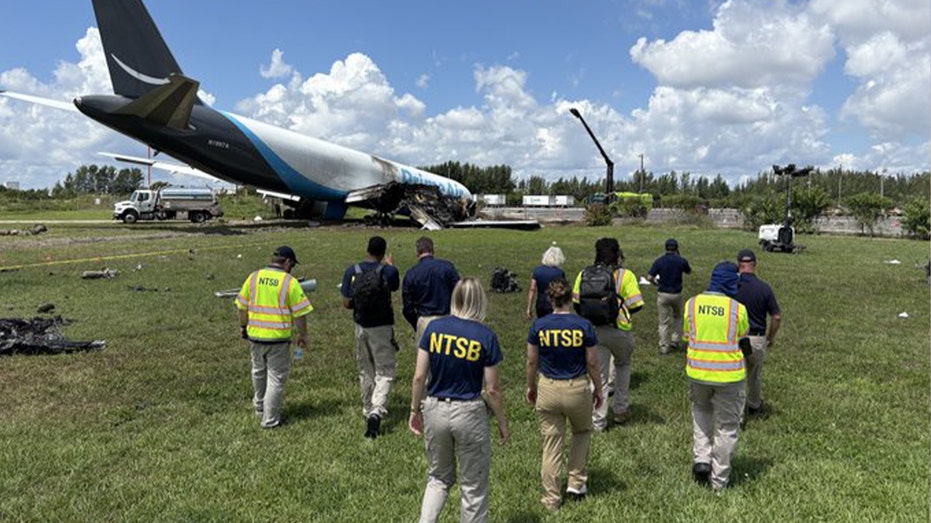
The two crew members aboard an Amazon cargo Boeing 767 survived after the aircraft overran a runway at Miami International Airport on Sunday, September 6, 2026. The plane struck a contract cleaning van and a civilian vehicle before catching fire, authorities said. Five people were killed and five others were injured in the accident. Investigators are examining the aircraft, vehicles and recovered flight recorders to determine what caused the crash.
The National Transportation Safety Board said the jet traveled about 1,300 feet beyond the paved runway surface. The collision involved vehicles carrying at least eight occupants and caused extensive damage to airport fencing, navigation equipment and nearby property.
| 1) | Crew survival and casualty update |
|---|---|
| 2) | Vehicles involved in the collision |
| 3) | Runway overrun and crash site damage |
| 4) | Flight history and investigation evidence |
| 5) | What investigators will examine next |
Crew survival and casualty update
Federal regulators said both crew members aboard the Amazon Prime Air cargo aircraft survived the accident. The update was provided during a National Transportation Safety Board briefing on Sunday after the Boeing 767 overran the end of a runway while landing at Miami International Airport in Florida.
Authorities reported five deaths and five injuries among people affected by the crash. The aircraft operator, 21 Air LLC, is based in Miami. Officials have not released further details about the identities or conditions of the victims in the information provided.
Vehicles involved in the collision
The aircraft struck two vehicles after leaving the runway area. One was a 2012 white Ford Econoline van owned by Ocean Service Corporation, a contract cleaning company that provides airline services. Seven of the victims were in that van, which investigators said was torn apart in the collision.
The aircraft then crossed the airport perimeter and struck a Toyota Corolla Cross LE traveling on Northwest 67th Avenue. The National Transportation Safety Board said the two vehicles together carried at least eight occupants. Investigators observed what appeared to be deployed airbags while surveying the site.
“You can see components from vehicles, both passenger vehicles and the aircraft itself,” National Transportation Safety Board Chairwoman Jennifer Homendy said.
Runway overrun and crash site damage
The Boeing 767 overran Miami International Airport’s diagonal Runway 30 during its landing and continued approximately 1,300 feet beyond the paved surface. It crossed into grass, struck another fence line and entered an area where Tesla robotaxis were stationed.
The crash caused an extensive debris field and damaged airport navigational aids and other equipment. Fencing was ripped apart across the area, while tire marks extended from the paved runway into the grass. The aircraft caught fire after the impact, adding to the emergency response and complicating the scene examination.
“I would describe it in one word, devastating, utter devastation,” Jennifer Homendy said. “You can see on the paved surface, tire marks that continue through the grass. There’s debris everywhere.”
Flight history and investigation evidence
The aircraft had completed two flights before the accident in Miami, according to investigators. It flew from Cincinnati to Miami, continued from Miami to San Juan, Puerto Rico, and then returned to Miami before the runway overrun.
Investigators recovered both the flight data recorder and cockpit voice recorder. The devices were expected to provide information about the aircraft’s performance, cockpit communications and events leading up to the landing accident.
What investigators will examine next
Investigators will document the wreckage, runway, surrounding fences, airport equipment and the damaged vehicles as they reconstruct the aircraft’s path. They will also analyze the recorders and review the plane’s recent operating history, including its earlier flights that day.
The investigation is intended to establish why the aircraft left the paved runway, how it traveled through the airport perimeter and how the subsequent vehicle collisions occurred. Officials have not announced a final cause, and the inquiry remains ongoing.
| Number | Key Point |
|---|---|
| 1 | Both crew members survived the crash. |
| 2 | Five people died and five were injured. |
| 3 | The aircraft struck a cleaning van and a civilian vehicle. |
| 4 | The Boeing 767 traveled about 1,300 feet beyond the paved runway. |
| 5 | Flight data and cockpit voice recorders were recovered. |
Summary
The Miami cargo jet accident killed five people and injured five others, while both crew members survived. The aircraft overran Runway 30, crossed airport boundaries and struck two vehicles before coming to rest after traveling about 1,300 feet beyond the paved surface. Investigators are using physical evidence and the recovered recorders to determine the sequence of events and the cause of the crash.
Frequently Asked Questions
Did the cargo jet crew survive?
Yes. Federal regulators said both crew members aboard the Boeing 767 survived the accident.
How many people were killed or injured?
Authorities reported five deaths and five injuries. The aircraft collided with vehicles carrying at least eight occupants.
What vehicles did the aircraft hit?
The aircraft struck a 2012 Ford Econoline van operated by a contract cleaning company and a Toyota Corolla Cross LE traveling on Northwest 67th Avenue.
What evidence has been recovered?
Investigators recovered the flight data recorder and cockpit voice recorder. They are also examining the wreckage, vehicles, runway and damage across the airport perimeter.