
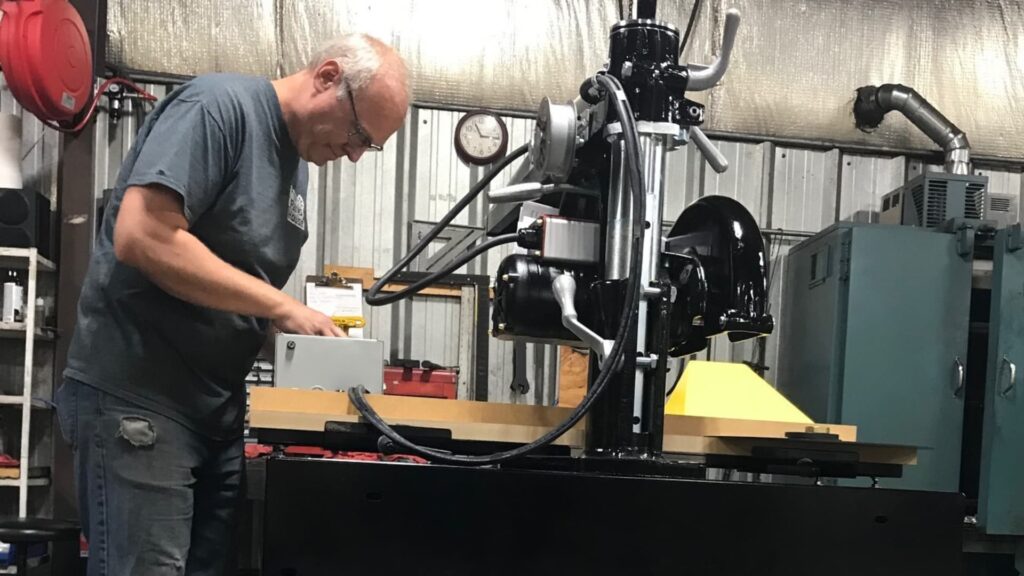
The tightening grip of economic pressures is forcing American businesses to confront rising costs and dwindling margins. Factors such as tariffs implemented under former President Donald Trump’s administration, soaring fuel prices attributable to geopolitical tensions, and escalating interest rates are notably constraining midsize manufacturers. These external challenges affect companies ranging from small tool manufacturers to major industrial players, generating a ripple effect that extends to retail giants and the broader economy.
| Article Subheadings |
|---|
| 1) Economic Pressures Mount on American Manufacturers |
| 2) Impact on the Automotive Sector |
| 3) Corporate America: A Divide in Financial Fortunes |
| 4) Retailers Feel the Squeeze |
| 5) The Future of Pricing Power |
Economic Pressures Mount on American Manufacturers
In the wake of increasing economic challenges, companies like the Original Saw Co., run by owner Allen Eden, are resorting to stockpiling inventory as a preventive measure against escalating material costs. Located in Britt, Iowa, the medium-sized manufacturer, which produces industrial power saws for both wood and metalwork, is witnessing a significant resurgence in the prices of essential materials like aluminum and steel. For example, a basic component used in their saw motors saw a price increase from $42 to $87 this summer alone.
The dilemma faced by American manufacturers is underpinned by three critical factors: tariffs making raw materials costlier, soaring fuel prices affecting transportation costs, and rising interest rates increasing finance charges for operational sustainability. Companies are left with little choice but to pass on these costs to consumers, thereby fueling ongoing inflation, which has plagued the economy for the past few years.
According to experts, the manufacturing sector, particularly small to mid-sized operations, feels the most acute pressure due to their reliance on short-term financing. As interest rates rise, these companies face a dual challenge of increased borrowing costs while grappling with higher expenses associated with raw materials, labor, and logistics.
Impact on the Automotive Sector
The automotive manufacturing sector finds itself in a particularly precarious position amidst these economic conditions. Companies like Lucerne International have ceased U.S. manufacturing operations altogether, closing down plans for significant investments due to uncertainties arising from tariffs and escalating raw material costs. Mary Buchzeiger, CEO of Lucerne, pointed to the tariffs introduced under the previous administration as damaging to their supply chain, driving them to pivot their focus towards warehousing and distribution. This strategic shift aims to boost margins while sidestepping the pitfalls of manufacturing in a high-cost environment.
Industry reports indicate that earnings in the automotive sector are shrinking, as illustrated by a decline in growth figures for top-tier auto suppliers, which fell to 4.2% from over 6% the previous year. Additionally, companies such as Grupo Antolin, a Spanish parts supplier, recently sought Chapter 15 bankruptcy protection in the U.S., citing unsustainable cost pressures from tariffs and supply-chain disruptions.
The ripple effect from challenges in the automotive supply chain extends to the broader manufacturing landscape, where many companies are grappling with the dual burden of higher input costs and diminished profitability.
Corporate America: A Divide in Financial Fortunes
In a striking contrast, the corporate giants in America—particularly those within tech and finance sectors—have been navigating these turbulent waters with greater resilience. Firms within the S&P 500 possess substantial cash reserves, enabling them to withstand higher borrowing costs better than their smaller counterparts. Analysts assert that organizations with significant cash flows can take on long-term debt, which acts as a buffer against the immediate impact of increased interest rates on their operations.
Nonetheless, should the yield on the 10-year Treasury bond reach 6%, these companies might soon find their stability challenged. The prevailing sentiment is that high borrowing costs may persist as inflation continues to compel the Federal Reserve to raise interest rates.
Corporate America remains unevenly impacted; while larger firms capable of passing costs onto consumers thrive, smaller manufacturers often face the harsh choice between raising prices and risking a decline in consumer demand.
Retailers Feel the Squeeze
Retail giants like Home Depot are not exempt from the financial squeeze caused by the convergence of rising energy and raw materials costs. An unexpected surge in both categories has made it challenging to balance expenses while still meeting consumer demand. Last month, the company’s CFO remarked that the pressure from energy and commodities could effectively nullify any financial benefits gained from tariff refunds.
In terms of pricing strategies, retailers are currently evaluating their positions in light of persistent inflation and rising interest rates. Analysts predict that many retailers will need to adjust their pricing strategies accordingly to remain viable amidst these economic headwinds. The challenge lies in determining how much of the increased costs can be comfortably passed on to the consumer without triggering a widespread decline in sales.
The Future of Pricing Power
As inflationary pressures continue to mount, one pressing question looms large across corporate America: which companies hold the pricing power necessary to weather the storm? Many industries have learned they can easily adjust prices in response to increased costs, while others, particularly those with tight profit margins, find themselves in challenging positions. The constant fluctuation of fuel and commodity prices means that the ability to pass on these expenses will vary substantially by sector.
Some companies, particularly in the travel industry, are navigating this environment by reducing less profitable operations and implementing higher fares on available routes to balance rising costs. Michael Leskinen, CFO of United Airlines, highlighted the need to cut marginal routes even amidst strong consumer demand to maintain profitability in an era of high fuel prices.
For many businesses, the challenge is to maintain profitability without outpricing themselves in a climate where consumers are increasingly price-sensitive. Future pricing strategies will need careful consideration to ensure that companies can survive during these economically challenging times.
| No. | Key Points |
|---|---|
| 1 | Rising prices for materials, driven by tariffs and geopolitical unrest, are straining American manufacturers. |
| 2 | Smaller manufacturers face significant challenges due to higher financing costs resulting from rising interest rates. |
| 3 | The automotive sector is particularly affected, with many companies halting operations or restructuring amidst rising costs. |
| 4 | Larger corporations benefit from better cash reserves and longer-term debts, giving them a cushion against rising costs. |
| 5 | Retailers face pressure from rising energy costs, often leading to inevitable price increases passed on to consumers. |
Summary
The economic landscape for American manufacturers, particularly those in the mid-market segment, has become increasingly fraught with challenges. The convergence of tariffs, soaring fuel prices, rising interest rates, and the associated costs have collectively stressed the manufacturing sector, forcing firms to make tough operational decisions. The variations in company size and financial capabilities highlight a growing divide in how businesses are managing these pressures, shaping the future of pricing and consumer markets across multiple sectors.
Frequently Asked Questions
Question: What are the main factors impacting manufacturers today?
Manufacturers today are primarily affected by rising raw material costs due to tariffs, increasing fuel prices, and higher interest rates that elevate financing costs.
Question: How are supply chain disruptions influencing the automotive industry?
Supply chain disruptions have led companies to halt or downsize their U.S. operations, pushing them to seek alternative solutions for warehousing and distribution in response to increased costs and tariffs.
Question: What divides corporate America during economic challenges?
Corporate America is divided based on pricing power; larger firms often have the ability to pass on costs to consumers more easily, while smaller companies may struggle to maintain profitability without risking a decline in demand.