
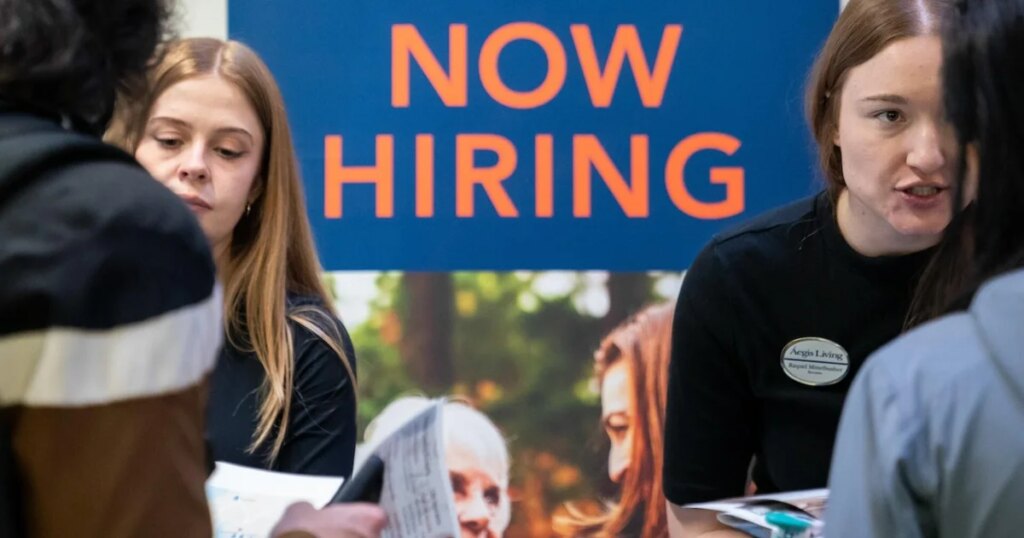
The U.S. labor market presented mixed signals in September, with employers adding only 29,000 jobs—significantly below economists’ expectations. The unemployment rate edged up to 4.2%, indicating potential concerns among businesses regarding economic stability amidst rising energy costs and persistent inflation. As hiring slowed, experts raised questions about the future trajectory of the job market and the implications for the Federal Reserve’s interest rate policies.
| Article Subheadings |
|---|
| 1) National Job Growth Slows Down |
| 2) Insights on Wage Growth in a Cooling Economy |
| 3) Trends in Job Cuts and Layoffs |
| 4) Implications for Federal Reserve Interest Rates |
| 5) Future Outlook: Labor Market Developments |
National Job Growth Slows Down
In September, the U.S. economy added just 29,000 jobs, falling far below economists’ forecasts of 90,000 new positions. This decline raises significant concerns about the health of the labor market and may indicate a significant slowdown in hiring activity. Analysts have pointed to various external factors, such as surging energy prices and ongoing inflation, contributing to this tempered growth. September’s figure stands in stark contrast to the average monthly job gains of approximately 150,000 seen earlier in 2023, suggesting that many businesses are adopting a cautious approach to hiring.
The slight increase in the unemployment rate to 4.2% from 4.1% the prior month further fuels concerns about labor opportunities across the nation. In particular, certain sectors that previously exhibited robust hiring patterns have begun to show signs of weakness. For instance, healthcare, which had been a stronghold for job creation this year, only contributed 17,000 new positions in September. The overall sentiment among labor market experts reflects that the current environment is fraught with uncertainty, and discontent with job market conditions among American workers is palpable.
According to Jerry Tempelman, vice president of economic and fixed income research at Mutual of America, “September’s nonfarm payroll gain of just 29,000 jobs raises questions about the durability of the labor market…” As more businesses tighten their belts in response to economic pressures, the pressure could mount on future job growth.
Insights on Wage Growth in a Cooling Economy
Despite the difficulty in securing job growth, wage increases have also faced challenges under current economic conditions. In September, wages increased at an annual rate of only 3%, trailing behind the August Consumer Price Index (CPI) of 3.4%. This discrepancy highlights a concerning reality where inflation has outpaced wage growth for five consecutive months, leading to a decline in real purchasing power among workers. The forthcoming CPI data, set to be released on October 14, will provide further insight into this trend.
Experts like Heather Long, chief economist at Navy Federal Credit Union, underscore the seriousness of this wage stagnation: “Inflation has wiped out wage gains since March. That’s a real financial squeeze.” With the costs of essentials rising, workers are feeling increasingly pressed financially, raising concerns that stagnant wages may exacerbate consumer discontent and hinder economic expansion.
The ongoing trends may not only affect consumer sentiment but could also shape policy decisions among lawmakers and economic regulators. As wage growth lags behind inflation, it casts doubt on the sustainability of household spending—key for a recovery trajectory. Labor market policymakers will closely monitor wage trends to ensure they align with broader economic health indicators.
Trends in Job Cuts and Layoffs
Interestingly, despite the lack of job creation, a report by outplacement firm Challenger, Gray & Christmas indicates that job cuts have sharply decreased through September 2026 when compared to the previous year. Layoffs dropped 40%, marking a noteworthy decrease from September 2025. This downward trend signifies possible stability or improvement for employees within various industries, presenting a mixed message in the labor landscape.
The report also highlighted that layoffs in September 2026 fell by 20% compared to the previous month, signaling the lowest level of job cuts in four years. While this drop provides a slight silver lining, it coexists with muted hiring numbers. Steve Rick, chief economist at TruStage, remarked that past one-month recoveries may not signify a lasting trend. He stressed that long-term observations of labor market dynamics will be essential in forging a clear understanding of economic stability.
While job cuts have diminished, the impact of firmer economic conditions continues to pose challenges for many workers. Discontent over limited job opportunities persists, which could create serious economic implications if not addressed. Striking a balance between job creation and layoffs will be paramount in fostering a more robust employment climate.
Implications for Federal Reserve Interest Rates
The Federal Reserve faces crucial decisions in light of the recent employment data. The uptick in the national unemployment rate combined with softening hiring trends could prompt the Federal Reserve to reconsider plans for future interest rate adjustments. Ken Mahoney, CEO of Mahoney Asset Management, articulated that “these numbers do not make a case for a rate increase in October.” The interpretation here is clear: without solid labor market improvements, the central bank may hesitate to increase rates, favoring a cautious approach to economic growth.
Economists suggest that a stable labor market presents the Federal Reserve with more room to increase interest rates, with inflation remaining a priority. The central bank aims to steer inflation down towards its 2% target, having already raised the benchmark interest rate in September for the first time in over three years. As rising energy costs have driven consumer prices higher, the interplay between interest rates and inflation will remain under close scrutiny.
This balancing act highlights the challenges encountered by financial regulators seeking to promote economic stability. The decisions made by the Federal Reserve could ultimately shape the broader economic landscape in the months to come, making these indicators increasingly relevant to policymakers.
Future Outlook: Labor Market Developments
As the landscape of the labor market evolves, stakeholders from businesses to policymakers must pay close attention. The September job growth figures signal a cautious approach among employers grappling with inflationary pressures and an unpredictable economic environment. Should these trends persist, more pronounced economic ramifications may surface—both for hiring practices and consumer sentiment.
Experts urge that immediate monitoring of wage growth and employment figures will prove vital for future assessments of economic recovery. Continued stagnation of wages could illuminate deeper systemic issues within the economy, necessitating a robust response from decision-makers. The dual pressures of inflation and a weak job market may hinder recovery and impact household spending, indicating systemic challenges.
Overall, the future of the labor market remains uncertain as the complexities of economic stability influence hiring practices and wage growth. Continued scrutiny from economic analysts and the Federal Reserve will play a pivotal role in steering the next phases of recovery and growth.
| No. | Key Points |
|---|---|
| 1 | Employers added just 29,000 jobs in September, far short of economists’ expectations. |
| 2 | The unemployment rate rose to 4.2% from 4.1%, raising concerns about job opportunities. |
| 3 | Wage growth in September lagged behind inflation, impacting workers’ purchasing power. |
| 4 | Job cuts have significantly decreased, with layoffs falling 40% year-on-year as of September. |
| 5 | The Federal Reserve is likely to reassess interest rate hikes based on soft labor market data. |
Summary
The report on U.S. job growth in September paints a complex picture of the labor market, revealing potential challenges ahead. With the drastic shortfall in job creation, rising unemployment, and stagnating wage growth, concerns about economic stability are mounting. Policymakers, particularly at the Federal Reserve, will need to evaluate these developments closely to navigate potential economic hurdles and maintain sustainable growth in the future.
Frequently Asked Questions
Question: What factors contributed to the slow job growth observed in September?
The slow job growth can be attributed to various factors, including rising energy prices, increased inflation, and businesses adopting cautious hiring practices amidst economic uncertainty.
Question: How does the increase in unemployment rate impact economic policy?
An increase in the unemployment rate may lead the Federal Reserve to reconsider interest rate hikes, as it signals a weakening labor market that could constrain economic activity.
Question: What are the implications of stagnant wage growth for consumers?
Stagnant wage growth has a direct impact on consumers’ purchasing power, as it can lead to financial strain when inflation rates exceed wage increases, limiting families’ ability to spend effectively.